
Custom promotional bag manufacturing at JUNYUAN BAGS runs on a 500-piece minimum per style and colour, 6–10 business day sampling, 35–50 day bulk production and AQL 2.5 major / 4.0 minor final inspection, produced through affiliated and partner factories in Quanzhou, Fujian — the Chinese city that supplies a large share of the world’s soft-goods bag capacity. The company has been in the bag trade since 2004 and has operated as a Quanzhou-based OEM/ODM exporter since 2014, shipping FOB Xiamen.
That paragraph is the short answer. What follows is what a procurement manager actually needs before raising a purchase order: which bag formats belong in the promotional category and which do not, why the word “swag” in your brief changes the quote you get back, what a branded bag costs per impression against other media, what the 2026 tariff environment has done to landed cost, how seven substrates differ in weight and print compatibility, which decoration method survives the number of washes your programme actually requires, where California Proposition 65 exposure genuinely sits in a bag, and how to read a low quote without buying the wrong product.
What a promotional bag is — and why the category is not one product
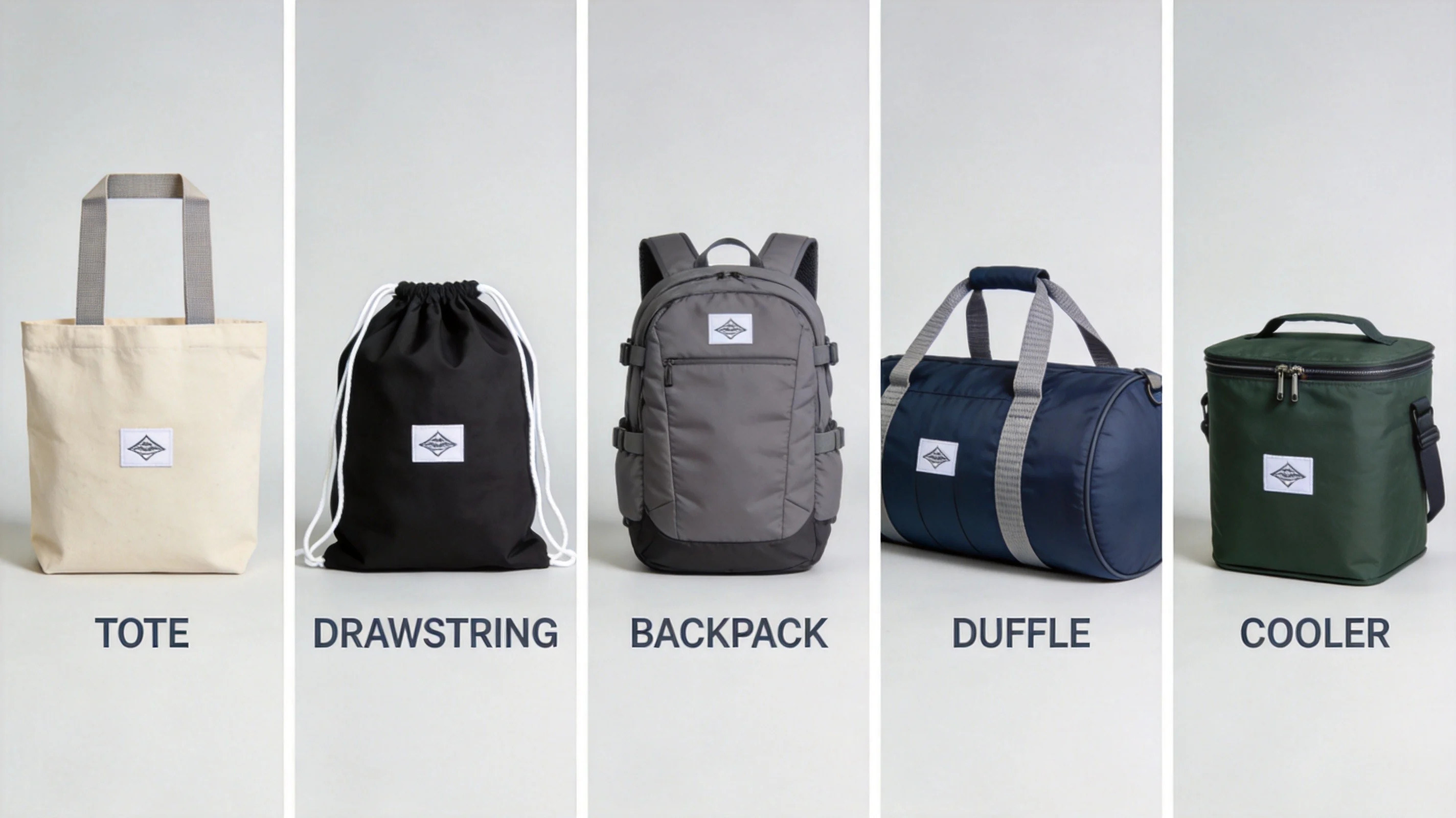
A promotional bag is a reusable soft-goods bag — tote, drawstring pack, backpack, duffle or insulated cooler — decorated with a brand mark and distributed to carry a message rather than to be sold as a retail product. It is classified as a bag under HS 4202, not as packaging under HS 4819 or 3923. That classification detail is not pedantry. It decides which supply chain you end up talking to.
Search any B2B marketplace for “promotional bags” and the results are dominated by paper bags, non-woven shopping bags and laminated film carriers — HS 4819 and 3923 products — quoted by printing and packaging converters at fractions of a cent per unit, at minimums of 100 to 1,000 pieces. Those suppliers are competent at what they do. They are not bag manufacturers. A packaging converter cannot build a 10 oz cotton canvas tote with bar-tacked handle anchors and a boxed gusset, and cannot quote a 1680D backpack at all, because those are cut-and-sew constructions that need pattern making, panel assembly, webbing, zipper installation and stress-point reinforcement.
If you are sourcing a reusable branded bag, search “custom promotional bags”, “branded tote bag manufacturer”, “promotional backpack supplier” or “swag bag manufacturer” — not “promotional bags wholesale”. The five formats below are grouped together in buying conversations and are not interchangeable in a tech pack:
| Format | What it actually is | Typical published FOB band | Usable print area | Procurement note |
|---|---|---|---|---|
| Tote (canvas or rPET) | Open-top flat or gusseted carry bag with two sewn handles | US$0.80–1.90 | 10″ × 11″ on a 15″ × 16″ body | Highest impressions per dollar; the default anchor of most programmes |
| Drawstring sport pack | Cinch-top pack with cord closure and reinforced eyelets | US$0.55–1.40 | 8″ × 8″ | Lowest unit cost; lowest perceived value; eyelet reinforcement is where cheap packs fail |
| Backpack | Structured multi-panel pack with padded straps | US$3.50–9.50 | 5″ × 5″ front panel | Right answer for onboarding and employee kits; survives daily use |
| Duffle | Barrel or rectangular barrel bag with webbing handles | US$4.00–10.50 | 8″ × 4″ side panel | Reads as a gift rather than a giveaway; higher freight volume per unit |
| Insulated cooler tote | Foam-insulated body with PEVA or TPU liner | US$4.50–12.00 | 7″ × 4″ front panel | Highest perceived value; most compliance-sensitive liner and food-contact questions |
Published bands above are marketplace quotes at 100–500 piece volumes and are given as a market reference, not as our pricing. Our costing is issued line by line so that substrate, hardware and decoration substitutions are visible before they are approved.
Swag bags, promotional products, branded merch or corporate gifts — the four terms your brief has to get right
“Swag bags” is the informal US buying term for high-volume, low-cost branded giveaways where the goal is awareness and reach rather than engagement. “Promotional products” is the industry’s formal category term, used by ASI and PPAI, and spans everything from a US$0.50 pen to a US$75 jacket. “Branded merchandise” usually signals a higher grade of product that may be sold rather than given away. “Corporate gifts” means premium, often personalised items sent to named recipients.
The four are not synonyms, and the word you put in a brief determines which quality tier, which construction standard and which fulfilment model a supplier quotes against. This is why two buyers can request “a custom bag” and receive quotes 20 times apart without either supplier being wrong.
| Term | What it means in a US buying conversation | Typical unit cost | Fulfilment model | What it tells a supplier to quote |
|---|---|---|---|---|
| Swag bags | Informal shorthand for high-volume, low-cost branded giveaways; awareness and reach, not deep engagement | US$0.50–3.00 | Bulk shipment to one address | Volume pricing, simplest construction, fastest route to a quote |
| Promotional products | The formal ASI / PPAI category term covering the full range from entry giveaways to premium items | US$0.50–75.00 | Bulk or distributed | A specification-led quote with material and compliance detail attached |
| Branded merchandise (merch) | Higher-grade product, sometimes sold rather than given; emphasis shifts from awareness to identity and revenue | US$5–40 | Often retail-ready, individually packed | Retail-grade QC, hang tags, barcodes, size grading, individual polybag |
| Corporate gifts | Premium, often personalised items sent to specific recipients; long-term relationship building | US$50–150 | Drop-ship, kitting, name personalisation | Individual packing, personalisation, presentation box, per-recipient logistics |
The practical consequence is simple. A brief that says “swag bags” will come back priced as a giveaway. A brief that says “promotional products” will come back with a spec sheet and a compliance question. A brief that says “merch” will come back asking about hang tags and barcodes. A brief that says “corporate gifts” will come back asking who the recipients are and whether the names need to be embroidered. None of those is a better answer than the others — but only one of them matches the campaign you are actually running.
The economics of a promotional bag: what you are really buying is impressions
A branded bag is bought as media, not as a bag. ASI’s 2026 Ad Impressions Study puts average brand impressions per promotional product at roughly 3,300 and average cost per impression at about US$0.006 — and for a US$6 tote bag specifically, close to 5,000 impressions at roughly 0.1 cent per impression. Those are the numbers that justify the budget line, and they are also the numbers that decide whether a cheaper bag is actually cheaper.
The consumer-side evidence for retention is stronger than most buyers assume. PPAI’s Product Power 2026 study, fielded across more than 3,000 US consumers aged 16 to 60, found that 83% say receiving a promotional product makes them feel appreciated, 90% say branded merchandise improves their perception of the brand, 94% say they are likely to keep a branded product for at least six months, and 74% say they are still using the last few products they received. PPAI’s mid-2026 industry assessment adds that 80% of consumers have looked up or purchased from a brand after receiving a promotional product, 51% prefer receiving a promotional product over ads, emails, texts or sales calls, and 84% say merchandise improves their impression when it is included in an event or campaign.
| Metric | Value | Source |
|---|---|---|
| Average brand impressions per promotional product | ~3,300 | ASI 2026 Ad Impressions Study |
| Average cost per brand impression, promotional products | ~US$0.006 | ASI 2026 Ad Impressions Study |
| Brand impressions, US$6 tote bag | ~5,000 | ASI 2026 Ad Impressions Study |
| Cost per impression, US$6 tote bag | ~US$0.001 | Derived from the two ASI figures above |
| Consumers who recall the advertiser after receiving a logoed item | 85% | ASI 2026 Ad Impressions Study |
| Consumers who say branded merchandise improves brand perception | 90% | PPAI Product Power 2026 |
| Consumers likely to keep a branded product 6+ months | 94% | PPAI Product Power 2026 |
| Consumers still using the last few products received | 74% | PPAI Product Power 2026 |
| Consumers who looked up or purchased from a brand after receiving | 80% | PPAI mid-2026 industry assessment |
| Consumers preferring a promotional product over ads, emails, texts or calls | 51% | PPAI mid-2026 industry assessment |
The cost-per-impression argument only holds if the bag survives. A non-woven bag at US$0.40 that tears on the second use delivers a fraction of the impressions a US$1.40 canvas tote delivers over three years, and the “cheaper” option costs more per impression in the end. That is the honest case for specifying substrate before price — not aesthetics, arithmetic. Sources: PPAI, Alok Bhat: 6 Strategic Shifts Defining Branded Merchandise.
The 2026 market: tariffs, landed cost and what belongs in your quote
The 2026 promotional products market is growing slowly and under structural margin pressure, and the pressure sits in landed cost rather than in demand. PPAI’s 2025 US Distributor Sales Volume Estimate put industry sales at US$27.1 billion, up 1.3% — a growth rate below inflation. For a bag buyer, the practical consequence is that a quote which does not state its material, freight and tariff assumptions is not a quote. It is a starting position.
The supplier-side data is unusually specific this cycle. Among PPAI 100 suppliers, 60% report higher landed product costs, 60% cite pricing uncertainty and 51% report reduced gross margins. Only about 10% are passing through most of the additional tariff, freight and input costs, while more than a third continue to absorb most or nearly all of the impact. On the distributor side, 56% report higher supplier costs, 44% cite pricing uncertainty and 42% say customer decisions are being delayed as buyers ask more questions, seek alternatives or reduce order quantities. More than half of suppliers are diversifying countries of origin, 41% are increasing inventory on selected products and 29% are renegotiating vendor terms — and 53% of distributors say they are relying more heavily on preferred or trusted suppliers as volatility continues.
The sourcing alternative is not a free lunch either: 74% cite higher cost for domestic and nearshore sourcing, 42% cite limited availability and 42% cite customer unwillingness to pay the premium. A bag programme re-shored to the US at 2.5 to 3 times the FOB cost is a legitimate strategic choice, but it is a different programme, not a cheaper version of the same one.
For context on scale, the PPAI study conducted with Oxford Economics estimated US$174 billion spent on branded merchandise in the United States in 2025 — roughly 51% of global branded merchandise spending — comprising US$50 billion in promotional products and US$124 billion in licensed merchandise. The US$50 billion promotional products figure is equivalent to about 13% of total US advertising spending in 2025, and the sector supported an estimated US$170.2 billion in GDP, 1.2 million jobs and US$37 billion in tax contributions. Notably, for every US$1 spent on branded merchandise in the US, approximately 61 cents is retained domestically — and for promotional products specifically, approximately 70 cents. Sources: PPAI 2025 Distributor Sales Volume Estimate, PPAI / Oxford Economics, Inside the $174 Billion US Branded Merchandise Market.
| Cost element | What moves it | What the quote has to state |
|---|---|---|
| Substrate | Gram weight, fibre, coating, certification | Exact spec with gsm and composition |
| Decoration | Colour count, number of print positions, method | Per-colour and per-position pricing, separately |
| Hardware | Zipper brand, buckle grade, webbing quality | Named brand or an accepted equivalent grade |
| Freight | Mode, volumetric weight, port pair | Incoterm basis and a price validity window |
| Tariff and duty | HS classification and country of origin | HS code used and the duty assumption applied |
| Compliance testing | Destination market and requirement | Which tests are included, and who pays for optional ones |
| Payment terms | Order value, trading history | T/T split or L/C terms, and whether they hold on reorder |
Material specification: seven substrates and what each one costs you
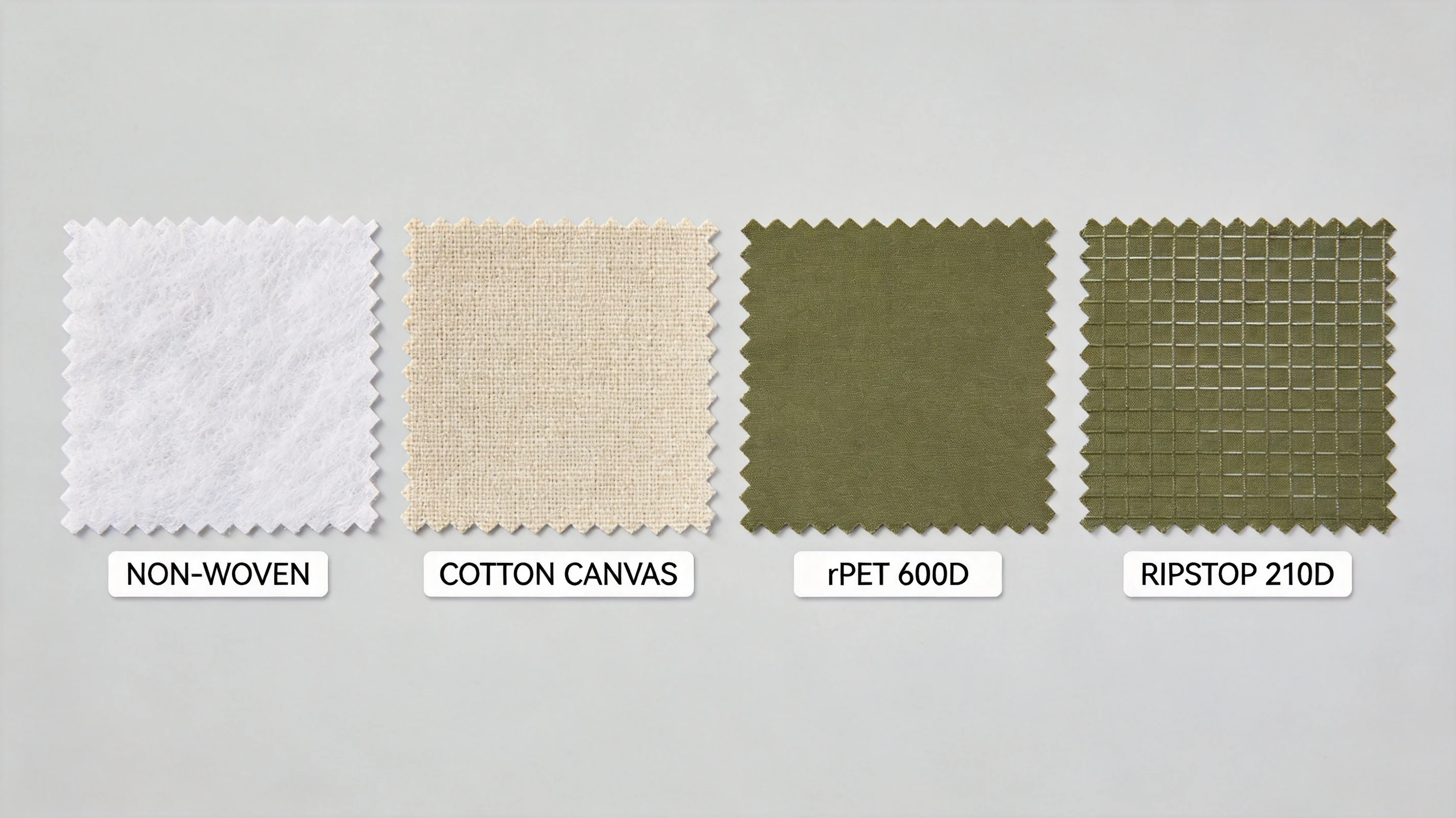
Substrate choice is the single largest lever on both unit cost and programme outcome, and it is the specification most often reduced to a single word in a brief. “Cotton” spans a 6 oz bag that will not hold a laptop and a 12 oz bag that outlives the campaign. “Polyester” spans a 210D packable tote and a 1680D structural pack. The table below gives the working range we specify against.
| Substrate | Weight / construction | Typical FOB band | Abrasion and usable life | Print compatibility | Compliance notes | Programme fit |
|---|---|---|---|---|---|---|
| Non-woven PP | 80–100 gsm spunbond polypropylene | US$0.30–0.80 | Low; typically single-event use | Screen print, heat transfer | Recycle code 5; rarely recycled in practice despite the claim | High-volume events where unit cost dominates and retention is not the goal |
| 10 oz cotton canvas | ~340 gsm woven cotton | US$0.80–1.90 | Good; 2–4 years of regular use | Screen print, embroidery, heat transfer | Shrinks 3–8% unwashed; azo dye and formaldehyde screening for EU | The default premium giveaway; the format buyers actually keep |
| 10 oz recycled cotton | ~340 gsm pre-consumer or post-industrial recycled cotton | US$0.90–2.10 | Good; slightly more variable hand and shade | Screen print, embroidery | Recycled-content claim requires traceable documentation | Sustainability-led programmes with a published content target |
| rPET 600D | 600 denier recycled polyester, PU back-coat | US$0.90–1.80 | Good; resists scuffing and light rain | Screen print, heat transfer, sublimation | GRS certification required if the recycled claim is published | Brands reporting recycled content in an ESG or packaging disclosure |
| RPET 210D ripstop | 210 denier ripstop, PU coated, packable | US$2.50–6.00 | Medium; light, folds into its own pocket | Screen print, heat transfer | PFC-free water repellency available on request | Conference and travel programmes where freight volume matters |
| 1680D polyester or nylon | 1680 denier ballistic weave, multi-panel | US$3.50–9.50 (backpack) | High; structural and abrasion resistant | Embroidery, rubber patch, silicone print | REACH SVHC screening; metal hardware lead screening for California | Onboarding kits and employee programmes meant to last years |
| PU or split leather | 1.2–1.4 mm PU or leather, trim or full body | US$8.00–25.00 | High perceived value; medium abrasion | Emboss, foil, embroidery, deboss | Highest Prop 65 exposure: lead in vinyl and imitation leather, phthalates in PVC, lead in dyes and zipper pulls | Executive and client gifting where perceived value is the point |
Water resistance is a specification, not a category. A PU back-coated 600D resists road spray and a light shower; a seam-sealed laminate resists sustained rain but adds weight, stiffness and cost. Ask which one is being quoted. For programmes where weather protection is the actual requirement, the construction logic overlaps with our custom dry bag manufacturing and waterproof bag OEM/ODM lines.
Decoration: a selection matrix, not a list of options
Decoration is where promotional bag programmes most often go wrong, because the cheapest method per unit is frequently the most expensive method per usable unit. A one-colour screen print at US$0.08 per bag that cracks after four washes is not cheaper than a four-colour print at US$0.22 that survives the life of the bag — it just moves the cost to the reprint.
| Method | Practical minimum run | Colour limit | Durability | Substrate compatibility | Effect on unit cost | Effect on lead time |
|---|---|---|---|---|---|---|
| Screen print | 100–250 pcs | 1–7 spot colours | Good on cotton; cracks on coated synthetics | Cotton, canvas, non-woven, rPET | Lowest at volume; per-colour setup charged once | +0 to +2 days |
| Embroidery | 50–100 pcs | Up to 12 thread colours | Excellent; outlasts the bag | Canvas, 1680D, PU, fleece | Highest per unit; one-off digitising fee | +2 to +4 days |
| Heat transfer | 100 pcs | Full colour, photographic | Medium; degrades with heat and repeated washing | Most substrates including coated synthetics | Medium; no per-colour penalty | +1 to +3 days |
| Sublimation | 250 pcs | Full colour | Good, but polyester only | Light-coloured polyester and rPET | Medium | +2 to +4 days |
| Silicone / high-density print | 250 pcs | 1–2 colours | Excellent; raised tactile finish | Canvas, 1680D, PU | High | +3 to +5 days |
| Woven label | 500 pcs | Up to 8 colours | Excellent; permanent | Any substrate | Low per unit; label cost added separately | +3 to +5 days |
| Foil / deboss | 250 pcs | 1 colour | Good; premium appearance | PU, leather, coated canvas | High; requires a die | +2 to +4 days |
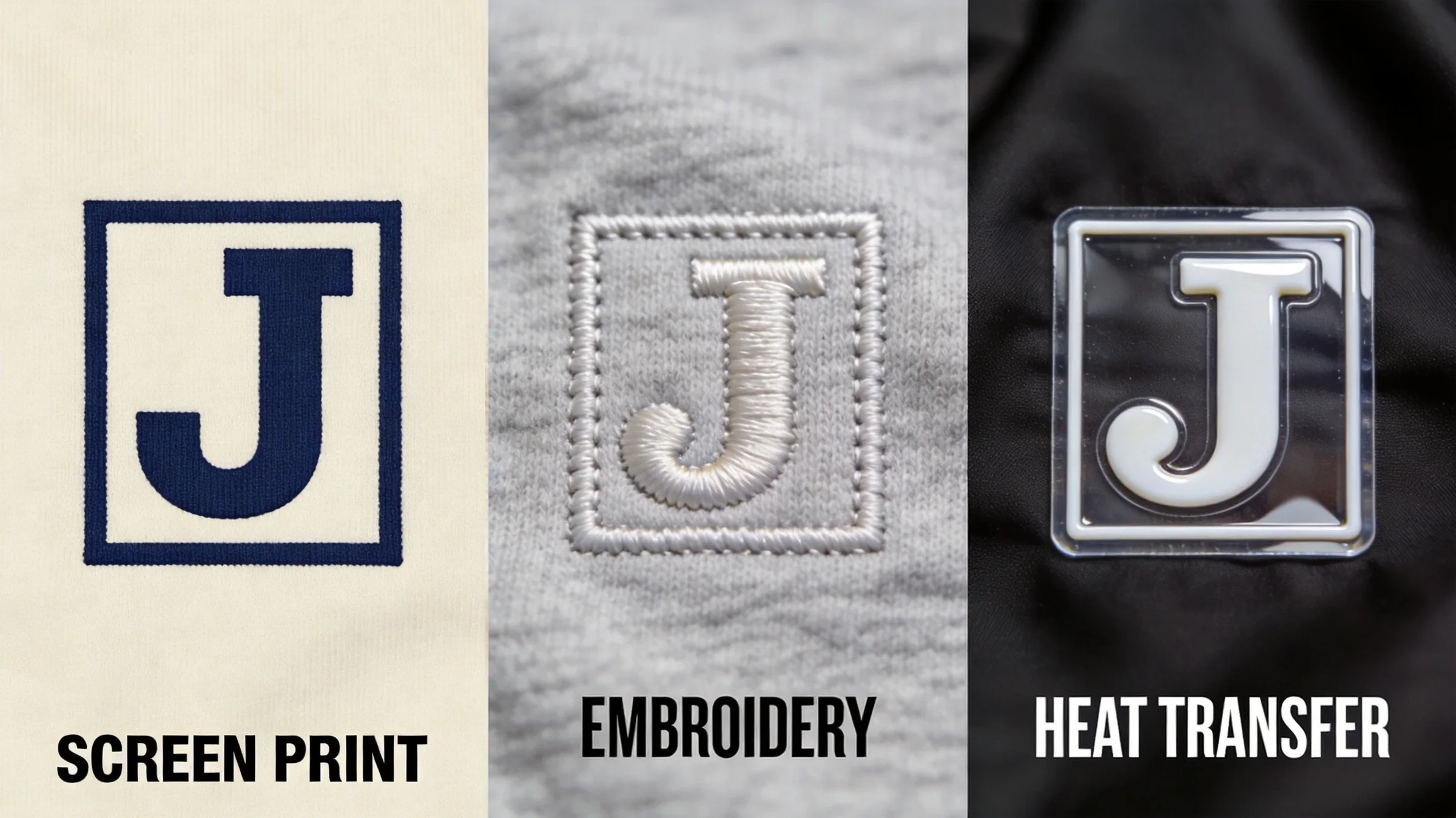
The decision rule we use in programme reviews is straightforward. If the bag will be washed or used outdoors, specify embroidery or silicone. If the artwork is photographic or carries more than five colours, specify heat transfer or sublimation. If the budget is the binding constraint and the bag is a single-event giveaway, screen print one or two colours. What does not work is specifying a seven-colour screen print on a coated synthetic and expecting it to survive a summer.
Print area and placement: the measurements that decide your artwork
A standard 15″ × 16″ tote has a maximum screen print area of about 10″ × 11″, and artwork must clear the side seams and the top hem by roughly 2″ on every side. Submitting artwork sized to the bag rather than to the print area is the single most common cause of a reprint charged to the buyer. The numbers below are the working specification we check artwork against.
| Bag size | Physical dimensions | Maximum screen print area | Maximum digital / DTG area | Required clearance |
|---|---|---|---|---|
| Small tote | 12″ W × 11″ H × 3″ D | 8.0″ × 7.0″ | 8.5″ × 7.5″ | 1.5″ sides / 2.0″ top hem |
| Medium tote (standard) | 15″ W × 16″ H × 4″ D | 10.0″ × 11.0″ | 11.0″ × 12.0″ | 2.0″ all seams and top hem |
| Large tote | 18″ W × 15″ H × 6″ D | 12.0″ × 9.0″ | 13.0″ × 10.0″ | 2.5″ gusset seams / 2.0″ top |
| Extra-large tote | 22″ W × 17″ H × 7″ D | 14.0″ × 10.0″ | 15.0″ × 11.0″ | 3.0″ gusset seams / 2.5″ top |
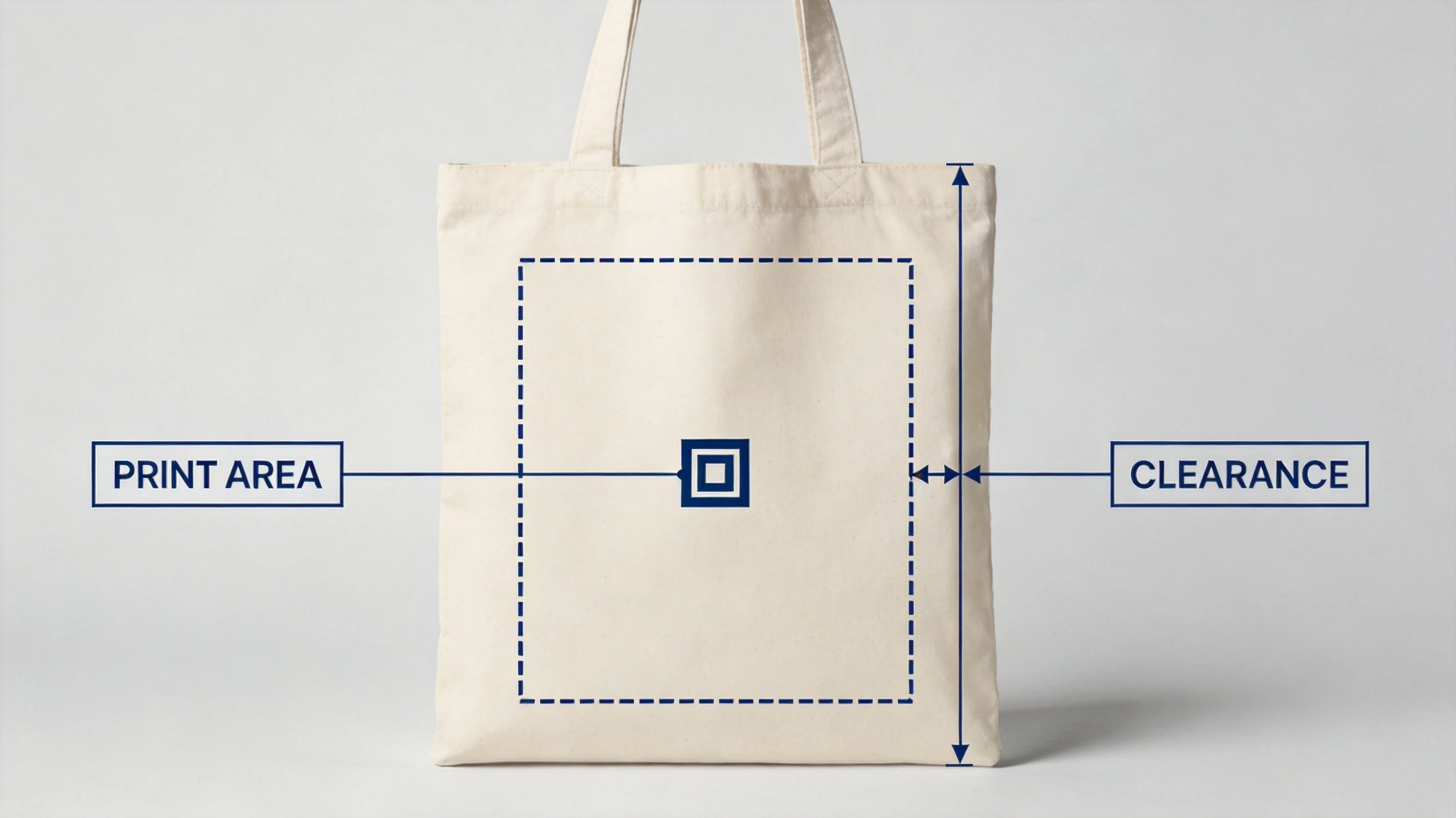
Placement matters as much as size, and it is decided by where the bag sits on a shoulder rather than by where the panel is. A mark centred in the true printable square reads low once the bag is carried, so artwork is normally biased upward by roughly 5–8% of the panel height.
| Placement zone | Recommended width | Recommended height | Preferred method | Brand visibility |
|---|---|---|---|---|
| Centre front | 3–4″ | 1.5–2″ | Screen print, DTG | Highest |
| Corner front | 2–3″ | 1–1.5″ | Screen print, embroidery | High |
| Top header | 2.5–3.5″ | 1–1.5″ | Screen print, heat transfer | High |
| Back panel centre | 3–4.5″ | 1.5–2″ | Screen print, DTG | Highest |
| Bottom corner | 1.5–2.5″ | 1–1.5″ | Screen print, embroidery | Medium |
| Handle or strap | 1–1.5″ | 0.5–0.75″ | Embroidery, deboss | Low, but permanent |
One shrinkage warning that costs buyers real money: unwashed cotton canvas shrinks 3–8% on the first wash, while synthetic substrates do not shrink at all. On a 15″ × 16″ cotton tote that is up to 1.3″ of height lost, which is why cotton programmes should be specified pre-shrunk or cut with a shrinkage allowance rather than printed to the finished measurement. Artwork sized to the pre-shrink dimension ends up high on the panel after the first wash.
Two further artwork rules matter more than they sound. Hairlines below about 1.5 pt and small reversed type lose definition on natural cotton, because the weave texture breaks up fine detail — specify heavier strokes or a solid patch. And most strong designs use 70–85% of the available print width rather than filling it edge to edge, which is a design observation but also a production one: artwork that runs to the clearance line has no tolerance for placement variation across a 500-piece run.
MOQ, sampling, lead time and FOB structure
The standard commercial terms for a custom promotional bag programme are 500 pieces per style and colour, 6–10 business days for sampling, 35–50 days for bulk production after sample approval, and AQL 2.5 major / 4.0 minor final inspection. Sample fees are charged and credited in full against the first bulk order. Mixed sizes within one style and colour count as one SKU, so a three-size run of 167 pieces per size meets the 500-piece minimum.
| Item | Standard term | Notes |
|---|---|---|
| MOQ | 500 pcs per style and colour | Mixed sizes within one style and colour count as one SKU |
| Sample lead time | 6–10 business days | From approved tech pack and confirmed materials |
| Bulk lead time | 35–50 days | After sample sign-off, not after deposit alone |
| Sample fee | Charged, credited against first bulk order | Includes one round of pre-production modification |
| Inspection | AQL 2.5 major / 4.0 minor | Inline plus final; first orders receive a 100% final check |
| Warranty | 12 months | Against manufacturing defect, not against wear |
| Trade term | FOB Xiamen | CIF, CFR, DAP and DDP available on request |
| Payment | T/T, L/C at sight | Repeat-order terms negotiable after three completed orders |
What the published market price bands look like
Published supplier quotes for promotional bags on B2B marketplaces cluster in the bands below at 100 to 500 piece volumes. The spread within each band is not arbitrary — it tracks substrate weight, construction detail and decoration method, and it is the reason a quote 40% below the band should trigger a material question rather than a purchase order.
| Format | Published band at 100–500 pcs | What drives the spread within the band |
|---|---|---|
| Non-woven PP tote | US$0.30–0.80 | Gram weight, handle type, number of print colours |
| Cotton canvas tote | US$0.80–1.60 | Ounce weight, gusset depth, handle reinforcement method |
| rPET tote | US$0.90–1.80 | Denier, GRS certification, print method |
| Drawstring sport pack | US$0.55–1.40 | Fabric weight, cord grade, eyelet reinforcement |
| 1680D backpack | US$3.50–9.50 | Panel count, padding density, zipper brand |
| Insulated cooler tote | US$4.50–12.00 | Liner material, foam thickness, zip type |
A quote at the bottom of a band is normally built from a lighter substrate, single-stitch seams, unbranded zips and one-colour print. A quote at the top carries the specified ounce weight, bar-tacked stress points, branded hardware and multi-position decoration. Both are legitimate products for different programmes. The failure mode is paying top-band money for bottom-band construction — which is why we cost line by line, so a substitution is visible on paper before it is approved rather than discovered at the loading dock.
Compliance: what US and EU buyers now have to document
Compliance cost is now one of the three pressures PPAI names on both supplier and distributor margins, alongside tariffs and freight. For bags, the exposure concentrates in three places: phthalates and lead in coated, synthetic and metal components; azo dyes and formaldehyde in textiles; and recycled-content claims that cannot be substantiated when a customer or a regulator asks.
California Proposition 65 is not a theoretical risk for this category. The state’s own 60-day notices name children’s backpacks for exposure to di(2-ethylhexyl) phthalate (DEHP) from PVC components, and separately name backpacks made with leather, vinyl or imitation leather for lead exposure — with lead present as a stabiliser in the vinyl or imitation leather, as a chemical ingredient in some dyes, paints and colouring agents, in the chemicals used in leather tanning, and in metallic components such as zippers and zipper pulls. Six phthalates are on the Proposition 65 list, and California law separately prohibits BBP, DBP and DEHP above 0.1% in children’s toys and child care articles. Federal law contains similar prohibitions.
The commercial reading is direct. A drawstring pack given away at a school event and a PU-trim tote sold into a California retail channel both sit in the highest-exposure part of this category, and neither is protected by the supplier’s location. The warning obligation attaches to the business exposing the consumer. Sources: California Attorney General, 60-Day Notice 2023-00697 (children’s backpacks, DEHP), California Attorney General, Notice 2016-00115 (lead in leather, vinyl and imitation leather backpacks), OEHHA, Phthalates fact sheet.
| Market | Requirement | What it covers | What we supply |
|---|---|---|---|
| US — California Prop 65 | Clear and reasonable warning where an exposure to a listed chemical occurs | Lead in vinyl, imitation leather, dyes and zipper pulls; DEHP and DBP in PVC components | Component-level material declarations; phthalate-free PVC alternatives; warning label artwork where required |
| US — CPSIA | Federal limits on lead and phthalates in children’s products | Bags marketed to or intended for children under 12 | Substrate and component test reports; age-grading guidance on borderline products |
| US — FTC Green Guides | Competent and reliable evidence for environmental claims | “Recycled”, “eco” and content-percentage claims in the US | GRS transaction certificates; supplier declarations for recycled cotton |
| EU — REACH SVHC | Screening against the candidate list; communication above 0.1% w/w | All articles placed on the EU market | SVHC screening reports per material batch |
| EU — Textile dye requirements | Restrictions on azo dyes and formaldehyde | Cotton and polyester textile components | Mill declarations and batch test reports |
| EU — Leather due diligence | Documented sourcing for leather and coated leather | Leather trim and full-leather bodies | Sourcing documentation where leather is specified |
| Packaging and labelling | Recyclability and material marking of packaging | Polybags, hang tags, cartons, inserts | Recycled and recyclable packaging options; material marking per market |
Practical guidance from programme reviews: specify phthalate-free PVC or move to PU on any bag likely to reach a child, and screen metal hardware for lead on any bag sold into California rather than assuming the zipper is compliant because the fabric is. Both decisions are cheap before tooling and expensive after.
Quality control and testing protocol
Every promotional bag order runs through incoming material inspection, inline inspection at roughly 30% and 70% of production, and a final AQL 2.5 major / 4.0 minor inspection before packing. First orders receive a 100% final check in addition to the sampling plan. The test list below is what we run on a bag programme; items marked optional are specified when the brief or the destination market calls for them, because each one adds cost and time.
| Test | Method / reference | Acceptance | Standard or optional |
|---|---|---|---|
| Seam and bar-tack strength | Tensile pull on handle anchors and stress points | No failure below the agreed load | Standard |
| Handle attachment cycle | Repeated loaded lift cycles at rated capacity | No stitch failure or elongation beyond tolerance | Standard |
| Zipper cycle | Repeated open and close on main compartment | 5,000 cycles without skip or separation | Standard |
| Colourfastness to rubbing | Wet and dry crocking | Grade 4 or better | Standard |
| Colourfastness to washing | Domestic wash cycles where the brief requires it | Grade 4 or better after the agreed cycle count | Optional |
| Print adhesion | Cross-hatch or tape pull on the decorated area | No lifting beyond the agreed threshold | Standard |
| Dimensional check | Flat measurement against the approved spec sheet | Within tolerance on all graded sizes | Standard |
| Fabric weight verification | gsm check against the approved swatch | Within ±5% | Standard |
| Static load capacity | Loaded seam test per format | Per agreed specification by format | Standard |
| Phthalate screening | GC-MS on PVC and coated components | Below Prop 65 and CPSIA thresholds | Optional by market |
| Lead screening | Total lead on coated and metal components | Below CPSIA and Prop 65 thresholds | Optional by market |
| Azo dye and formaldehyde | Textile screening | Below REACH and destination-market thresholds | Optional by market |
| Insulated liner food contact | FDA 21 CFR for the US; EU 10/2011 for Europe | Declaration of compliance | Optional, cooler totes only |
Inspection reports with photographs are issued before shipment, so a buyer can clear the order without a third-party visit. Where a buyer prefers an independent inspection, we schedule it into the production window rather than after packing — a report that arrives after the cartons are sealed cannot change anything.
The OEM/ODM development process, step by step
A promotional bag programme runs through six stages from brief to shipment, and the two stages buyers most often compress — tech pack review and sample revision — are the two that decide whether bulk production runs on schedule.
- Brief and tech pack review (3–5 days). Format, dimensions, substrate weight, decoration method, print positions, target quantity and target FOB are fixed on paper. Gaps in the tech pack are raised here rather than during sampling, because a gap found at sampling costs a sampling cycle.
- Design and material selection (5–8 days). Panel layout and construction are confirmed, with fabric swatches, handle webbing, zipper and hardware samples issued for approval. Pantone matching on fabric is done at this stage, not at print.
- Prototype sampling (6–10 business days). First sample built to the approved specification in the specified substrate and hardware, decorated in the specified method.
- Sample review and revision (1–2 rounds). Handle length, gusset behaviour under load, print position and colour are assessed against the brief; revisions happen pre-production, never after bulk starts.
- Bulk production (35–50 days). Material inspection on receipt, inline checks at approximately 30% and 70%, then final AQL inspection before packing.
- Inspection, packing and shipment. Photographic inspection report issued, packing to the brief — individual polybag, hang tag, barcode, kitting or retail carton — and shipment FOB Xiamen or to a buyer-nominated forwarder.
Full programme management, including tech pack drafting support and material sourcing across formats, is described under our OEM/ODM service. Related bag programmes built on the same factory base include custom backpacks, custom tote bags, custom duffle bags and custom cooler bags.
Matching bag format to campaign type
Format follows campaign, not budget. The most common programme error is choosing the cheapest format that fits the budget instead of the format that matches how the bag will actually be used — which produces a giveaway nobody keeps and a retention number nobody can defend.
| Campaign type | Format that works | Why | Typical quantity |
|---|---|---|---|
| Trade show giveaway | Non-woven or cotton tote | Carried on the show floor and reused for the rest of the day; highest visibility per dollar | 500–5,000 |
| Employee onboarding kit | 1680D backpack or duffle | Signals investment in the hire; survives daily commuting for years | 100–1,000 |
| Client appreciation | PU tote or leather-trim duffle | Perceived value above cost; accepts embroidery or deboss personalisation | 50–500 |
| Conference attendee bag | RPET 210D packable tote | Light to ship, easy to brand, low volumetric freight | 1,000–10,000 |
| Retail gift-with-purchase | Cotton canvas tote | Retail-ready presentation; consistent with a paid product | 500–3,000 |
| Sustainability campaign | rPET 600D or recycled cotton | Substantiable recycled content with GRS documentation | 500–5,000 |
| School or youth programme | Drawstring sport pack in phthalate-free material | Lowest cost per unit; highest compliance scrutiny of any format | 1,000–20,000 |
A programme that needs to cover several of these at once usually runs one anchor format at volume and one premium format at low quantity, rather than three mid-priced formats that each underperform.
Why promotional bag production concentrates in Quanzhou
Promotional bag production concentrates in Quanzhou, Fujian, because the product is a cut-and-sew soft-goods assembly — pattern making, panel cutting, webbing and handle attachment, bar-tacked stress points, zipper installation and final trimming — which sits in the bag supply chain rather than the printing and packaging supply chain. The same industrial base that builds backpacks, duffles, cooler bags and travel luggage also builds promotional totes and drawstring packs, and it draws on the same fabric mills, webbing suppliers and hardware importers.
The practical consequence for a buyer is a shorter sampling loop and a lower minimum than a packaging converter can offer on a sewn product, plus a materially deeper substrate library: 10 oz and 12 oz cotton canvas, recycled cotton, 600D and 1680D polyester, 210D ripstop and PU-coated substrates in the required weights are regional stock items rather than special orders. It also means decoration capacity — screen print, embroidery, heat transfer and sublimation — sits alongside the sewing floor rather than in a separate vendor, which is what makes a 35–50 day bulk window realistic rather than optimistic.
JUNYUAN BAGS operates from Fengze District, Quanzhou, has been in the bag trade since 2004 and has run as an OEM/ODM exporter since 2014. Design, sourcing, quality control and export are managed in-house; production runs through affiliated and partner factories with documented inspection procedures. Adjacent programmes include custom backpacks, sports bags and custom equipment bags.
Frequently asked questions about custom promotional bags
Q1. What is the minimum order quantity for custom promotional bags?
The minimum order quantity is 500 pieces per style and colour. Mixed sizes within one style and colour count as a single SKU, so a three-size run of 167 pieces per size meets the minimum. Trial orders below this are considered case by case, usually for buyers who have already approved a sample and want a sell-through test before committing to a full run.
Q2. How long does sampling take for a custom promotional bag?
Sampling takes 6–10 business days from an approved tech pack and confirmed materials. Programmes that add a new pattern block, a Pantone-matched fabric, an embroidery digitising round or a new hardware combination sit at the upper end. One round of pre-production modification is included in the sample fee.
Q3. What is the bulk production lead time for promotional bag orders?
Bulk production takes 35–50 days after sample approval. The clock starts at sample sign-off rather than at deposit, because a programme cannot enter the line until the sample is approved. Orders that add a new size, new packaging, individual polybag and barcode, kitting or an independent inspection window should plan toward the upper end.
Q4. What is the difference between swag bags and promotional products?
“Swag bags” is the informal US buying term for high-volume, low-cost branded giveaways where the goal is awareness and reach. “Promotional products” is the industry’s formal category term, used by ASI and PPAI, and covers everything from an entry-level giveaway to a premium item. The distinction is not semantic decoration — it changes the quote. A brief that says “swag” signals volume pricing and the simplest viable construction; a brief that says “promotional products” signals a specification-led quote with material and compliance detail. Related terms sit on the same ladder: “branded merchandise” usually implies retail-grade product that may be sold rather than given, and “corporate gifts” implies premium, often personalised items sent to named recipients at a much higher unit cost.
Q5. Which promotional bag format gives the lowest cost per impression?
On published industry data, a cotton tote is the strongest performer. ASI’s 2026 Ad Impressions Study puts a US$6 tote bag at close to 5,000 brand impressions, or roughly 0.1 cent per impression, against an average of about 3,300 impressions and US$0.006 per impression across promotional products generally. The reason is retention rather than unit cost: a tote that survives three years of grocery runs keeps delivering impressions, while a cheaper non-woven bag that tears on the second use stops delivering them. Cost per impression, not cost per unit, is the number that belongs in a campaign business case.
Q6. What materials are used in custom promotional bags?
The seven substrates we specify most often are non-woven PP at 80–100 gsm, 10 oz cotton canvas at roughly 340 gsm, 10 oz recycled cotton, rPET 600D with PU back-coat, RPET 210D ripstop, 1680D polyester or nylon for structural packs, and PU or split leather at 1.2–1.4 mm for premium trims and bodies. Each sits at a different point on cost, durability and compliance. Non-woven is the cheapest and shortest-lived; 1680D is the most durable; PU and leather carry the highest perceived value and the highest Proposition 65 exposure on lead and phthalates.
Q7. What is the maximum print area on a tote bag?
On a standard 15″ × 16″ tote, the maximum screen print area is about 10″ × 11″, with a digital or DTG area of about 11″ × 12″, and artwork must clear the side seams and top hem by roughly 2″ on every side. Smaller totes carry less: a 12″ × 11″ bag takes about 8″ × 7″, an 18″ × 15″ bag about 12″ × 9″, and a 22″ × 17″ bag about 14″ × 10″. Artwork sized to the bag rather than to the print area is the most common cause of a reprint charged to the buyer.
Q8. Which decoration method lasts longest on a promotional bag?
Embroidery and silicone or high-density print outlast every other method, and woven labels are permanent by construction. Screen print performs well on cotton and canvas but cracks on coated synthetics as the coating flexes; heat transfer offers full-colour artwork but degrades faster under heat and repeated washing; sublimation is durable but only bonds to light-coloured polyester. If the bag will be washed or used outdoors, specify embroidery or silicone rather than the cheapest per-unit option.
Q9. Do I need a Proposition 65 warning on my promotional bags?
It depends on whether the bag can expose a consumer to a listed chemical, and the answer is decided by component rather than by product category. California’s own enforcement notices against bags name children’s backpacks for DEHP exposure from PVC components, and backpacks made with leather, vinyl or imitation leather for lead exposure — with lead present in the vinyl stabiliser, in dyes and colouring agents, in leather tanning chemicals, and in metal components such as zippers and zipper pulls. The warning obligation attaches to the business exposing the consumer, not to the factory. The practical route is to specify phthalate-free PVC or PU on any bag likely to reach a child, screen metal hardware and coated components for lead, and add warning label artwork only where a listed exposure remains.
Q10. How much does a custom promotional bag cost per piece?
Published B2B marketplace quotes cluster at roughly US$0.30–0.80 for non-woven totes, US$0.80–1.60 for cotton canvas totes, US$0.90–1.80 for rPET totes, US$0.55–1.40 for drawstring packs, US$3.50–9.50 for 1680D backpacks and US$4.50–12.00 for insulated cooler totes at 100–500 piece volumes. The spread inside each band tracks substrate weight, seam construction, hardware grade and decoration method — not supplier honesty. A quote at the bottom of a band normally means lighter substrate, single-stitch seams, unbranded zips and one-colour print; the top of the band means the specified ounce weight, bar-tacked stress points and multi-position decoration.
Q11. Can promotional bags be made from recycled materials with certification?
Yes, and the certification is the part that matters. rPET bags require a GRS (Global Recycled Standard) transaction certificate if the recycled content is going to be published, and recycled cotton requires traceable documentation from the fibre source through to the finished bag. Both are available on our programmes. The compliance trap is a supplier claiming recycled content without a certificate — which fails the moment a customer, a retailer or a regulator asks for substantiation under the FTC Green Guides in the US or the EU’s green claims requirements.
Q12. What is AQL 2.5 inspection and why does it matter for bag orders?
AQL 2.5 is an acceptance sampling standard: it defines how many defects are tolerated in a sample drawn from a batch before the batch is rejected. Our standard is AQL 2.5 major / 4.0 minor, applied at inline checks around 30% and 70% of production and again at final inspection, with a 100% final check on first orders. It matters for bags specifically because the defects that ruin a programme — handle anchor strength, stitch density, print adhesion, gusset alignment and dimensional consistency across a 500-piece run — are all things a buyer cannot see in a photograph of one sample.
Q13. Can you match Pantone colours on both fabric and print?
Yes, with one honest caveat. Pantone matching on fabric is a dyeing specification and is achievable within a stated tolerance; Pantone matching on screen print is a mixed-ink specification and is achievable to a much tighter tolerance. The two will not be identical on a textured cotton surface, and any supplier promising a perfect fabric-to-print match on natural canvas is overpromising. We match fabric and print separately, issue both swatches for approval before bulk, and state the tolerance in writing.
Q14. What is the difference between OEM and ODM for promotional bags?
In OEM, you supply the design and we manufacture to your specification — your pattern, your materials, your branding. In ODM, we bring an existing design and you brand it, which shortens development and lowers tooling cost but gives you less differentiation from other buyers using the same base. Most promotional bag programmes sit in between: a standard format adapted with your dimensions, substrate weight, decoration method and hardware. Both routes run at 500 pieces per style and colour with the same sampling and inspection standards; the difference is how much development sits before the first sample.
Start a promotional bag programme
Send the brief — format, dimensions, substrate preference, decoration method and positions, target quantity and target FOB — and we will return a material callout, an itemised cost breakdown and a sampling schedule. If the brief is still open on format, tell us the campaign and the quantity and we will propose two options with the trade-offs stated.
MOQ 500 pieces per style and colour, sampling 6–10 business days, bulk 35–50 days, AQL 2.5 major / 4.0 minor, 12-month warranty, FOB Xiamen.
Request a quote | Contact the team | Read the custom branding guide
Email [email protected] | WhatsApp / Tel +86 177 5002 0688
Specifications, substrate bands and test methods described here reflect standard production for JUNYUAN BAGS promotional bag programmes. Published competitor prices and industry statistics are quoted for market reference and were accurate as published at the time of writing; they are not our specifications or our pricing. Proposition 65 and CPSIA obligations attach to the business placing the product on the market, and this page is a sourcing reference rather than legal advice — confirm the applicable requirement with your compliance counsel for each destination market.