
Custom hydration vest manufacturing at JUNYUAN BAGS runs on a 500-piece minimum per style and colour, 6–10 business day sampling, 35–50 day bulk production and AQL 2.5 final inspection, produced through affiliated and partner factories in Quanzhou, Fujian — the Chinese city where most of the world’s running vest capacity is located. The company has been in the bag trade since 2004 and has operated as a Quanzhou-based OEM/ODM exporter since 2014, shipping FOB Xiamen.
That paragraph is the short answer. What follows is the specification detail a sourcing manager actually needs before committing a tooling deposit: how capacity, hydration system and harness interact, what the shell and mesh are made of, how bounce is engineered out, what the FOB range looks like against published competitor quotes, and where “running vest” as a search term will send you to the wrong factory entirely.
What a hydration vest is — and why “running vest” is the wrong sourcing term
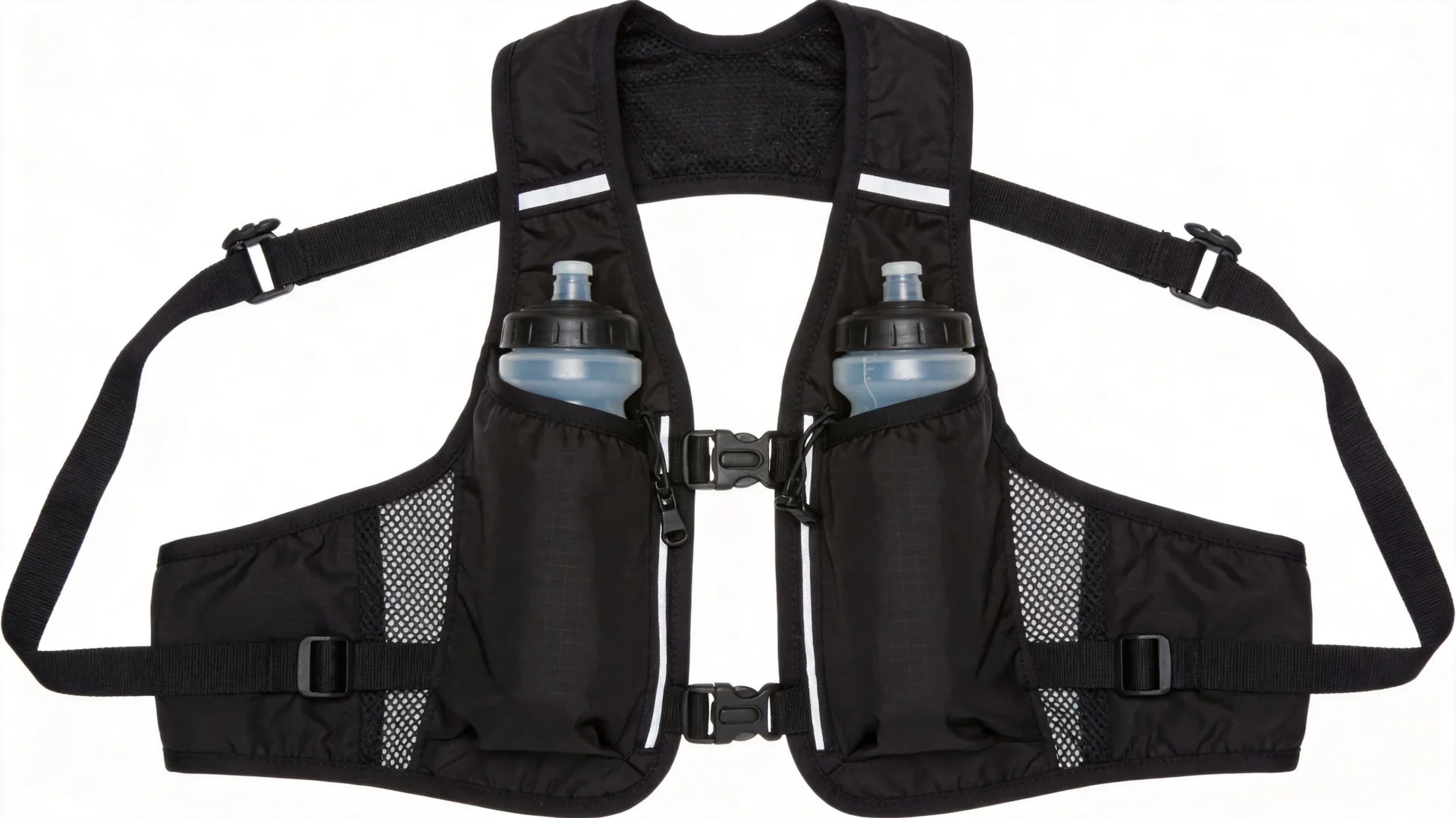
A hydration vest is a close-fitting harness-style carry system worn on the torso, with front-mounted soft flask pockets and a rear compartment for a bladder, spare layers or mandatory race kit. It is classified as a bag under HS 4202, not as a garment under HS 61 or 62. That classification detail is not pedantry. It determines which supply chain you end up talking to.
Search any B2B marketplace for “running vest manufacturer” and a large share of the results are running singlets — sleeveless polyester training shirts, priced per piece at apparel volumes, quoted by garment factories with sewing lines geared to jersey knit. They are not the same product, they are not made by the same factories, and a garment supplier cannot quote you a vest with an elastic side-cord harness, a heat-sealed soft flask pocket and a bladder hanger loop, because those are bag constructions.
If you are sourcing a hydration carrier, search “hydration vest”, “trail running vest”, “race vest” or “hydration pack” — not “running vest”. The four terms below are frequently used interchangeably by consumers and are not interchangeable in a tech pack:
| Term | What it actually refers to | Typical capacity | Supply-chain category |
|---|---|---|---|
| Hydration vest | Harness-style torso carrier with front flask pockets; may accept a rear bladder | 2–12 L | Bag / soft goods (HS 4202) |
| Running vest | Ambiguous — in apparel it means a sleeveless running shirt; in gear reviews it means a hydration vest | n/a or 2–12 L | Both, depending on context |
| Hydration pack | Backpack-form carrier, rear reservoir dominant, shoulder or waist harness | 8–30 L | Bag (HS 4202) |
| Running belt | Waist band with bottle holsters and small pockets, no torso coverage | 0.5–2 L | Bag / accessory |
Capacity, hydration system and harness: the three decisions that define the product
Capacity should be chosen from run duration, not from what looks generous on a spec sheet. The working baseline used across the gear-testing industry is roughly 2 litres of total carry for runs under two hours, 4 to 6 litres for one to three hours, and 8 to 12 litres once you go beyond three hours or race rules add mandatory kit. REI’s published testing guidance puts the mid-capacity sweet spot for marathon training at around 5 litres, Treeline Review’s 2026 vest testing reaches the same conclusion after multi-month field testing across body types, and GearJunkie’s 2026 running vest guide runs the same 2-to-12-litre span across its 2026 picks.
| Total capacity | Typical use case | Hydration setup | Vest-only weight target |
|---|---|---|---|
| 2–4 L | Runs under 90 minutes; road 10K to half marathon | 1–2 × 250–500 ml soft flasks | 140–190 g |
| 5–6 L | 1–3 hours; marathon training; short trail races | 2 × 500 ml soft flasks | 180–230 g |
| 8–10 L | 3–6 hours; trail 25K to 50K; fastpacking | 2 × 500 ml flasks + 1.5–2 L bladder | 230–300 g |
| 12 L + | Ultra and mountain routes with mandatory kit | Flasks + 2 L bladder, rear load dominant | 280–380 g |
Weight targets are not arbitrary. The competitive set defines them: the Salomon S/Lab Ultra 12 carries 12 litres at 205 g, the On Ultra Vest Pro carries 10 litres at 300 g with a removable dry pack, and the CamelBak Ultra Pro carries 6 litres at 255 g. A 10-litre vest above 320 g reads as heavy to a buyer who has handled those three. RunningGearLab publishes a specification table across the 2026 pick set that makes weight-to-capacity ratios directly comparable.
Fluid intake planning follows roughly 450 to 700 ml per hour, adjusted upward for heat and sweat rate. Two 500 ml soft flasks therefore cover a two-hour effort in moderate conditions, which is why the dual-flask front is the default configuration across the category.
Materials and construction: what a hydration vest is actually made of
A hydration vest is a multi-panel soft-goods assembly with four distinct material zones. Each has a different job, and substituting one to hit a price point is where most programmes lose either durability or fit.
| Zone | Typical material | Gram weight | Function | Cost sensitivity |
|---|---|---|---|---|
| Front body / chest panel | Stretch power mesh, polyester–elastane (85/15 to 90/10) | 120–180 gsm | Holds flasks tight without pressure points; must recover shape | High — stretch ratio drives price |
| Rear compartment | Ripstop nylon or polyester, 70D–210D, PU back-coated | 70–140 gsm | Load-bearing volume; light water resistance | Medium |
| Back panel / spacer | 3D spacer mesh or perforated EVA | 180–260 gsm | Ventilation and load spread across the back | Medium |
| Harness and binding | Elastic binding tape, side compression cord, stretch webbing | n/a | Bounce control; the single largest comfort variable | High — cord and buckle grade |
Hardware and hydration components
- Zippers: #3 or #5 coil for rear pockets; reverse coil where the pocket sits against the back. Water-resistant PU-taped zips are specified only on rear compartments that must protect electronics.
- Buckles and cord locks: Duraflex, Woojin or equivalent; sternum buckles must survive repeated one-handed operation with cold hands.
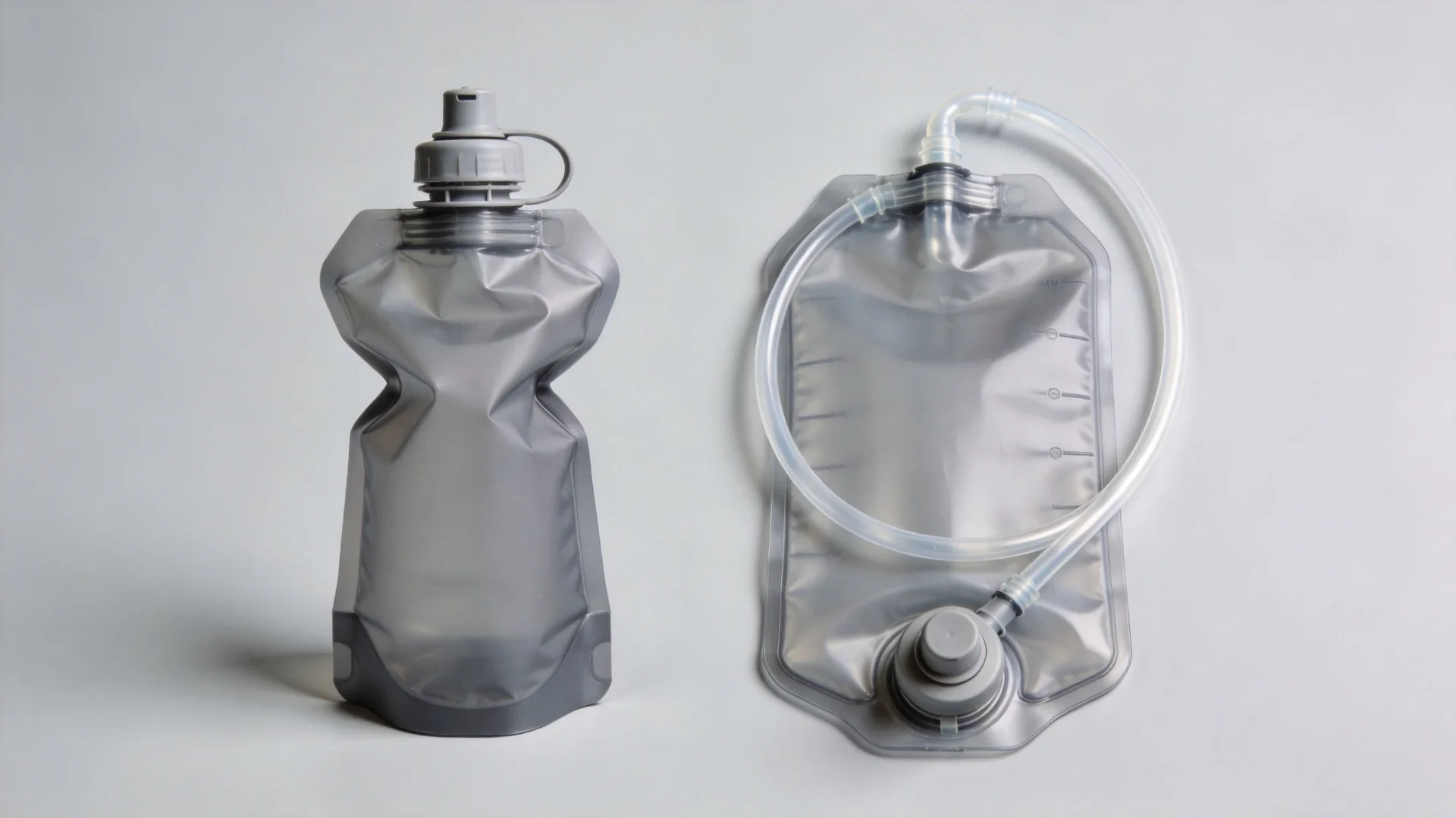
- Soft flasks: TPU or PE, BPA-free, 250–600 ml, with a bite valve or push-pull cap. Flasks are usually quoted separately from the vest because brand and volume vary so widely.
- Bladders: 1.5–2 L TPU with a quick-release hose and insulated tube sleeve where the brief requires it.
- Reflective elements: printed or taped, positioned on the rear and shoulders for night-running briefs.
Water resistance is a specification, not a category. A PU back-coated 210D shell resists rain and road spray; a seam-taped TPU laminate resists sustained rain but adds weight, stiffness and cost. Ask which one you are being quoted. For programmes that genuinely need weather protection rather than splash resistance, the construction logic overlaps with our custom dry bag manufacturing and waterproof bag OEM/ODM lines.
Harness and bounce control: the engineering that decides whether the vest works
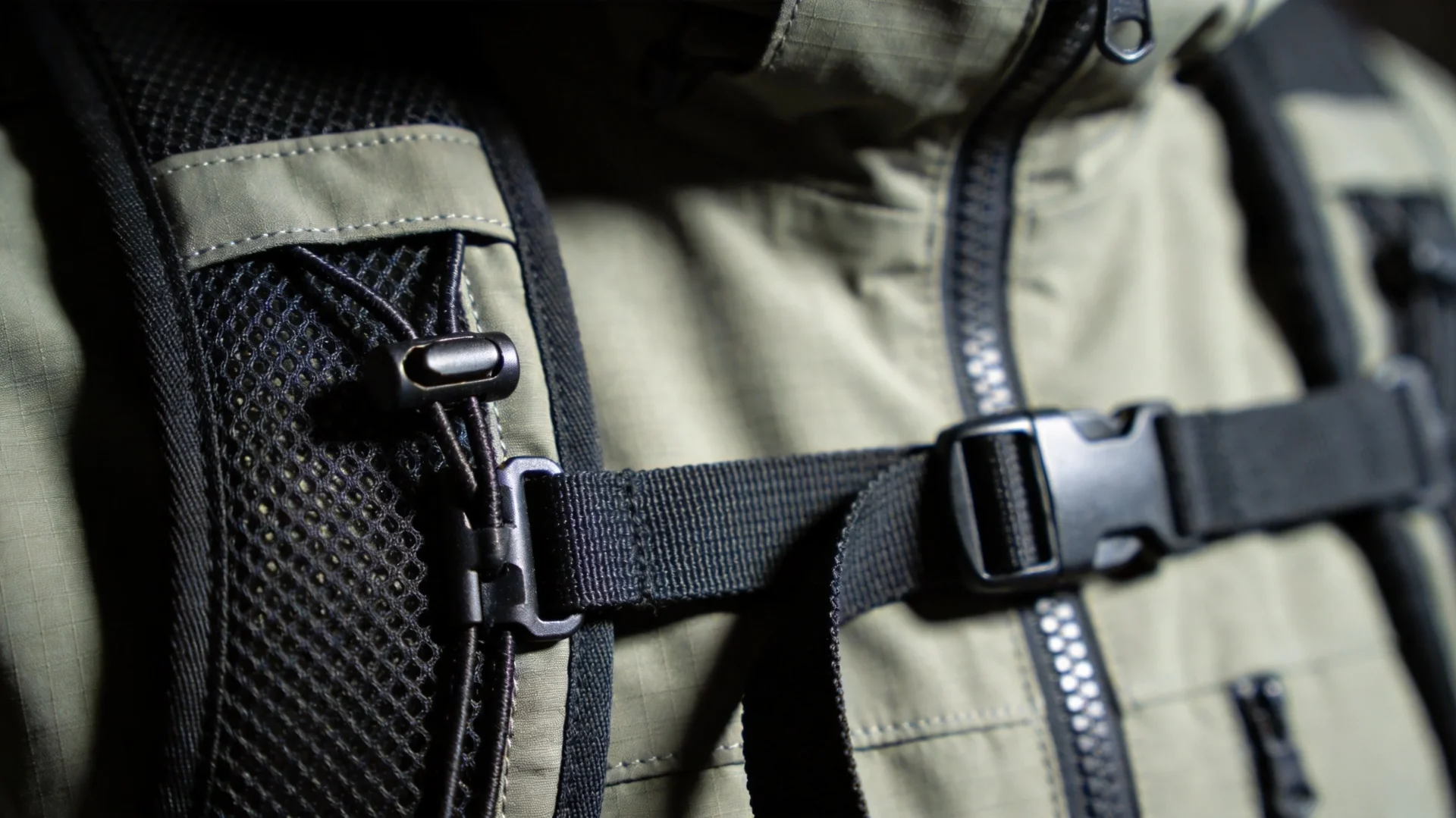
Bounce is controlled by the harness, not the fabric. Three variables decide it: side compression cord tension, sternum strap height and count, and whether sizing is graded on chest circumference rather than body weight. A vest that moves a full inch on every stride will wear a runner down faster than mild chafing, which is why OutdoorGearLab’s fit analysis treats harness conformity as the primary differentiator rather than a spec-sheet footnote.
How the three variables are set in production
- Side compression cord. Runs from the lower front panel around to the rear, pulling the vest against the ribs. Too little tension and the rear load swings; too much and the front flask pockets collapse and become hard to drink from one-handed.
- Sternum strap stack. Two straps is standard for 8 L and above; a third, lower strap is added on 12 L mountain vests to stop the rear load rotating on descents. Strap height must be set from the sternum, not from the shoulder seam.
- Sizing graded on chest circumference. Most brands size this way because torso length varies less than chest girth among runners of the same build. Grading on body weight produces a vest that fits the chest and gaps at the ribs.
A representative five-size grade, measured at the chest, is XS 80–86 cm, S 87–93 cm, M 94–100 cm, L 101–107 cm and XL 108–115 cm. Anything outside that range needs a dedicated women’s or extended-size block rather than a scaled pattern.
For buyers developing a women’s-specific version, the pattern work is not a scaled-down men’s block. Chest volume, sternum strap angle and flask pocket position all shift, and the gear-testing community has been explicit that unisex vests fit a meaningful share of female runners poorly. Budget a separate block, not a size extension.
Soft flask or bladder: choosing the hydration system before the pattern
Soft flasks and bladders solve different problems. Flasks give visible volume, fast refills and drinking without breaking stride; bladders give maximum volume on remote routes where refill points are scarce. Most 8 L and above vests are built to accept both.
| Decision | Soft flask front | Rear bladder |
|---|---|---|
| Access while running | Immediate, one-handed | Hose and bite valve; hands-free |
| Volume visibility | Visible as it collapses | Hidden until you open the sleeve |
| Refilling | Fast, often without stopping | Stop, remove vest, open reservoir |
| Practical maximum | 2 × 500–600 ml | 1.5–3 L |
| Cleaning effort | Rinse and air dry | Brush, rinse and hang dry fully |
| Slosh when partly full | Minimal | Noticeable |
| Best fit | Races with aid stations; 1–3 hours | Remote routes; 3 hours and beyond |
The design consequence is practical: if your brief is a race-day vest, the front flask pockets need a stretch mesh with enough recovery to hold a full 500 ml flask without sagging when empty. If your brief is an ultra vest, the rear needs a bladder hanger, an insulated tube route and a hose clip on the sternum strap. Specifying both on a 5-litre vest usually produces a product that does neither well.
Customisation: what can be changed, and what cannot be changed cheaply
Logo method, Pantone colour, size grade, hardware grade, flask inclusion and packaging are all customisable at 500 pieces per style and colour. Pattern geometry, panel count and harness topology are effectively fixed once tooling and pattern are approved — changing them is a new style, not a revision.
| Customisable at MOQ | Method / options | Effect on lead time |
|---|---|---|
| Logo | Embroidery, heat transfer, silicone print, reflective print, woven label, rubber patch | None to +3 days |
| Colour | Pantone-matched fabric and binding; single colour per style minimum | None |
| Size grade | XS–XL, S/M/L, or separate men’s and women’s blocks | +5–8 days for a new block |
| Hardware | Buckle and cord-lock brand/grade substitution | None to +2 days |
| Hydration | Flasks included or excluded; bladder sleeve added; hose clip position | +2–4 days |
| Add-ons | Race bib holder, pole loops, emergency whistle, rain cover, key clip | +2–5 days |
| Packaging | Polybag, hang tag, colour box, recycled mailer, custom insert card | +2–5 days |
Related bag programmes developed on the same factory base include custom running bags and custom cycling bags, which share panel construction and hardware sourcing with vest production.
MOQ, sampling, lead time and FOB structure
The standard commercial terms for a custom hydration vest programme are 500 pieces per style and colour, 6–10 business days for sampling, 35–50 days for bulk production after sample approval, and AQL 2.5 major / 4.0 minor final inspection. Sample fees are charged and credited in full against the first bulk order.
| Item | Standard term | Notes |
|---|---|---|
| MOQ | 500 pcs per style and colour | Mixed sizes within one style and colour count as one SKU |
| Sample lead time | 6–10 business days | From approved tech pack and confirmed materials |
| Bulk lead time | 35–50 days | After sample sign-off, not after deposit alone |
| Sample fee | Charged, credited against first bulk order | Includes one round of pre-production modification |
| Inspection | AQL 2.5 major / 4.0 minor | Inline plus final; first orders receive 100% final check |
| Warranty | 12 months | Against manufacturing defect, not wear |
| Trade term | FOB Xiamen | CIF, CFR, DAP and DDP available on request |
| Payment | T/T, L/C at sight | Repeat-order terms negotiable after three completed orders |
What the market price band looks like
Published supplier quotes for hydration vests on B2B marketplaces cluster between roughly US$4.70 and US$11.50 per piece at 300–500 piece volumes, with the spread driven by shell fabric, harness complexity, hardware grade and whether flasks are included. That band is a useful sanity check on any quote you receive, and it is also the reason a “too good” quote should trigger a material question rather than a purchase order.
A quote at the bottom of that band is normally built from a single-layer non-stretch front panel, a basic coil zip, unbranded cord locks and no flask inclusion. A quote at the top normally carries stretch power mesh, branded hardware, a spacer-mesh back panel and a flask pair. Both are legitimate products for different end markets; the failure mode is paying top-band money for bottom-band construction. Our costing is quoted line by line so that substitution is visible before it is approved.
Quality control and testing protocol
Every hydration vest order runs through incoming material inspection, inline inspection at roughly 30% and 70% of production, and a final AQL 2.5 major / 4.0 minor inspection before packing. First orders receive a 100% final check in addition to the sampling plan.
The test list below is what we run on a vest programme. Items marked optional are specified when the brief calls for them, since each adds cost.
| Test | Method / reference | Acceptance | Standard or optional |
|---|---|---|---|
| Bounce under load | Loaded vest on a treadmill or shaker rig; visual and measured displacement | No rotation of rear load; displacement within agreed tolerance | Standard |
| Seam and bar-tack strength | Tensile pull on critical seams and flask pocket bar-tacks | No seam failure below agreed load | Standard |
| Zipper cycle | Repeated open/close cycles on rear pocket zips | 5,000 cycles without skip or separation | Standard |
| Colourfastness to rubbing | Wet and dry crocking | Grade 4 or better | Standard |
| Soft flask leak | Filled, capped, inverted and pressure-checked | No leakage at cap or valve | Standard |
| Fabric tear strength | Tongue tear on shell and front panel | Per agreed spec by fabric weight | Standard |
| Food-contact compliance | FDA 21 CFR for US; EU 10/2011 for Europe (flask and bite valve) | Declaration of compliance | Optional by market |
| Chemical compliance | REACH SVHC screening; California Prop 65 where required | No substance above threshold | Optional by market |
| Dimensional check | Flat measurement against approved spec sheet | Within tolerance on all graded sizes | Standard |
Inspection reports with photographs are issued before shipment, so the buyer can clear the order without a third-party visit. Where a buyer prefers an independent inspection, we schedule it into the production window rather than after packing.
The OEM/ODM development process, step by step
A hydration vest programme runs through six stages from brief to shipment, and the two stages buyers most often compress — tech pack review and sample revision — are the two that decide whether bulk production runs on schedule.
- Brief and tech pack review (3–5 days). Capacity, hydration system, target weight, size grade, logo method and target FOB are fixed on paper. Gaps in the tech pack are raised here rather than during sampling.
- Design and material selection (5–8 days). Panel layout, harness topology and material callouts are confirmed, with fabric swatches and hardware samples issued for approval.
- Prototype sampling (6–10 business days). First sample built to the approved spec, in the specified fabric and hardware.
- Sample review and revision (1–2 rounds). Fit, bounce and pocket access are assessed; revisions are made pre-production, not after bulk starts.
- Bulk production (35–50 days). Material inspection, inline checks at 30% and 70%, then final AQL inspection.
- Inspection, packing and shipment. Photographic inspection report issued, packing per brief, FOB Xiamen or buyer-nominated forwarder.
Full programme management, including tech pack drafting support and material sourcing, is described under our OEM/ODM service.
Hydration vest, hydration pack or running belt: choosing what to develop
The dividing line between a vest and a pack is capacity and load placement, not marketing language: vests typically run 3 to 10 litres with the load distributed across chest and back, while packs run 10 to 30 litres with the load carried on the back and stabilised by a waist belt. Below 10 litres with an emphasis on speed and fit, a vest is almost always the better tool — the same conclusion Kit Authority reaches after comparing capacity, access, bounce and comfort.
| Format | Capacity | Load placement | Best end use | Development note |
|---|---|---|---|---|
| Hydration vest | 2–12 L | Chest and back, close to torso | Trail running, racing, fast hiking | Highest harness engineering effort per unit |
| Hydration pack | 8–30 L | Back, stabilised by shoulder and waist straps | Day hiking, biking, long self-supported runs | Closer to standard backpack construction |
| Running belt | 0.5–2 L | Waist only | Short runs, race essentials | Lowest complexity; often an add-on SKU |
| Run-commute backpack | 15–25 L | Back with laptop sleeve | Running to work | Needs structure and a padded sleeve |
Buyers often start with one format and extend the range once the first style sells. If the plan is a three-SKU running range, the usual build is a 5 L race vest, an 8–10 L training vest and a run-commute pack — which is why our custom running bag line and this vest programme share a material and hardware base.
Why hydration vest production concentrates in Quanzhou
Hydration vest production concentrates in Quanzhou, Fujian, because the product is a soft-goods bag assembly — elastic binding, stretch mesh panels, bar-tacked seams, soft flask pockets and cord-lock hardware — which sits in the bag supply chain rather than the apparel supply chain. The same industrial base that builds backpacks, cooler bags and travel luggage also builds vests, and it draws on the same fabric mills, webbing suppliers and hardware importers.
The practical consequence for a buyer is a shorter sampling loop and lower minimums than a garment factory can offer on a small technical run. It also means the material library is deep: stretch power mesh, spacer mesh, ripstop nylon and elastic binding in the required weights are stock items in the region rather than special orders.
JUNYUAN BAGS operates from Fengze District, Quanzhou, has been in the bag trade since 2004 and has run as an OEM/ODM exporter since 2014. Design, sourcing, quality control and export are managed in-house; production runs through affiliated and partner factories with documented inspection procedures. Adjacent programmes include custom hydration packs, custom backpacks and sports bags.
Frequently asked questions about custom hydration vests
Q1. What is the minimum order quantity for a custom hydration vest?
The minimum order quantity is 500 pieces per style and colour. Mixed sizes within one style and colour count as a single SKU, so a five-size run of 100 pieces per size meets the minimum. Trial orders below this are considered case by case, usually for buyers who have already approved a sample and want a sell-through test before committing to a full run.
Q2. How long does it take to produce a hydration vest sample?
Sampling takes 6–10 business days from an approved tech pack and confirmed materials. Programmes with a new women’s-specific pattern block, a custom heat-sealed pocket or a new hardware combination sit at the upper end. One round of pre-production modification is included in the sample fee.
Q3. What is the bulk production lead time for hydration vest orders?
Bulk production takes 35–50 days after sample approval. The clock starts at sample sign-off rather than deposit, because a programme cannot enter the line until the sample is approved. Orders that add a new size block, new packaging or an independent inspection window should plan toward the upper end.
Q4. What materials are used in a running hydration vest?
A running hydration vest is typically built from stretch power mesh (polyester–elastane, 120–180 gsm) on the front and chest panels, ripstop nylon or polyester (70D–210D, PU back-coated) in the rear compartment, 3D spacer mesh (180–260 gsm) on the back panel, and elastic binding tape with side compression cord in the harness. Hydration components are TPU or PE soft flasks (250–600 ml, BPA-free) and optional TPU bladders (1.5–2 L) with a quick-release hose.
Q5. How many litres should a hydration vest be for different run distances?
Match capacity to duration: 2–4 litres for runs under 90 minutes, 4–6 litres for one to three hours, 8–12 litres for three to six hours, and 12 litres or more for ultras and mountain routes where race rules add mandatory kit. Fluid intake planning runs at roughly 450–700 ml per hour, so two 500 ml soft flasks cover a two-hour effort in moderate conditions.
Q6. What is the difference between a hydration vest and a hydration pack?
A hydration vest sits close to the torso, distributes load across chest and back, and typically favours front-mounted soft flasks; it usually runs 2–12 litres. A hydration pack is backpack-form, carries the load on the back with a waist belt, usually centres on a rear bladder, and runs 8–30 litres. Choose a vest for running and fast light outings, a pack for day hiking, biking and longer trips with more gear. Runners Need buying guide draws the same line between vest, pack and belt on the retail side.
Q7. Can you put a hydration bladder in a running vest?
Yes, on vests built for it. Most vests of 8 litres and above include a rear bladder sleeve, a hanger loop and a hose route with a sternum clip. Vests of 4–6 litres are usually flask-only, and forcing a bladder into a small rear compartment produces slosh and poor load stability. Specify bladder compatibility in the tech pack rather than assuming it.
Q8. How do you stop a hydration vest from bouncing?
Bounce is a harness problem. Three settings control it: side compression cord tension (pull the cords first to bring the vest to the torso), sternum strap height and count (set snug but not restrictive, second strap added on 8 L and above), and shoulder strap fine-tuning last. Sizing on chest circumference rather than body weight prevents the chest-fits-but-ribs-gap failure that causes most bounce complaints.
Q9. What sizes do hydration vests come in, and how is fit graded?
A representative five-size grade measured at the chest is XS 80–86 cm, S 87–93 cm, M 94–100 cm, L 101–107 cm and XL 108–115 cm. Sizing is graded on chest circumference because torso length varies less than chest girth among runners of similar build. A women’s-specific version requires a separate pattern block — chest volume, strap angle and flask pocket position all shift — not a scaled men’s pattern.
Q10. Can hydration vests be customised with our logo and Pantone colours?
Yes. Logo methods include embroidery, heat transfer, silicone print, reflective print, woven label and rubber patch; fabric and binding can be Pantone-matched with a single colour per style as the minimum. Size grade, hardware grade, flask inclusion and packaging are also customisable at 500 pieces per style and colour. Pattern geometry and panel count are fixed once tooling is approved.
Q11. Are hydration vests waterproof?
Most are water-resistant, not waterproof. A PU back-coated 210D shell resists rain and road spray; a seam-taped TPU laminate resists sustained rain but adds weight, stiffness and cost. A vest sold as waterproof should name the coating polymer, the seam method and the zipper grade. Where sustained weather protection is the requirement, a dry-pack insert or a laminated rear compartment is the honest specification.
Q12. What is AQL 2.5 inspection and why does it matter for vest orders?
AQL 2.5 is an acceptance sampling standard: it defines how many defects are tolerated in a sample drawn from a batch before the batch is rejected. Our standard is AQL 2.5 major / 4.0 minor, applied at inline checks around 30% and 70% of production and again at final inspection, with a 100% final check on first orders. It matters because bounce, stitch density and flask pocket recovery are all defects a buyer cannot see from a photograph.
Q13. How much does a custom hydration vest cost per piece?
Published B2B marketplace quotes for hydration vests cluster between roughly US$4.70 and US$11.50 per piece at 300–500 piece volumes. The spread reflects shell fabric, harness complexity, hardware grade and whether soft flasks are included. A quote at the bottom of that band typically means a non-stretch front panel, basic coil zip and unbranded cord locks; the top of the band typically means stretch power mesh, branded hardware and a flask pair. Our costing is itemised so substitutions are visible before approval.
Q14. Why does searching “running vest manufacturer” return the wrong suppliers?
Because “running vest” is ambiguous. In apparel sourcing it means a sleeveless running shirt, classified under HS 61 or 62; in gear reviews it means a hydration vest, classified as a bag under HS 4202. A garment factory cannot quote a vest with an elastic side-cord harness, bar-tacked flask pockets and a bladder hanger loop. Search “hydration vest”, “trail running vest”, “race vest” or “hydration pack” instead.
Start a hydration vest programme
Send the brief — target capacity, hydration setup, size range, logo method and target FOB — and we will return a material callout, an itemised cost breakdown and a sampling schedule. MOQ 500 pieces per style and colour, sampling 6–10 business days, bulk 35–50 days, FOB Xiamen.
Request a quote | Contact the team | See our hydration pack programme
Email [email protected] | WhatsApp / Tel +86 177 5002 0688
Specifications, capacity bands and test methods described here reflect standard production for JUNYUAN BAGS hydration vest programmes. Published competitor weights and prices are quoted for market reference and were accurate as published at the time of writing; they are not our specifications.