
Custom Golf Cart Bags – OEM & ODM Manufacturer
Junyuan Bags builds custom golf cart bags for MOQ from 200 pieces, with in-house sampling (6–10 days) and full production (35–50 days). Since 2014 we have supplied golf course retailers, pro shops, brands and distributors with cart bags engineered around one question: does it still hold its shape after a full season strapped to a cart?
- Custom logo, embroidery, print or woven label on request
- 6-way to 15-way divider tops, padded caddy collar and reinforced base
- Water-resistant nylon, heavyweight polyester or premium PU leather
- Documented QC at affiliated partner facilities — AQL 2.5 inspection on every order

Custom Golf Cart Bags Market at a Glance
The global golf bags market was valued at about USD 1.6 billion in 2026 and is projected to reach USD 2.3 billion by 2030, growing at a CAGR of roughly 9.5%, led by North America at approximately 50.8% share. More than 66 million golfers worldwide continue to drive demand for functional, well-organised equipment — and the cart bag remains the single largest construction type in that mix, because the majority of recreational rounds are played from a riding cart rather than carried.
For brands and distributors, sourcing custom golf cart bags from an experienced OEM/ODM factory shortens lead time, protects margin and keeps your logo on a product golfers carry all season long. The category is also less price-sensitive than it looks: buyers comparing two cart bags at the same retail price will choose the one whose dividers do not jam, whose base does not sag and whose pockets still close in the rain. That is a manufacturing problem before it is a design problem.
Sources: Grand View Research – Golf Bags Market · Industry Research – Golf Accessories Market
Cart Bag, Stand Bag or Staff Bag: Which One Are You Actually Buying?
Most sourcing mistakes in this category happen before the sample stage, when a buyer orders a “golf bag” without deciding which of the three constructions they need. They are not variations of one product — they are three different products with different frames, different hardware and different retail positioning. If your brief says “golf bag”, the factory will build whatever is easiest, and you will find out at the photo shoot.
| Attribute | Cart Bag | Stand Bag | Staff / Tour Bag |
|---|---|---|---|
| How it is carried | Straps onto a riding cart or push cart; not designed for walking | Built-in retractable legs and dual shoulder straps for walking | Caddie-carried or trolley-mounted; oversized and heavy |
| Typical weight | 2.5–4.0 kg | 1.8–2.8 kg | 4.5–6.5 kg |
| Divider top | 6-way to 15-way full-length, flat or angled | 4-way to 14-way, usually shorter to save weight | 6-way to 15-way, wide mouth for quick access |
| Base and frame | Moulded EVA or rigid flat base, sits flush on the cart | Pivoting base with leg mechanism and spring housing | Reinforced rigid base, often with external frame |
| Pocket volume | 6–10 pockets, largest capacity of the three | 4–7 pockets, weight-limited | 8–12 pockets including cooler and umbrella sleeves |
| Retail price band | Mid to upper-mid | Entry to mid | Premium / tour |
| Best for | Riding-cart markets, pro shops, club rentals, corporate gifting | Walking-heavy markets, travel and junior lines | Brand halo, sponsorship, premium retail |
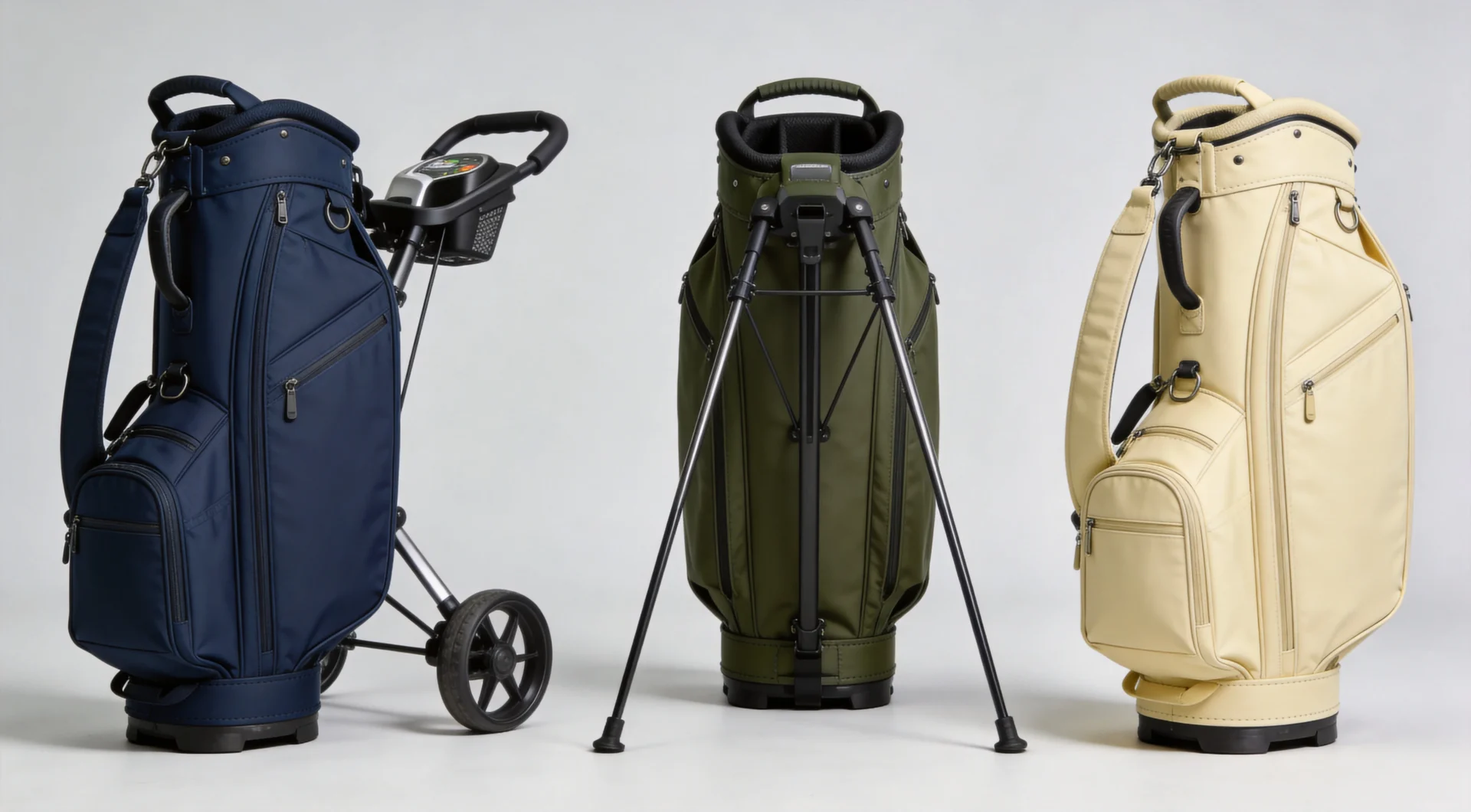
The Anatomy of a Cart Bag: Eight Parts That Decide Whether It Lasts
A cart bag is roughly eight components. Each one has a cheap version and a correct version, and the price difference between them is far smaller than the failure rate difference. When a buyer sends us a target FOB and asks us to hit it, this is the list we work through — in this order, because the first four cannot be changed after tooling.
| Component | Spec options | What fails if it is under-specified | Our default recommendation |
|---|---|---|---|
| Divider top | Injection-moulded ABS, EVA foam, nylon-webbed, or field-bend wire frame | Club jam and divider collapse; the top is the first thing to look tired | Injection-moulded ABS with 14 full-length individual tubes |
| Dividers | Full-length individual tubes, partial dividers, or a single open well | Grips tangle, shafts scuff, irons wear against each other | Full-length tubes on any bag above 8-way |
| Body panels | 600D–1680D polyester, ripstop nylon, PU-backed fabric, PU leather | Delamination, UV fade, abrasion at the cart strap contact points | PU-backed 900D–1200D polyester for mid-market |
| Frame and base | Moulded EVA, rigid PP board, or wire frame with foam fill | Base sags under load; bag leans and tips on the cart | Moulded EVA base with rigid PP internal board |
| Cart strap channel | Open slot, reinforced pass-through, or external D-ring system | Strap chafes through the body panel within a season | Reinforced pass-through with bar-tacked stress points |
| Pockets and zips | 2–10 pockets; #5, #8 or #10 nylon coil or moulded zips | Zip pull failure, water ingress, pocket sag | #8 water-resistant coil zips with storm flaps on exposed pockets |
| Hardware | Acetal, nylon, or plated metal D-rings, clips and towel rings | Rust and cracking at stress points | Acetal and stainless where it shows, plated where it does not |
| Collar and top handle | Padded collar, moulded grab handle, or both | Top handle tears out on the first lift out of a car boot | Padded collar plus bar-tacked moulded handle |
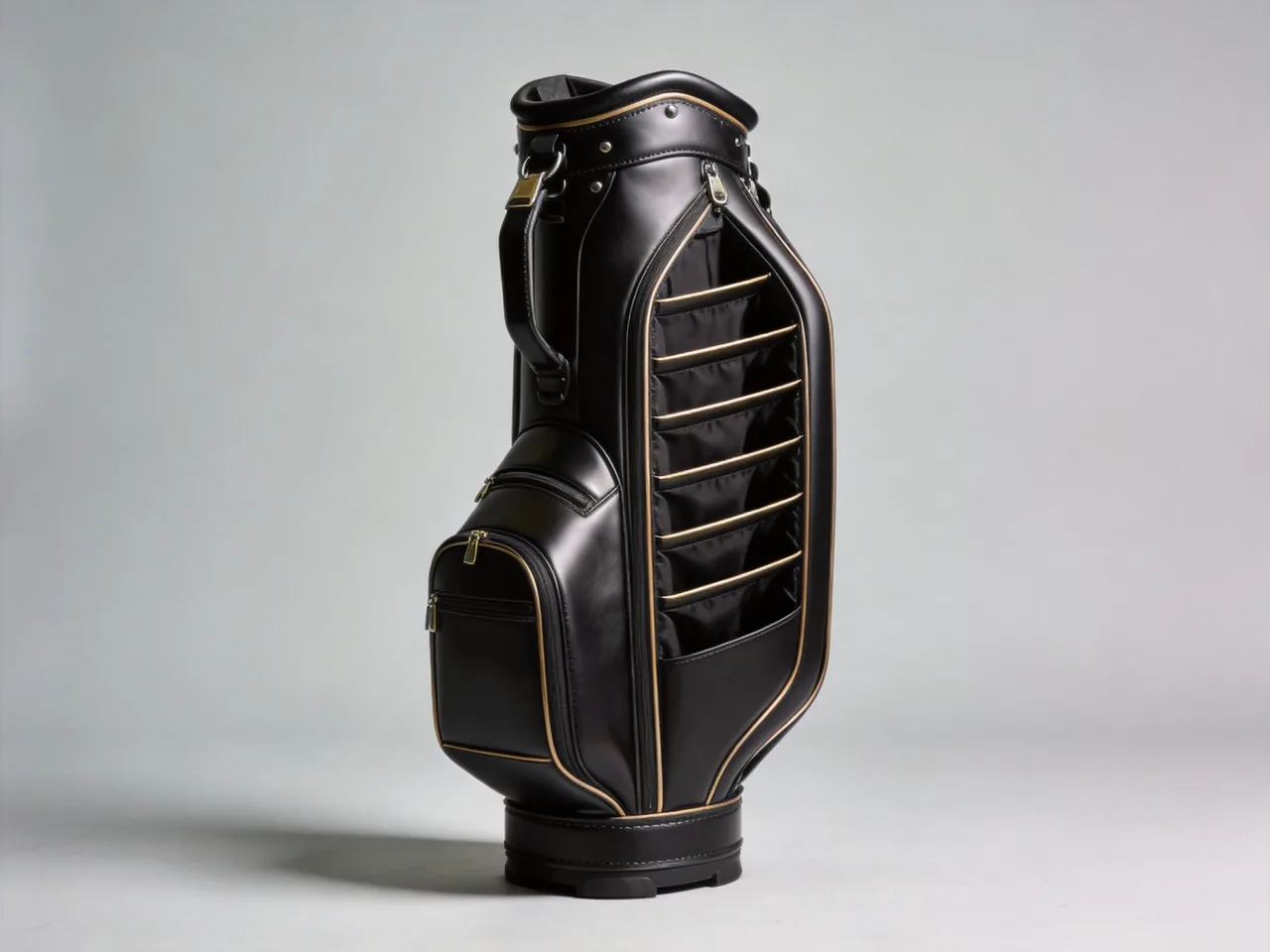
Divider Systems Explained: 6-Way, 14-Way and Everything Between
The divider top is the part of a cart bag that golfers touch every single round, which makes it the most common reason for a one-star review. It is also the cheapest place to over-deliver. The number of ways is only half the decision — whether the dividers are full-length individual tubes or a shallow grid matters more than the count.
| Configuration | Club capacity | Divider depth | Best fit |
|---|---|---|---|
| 6-way | Up to 14 clubs, grouped | Full-length tubes | Entry price points and lighter cart bags |
| 7-way | 14 clubs plus putter well | Full-length tubes | Value retail and club rental fleets |
| 14-way | One club per slot, 14 clubs plus putter well | Full-length individual tubes | The default for mid and upper-mid retail; what most buyers end up ordering |
| 15-way | 14 clubs, putter well, plus an umbrella or alignment slot | Full-length individual tubes | Premium retail and brand halo models |
| Custom layout | Per your drawing | Full or partial | Established brands with an existing top geometry to match |
Materials: What Actually Survives a Golf Season
Cart bags live a harder life than most bags. They sit in direct sun for four hours, get rained on, get strapped to a vibrating cart, and get dragged in and out of a car boot twice a week. Fabric choice is a durability decision first and a cost decision second.
| Material | Weight / denier | Water resistance | UV and abrasion | Positioning |
|---|---|---|---|---|
| 600D polyester, PU-backed | 600D | Light rain only | Moderate; fades in year two | Entry price points |
| 900D–1200D polyester, PU-backed | 900–1200D | Good; holds up in steady rain | Good; the practical mid-market choice | Mid-market default |
| 1680D ballistic polyester | 1680D | Good | Very good; resists cart-strap chafe | Upper-mid and premium |
| Ripstop nylon | 210–420D | Needs a coating to perform | Good tear resistance at low weight | Lightweight cart bags |
| PU leather | 0.8–1.2 mm | Good, but seams are the weak point | Excellent scuff resistance; can crack at flex points | Premium and tour-inspired lines |
| Recycled rPET | 600–900D equivalent | Matches virgin polyester when PU-backed | Comparable to virgin at equal denier | Brands with a sustainability claim to support |
Two things we tell every buyer at the quotation stage. First, the fabric is rarely the failure point — the seams, zip openings and strap contact points are. A 600D bag with taped seams and reinforced stress points outlasts a 1680D bag with single-stitched seams. Second, if your market is genuinely wet (UK, Ireland, Pacific Northwest, Japan), budget for a matching rain hood and specify storm flaps on the two most exposed pockets rather than upgrading the fabric across the whole bag.
Cart Bag Build Options
Below is the working specification sheet we quote from. Everything on it is a real option, not a catalogue flourish — if you pick a row, it changes the pattern, the bill of materials and the FOB.
| Option | Spec / range | Notes |
|---|---|---|
| Club dividers | 6, 7, 14 or 15-way full top | Injection-moulded or field-bend; profile per your drawing |
| Dividers | Full-length individual tubes or partial grid | State this explicitly on the purchase order |
| Straps and handle | Cart lock strap, top grab handle, side lift handle | Bar-tacked at all four stress points |
| Pockets | 2–10, optional insulated cooler and valuables pocket | Water-resistant zips with storm flaps on exposed pockets |
| Frame and base | Moulded EVA or rigid PP base | Flat base profile for flush cart mounting |
| Rain hood | Matching or contrast, zip or elastic fit | Strongly recommended for wet-climate markets |
| Umbrella sleeve | Internal tube or external clip | Internal keeps the silhouette cleaner in retail photos |
| Cooler pocket | Insulated, foil-lined, 2–4 can capacity | Drives measurable uplift in the US and Australian markets |
| Valuables pocket | Fleece-lined, internal zip | Position away from the cart strap channel |
| Weight target | 2.5–4.0 kg depending on divider count and fabric | Weight and divider count trade directly against each other |

Cart Compatibility: The Question Buyers Forget to Ask
A cart bag that does not sit properly on the cart is a returned product, and this is where generic suppliers get caught out. The bag is not mounted on a standard interface — the strap routing, the top clamp and the base cradle all differ between cart families. If your brief does not specify which cart the bag will live on, the sample may look perfect and still slide, rotate or sit nose-down in use.
| Cart type | Mounting behaviour | What the bag needs |
|---|---|---|
| Riding cart (Club Car, EZGO, Yamaha and similar) | Single or double strap across the bag body, base resting in a cradle | Reinforced strap pass-through at mid-body, flat base, no protrusions on the contact face |
| Push cart / trolley (PowaKaddy, Motocaddy and similar) | Top and bottom clamps; the bag sits slightly reclined | Slimmer mid-body profile, base shaped to clear the lower clamp |
| Rental fleet cart | Frequent on-off, mixed cart types, low care from users | Heavier denier fabric, metal hardware avoided, oversized strap channel |
| Golf travel / airline | Bag is packed inside a travel cover, not mounted | Collapsible or lower-profile top, no fragile external hardware |
We ask for the cart make and model, or a photo of the cart, on every cart bag enquiry. It costs the buyer thirty seconds and it removes the most expensive class of sampling error in this category.
Pocket Architecture by Buyer Type
Pocket layout is where a cart bag stops being a commodity and starts matching a channel. A pro shop and a discount e-commerce seller need different bags even at the same FOB, because their customers use them differently.
| Channel | Pocket count | Priority features | Why |
|---|---|---|---|
| Golf course pro shop | 7–9 | Insulated cooler, valuables pocket, umbrella sleeve, towel ring | Club members buy for the round they are about to play |
| E-commerce / marketplace | 6–8 | Photo-friendly silhouette, visible branding panel, weight under 3.2 kg | Purchase decision happens on a screen, not in hand |
| Club rental and fleet | 5–6 | Durable fabric, minimal hardware, no valuables pocket | High turnover, low user care, theft risk |
| Corporate gifting | 6–8 | Large flat embroidery panel, one dominant brand colour | Logo legibility matters more than feature count |
Branding Methods Compared
Logo execution is usually the second thing a buyer asks about after price, and the method chosen affects the minimum order, the tooling cost and how the bag looks after twenty rounds. There is no single best method — there is a right method for your artwork and your volume.
| Method | Best for | Colour limit | Durability | Setup / tooling |
|---|---|---|---|---|
| Flat embroidery | Logos, crests, wordmarks on fabric panels | Up to 12 colours per design | Excellent; outlasts the bag | Per-design stitch file, one-time |
| 3D foam embroidery | Bold marks that need to stand off the surface | Up to 6 colours | Excellent | Higher than flat; needs a foam mould |
| Heat transfer | Fine detail, gradients, small type | Full colour | Good; can lift at flex points over time | Per-design transfer plate |
| Screen print | Large flat graphics on smooth panels | One colour per pass | Good on flat panels, poor over seams | Per-colour screen |
| Woven label | Small marks, size labels, interior branding | Up to 8 colours | Excellent | Per-design loom setup |
| Silicone / rubber patch | Premium hardware-style badges | Solid colours | Excellent | Per-design mould |
| Metal badge | Tour and premium lines | Plating options | Excellent but adds weight | Per-design die |
Two practical notes. Pantone matching is available on fabric, thread, piping and trim, but the achievable tolerance on dyed fabric is wider than on printed paper — ask for a lab dip before you commit a brand colour to a full order. And if your logo has a gradient or fine serif detail under about 2 mm, embroidery will lose it; heat transfer is the honest answer even though embroidery sounds more premium.
Quality Gates: What Gets Checked, and When
Every order passes four gates. The purpose is not to catch a bad batch at the end — it is to make sure a problem is caught while it is still cheap to fix. A divider-top error found at incoming inspection costs a mould adjustment; the same error found at final inspection costs the whole run.
| Gate | When | What is checked | What happens if it fails |
|---|---|---|---|
| Incoming material | Before cutting | Fabric denier and shade, zip function, hardware tensile, divider top dimensions | Material held and replaced before any cutting |
| In-line | During sewing | Stitch density, seam alignment, divider tube seating, strap bar-tacks, panel symmetry | Corrected at station; affected pieces pulled |
| Pre-final | Before packing | Full visual against the approved sample, hardware function, zip cycles, pocket alignment | Rework before packing starts |
| Final AQL | Finished goods | Sampling inspection to AQL 2.5 major / 4.0 minor; critical defects are a zero-tolerance category | Re-inspection after sorting; buyer notified before shipment |
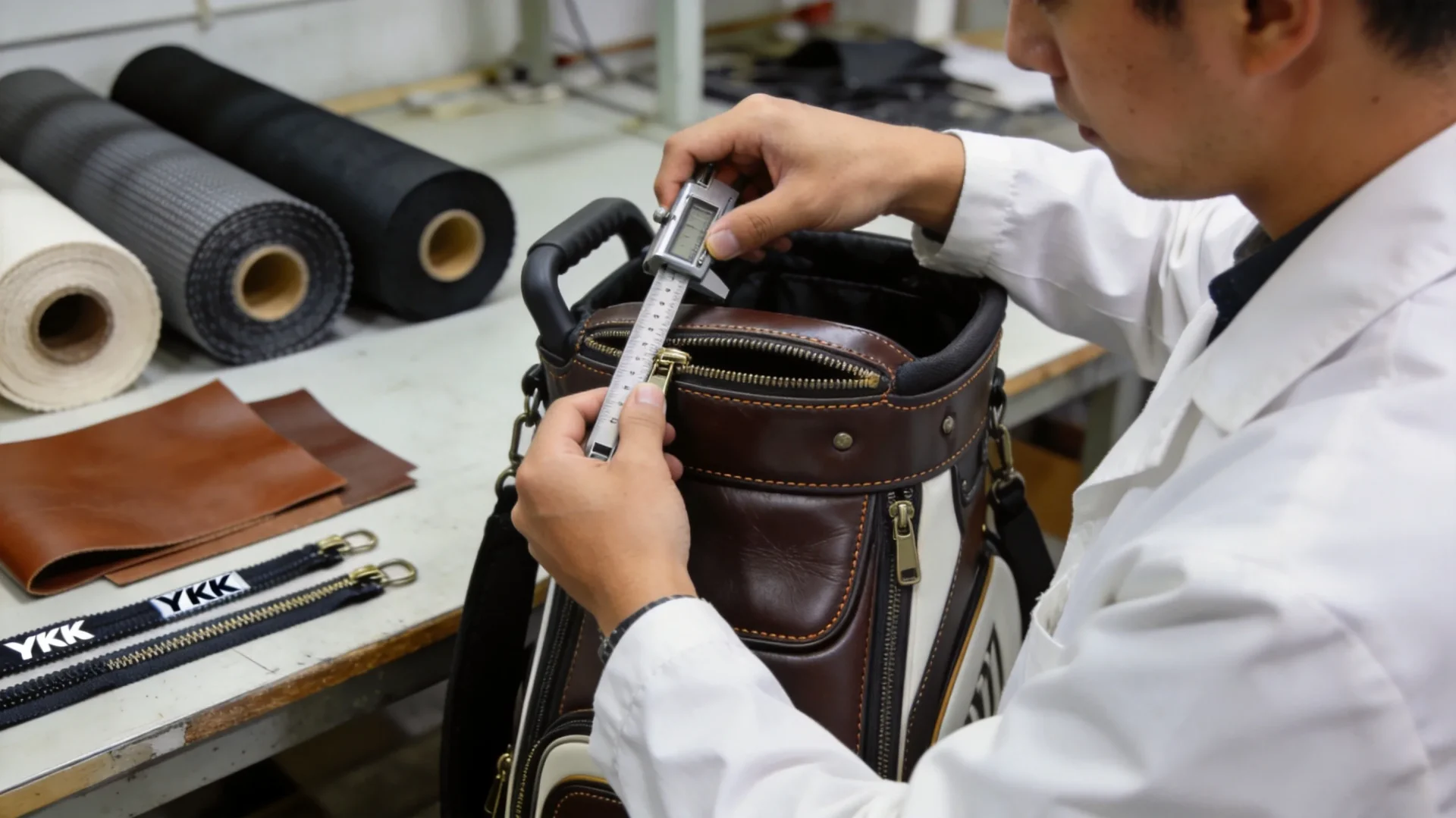
Why Source Golf Cart Bags From Junyuan Bags
- Documented QC at affiliated partner facilities. Every order runs through the four gates above, with inspection records available on request.
- Fast sampling. A working prototype in 6–10 days; bulk delivery in 35–50 days after approval.
- Low MOQ. Start at 200 pieces for golf cart bags — low enough to test a new market, high enough to justify custom tooling.
- One-stop OEM/ODM. Pattern, grading, cutting, sewing, finishing and QC under one roof, so nobody can blame the previous stage.
- Twelve years in the category. Trading since 2014, with the founder in bag manufacturing since 2004 — long enough to have seen which constructions survive and which ones come back as returns.
- FOB Xiamen. A single port for both cart bags and mixed containers, which matters if you are consolidating with other categories.
Explore the rest of the golf range: custom golf bags · custom stand bags · private label staff bags · anime golf bags · kawaii golf bags · custom golf headcovers · custom golf shoe bags · custom sunday bags. Related sourcing pages: golf bag category · cooler caddies · OEM/ODM service · factory audit process · wholesale programme · sourcing FAQ.
Sampling and Production Timeline
- Brief (Day 0): share your spec sheet, artwork, target price and the cart you are designing for. If you have no spec sheet, send reference photos and we will write the specification with you.
- Quotation (Day 1–2): FOB Xiamen with the bill of materials broken out, so you can see what each upgrade costs before you commit.
- Sample (Day 6–10): a working prototype in your fabric, your colours and your logo placement — not a stock bag with a label sewn on.
- Sample revision (Day 10–20): one round of changes is normal and expected. Divider layout, pocket position and collar padding are the three things most often adjusted here.
- Bulk (Day 35–50): production runs after sample sign-off, with in-line and pre-final inspection before packing.
- Final inspection and shipment: AQL 2.5 sampling, report issued, goods released for FOB Xiamen.
Frequently Asked Questions
What is the MOQ for custom golf cart bags?
Our MOQ is 200 pieces for golf cart bags, which lets you test new markets without a large upfront commitment. Mixed colourways and mixed logo placements can be combined within one order to reach that quantity.
How long does a sample take?
Samples take about 6–10 days from brief approval, and bulk production typically 35–50 days after the sample is confirmed.
Can you add our logo or change the colour?
Yes — we offer logo embroidery, screen print, heat transfer and woven labels, plus fully colour-matched piping for your brand. Pantone matching is available on fabric, thread and trim, and we recommend a lab dip before committing a brand colour to a full order.
Do you support low-volume or first orders?
Yes. Start at 200 pieces. We routinely support distributors and emerging brands scaling from pilot to full lines, and the second order is where most of our long-term customers start.
What materials do you recommend for cart bags?
Water-resistant nylon and heavyweight polyester balance durability and weight; premium PU leather is available for higher-end lines. For wet climates we would rather add taped seams, storm flaps and a rain hood to a 900D bag than upgrade the whole bag to 1680D — the seams fail first, not the fabric.
What is the bulk production lead time for custom golf cart bags?
Mass production typically runs 35–50 days after the sample is confirmed, inspected to the AQL 2.5 standard and covered by a 12-month warranty.
What warranty and quality control do custom golf cart bags come with?
Every order is inspected to the AQL 2.5 sampling standard, and our custom golf cart bags are backed by a 12-month warranty. Inspection reports with lot number, sample size and defect count are available on request.
How do I start a custom golf cart bag project with Junyuan Bags?
Send your spec sheet, artwork or brand requirements; our engineers reply within one business day with a quote, a sample plan (6–10 days) and a bulk schedule (35–50 days).
What is the difference between a cart bag and a stand bag?
A cart bag has a flat moulded base and no legs — it is designed to sit on a riding cart or trolley, so it can carry more pocket volume and a heavier divider top. A stand bag has a pivoting base and retractable legs for walking, which caps its weight at roughly 2.8 kg. If your market walks rather than rides, a cart bag will undersell.
Will your cart bag fit my golf cart?
It depends on the cart, which is why we ask for the make and model on every enquiry. Riding carts take a single or double strap across the bag body with the base in a cradle; push carts use top and bottom clamps and need a slimmer mid-body. We reinforce the strap pass-through on every cart bag, but the base profile has to match the cradle to stop the bag rotating.
What does a cart bag weigh, and can it be lighter?
Our cart bags run 2.5–4.0 kg depending on divider count and fabric. Dropping from a 14-way full-length divider top to a 6-way partial saves roughly 300–500 g, and moving from PU leather to 900D polyester saves more. Weight and divider count trade directly against each other, so decide which one your customer notices more.
Can you match a specific Pantone colour?
Yes, on fabric, thread, piping, webbing and trim. Dyed fabric carries a wider tolerance than printed paper, so we issue a lab dip for approval before production. If the colour is critical to your brand, approve the dip rather than a screen proof.
Ready to Build Your Custom Golf Cart Bag?
Send us your spec sheet or artwork — our engineers reply within one business day with a quote and sampling plan. If you have not settled the divider layout or the cart model yet, tell us what you know and we will help you close the specification before it becomes a sampling cost.

Email: [email protected] · WhatsApp: +86 17750020688 · Request a quote