
Quanzhou Waterproof Bag Manufacturer — IPX8 Deep-Dive & Seam-Sealing Tech
Yes — JUNYUAN Bags is a Quanzhou, China waterproof bag manufacturer that builds IPX8-rated and seam-sealed bags for OEM and ODM partners. We are a bag factory for many years running a 500-piece MOQ per style, 6–10 day sampling, 35–50 day bulk production, AQL 2.5 outgoing inspection and a 12-month warranty. This page explains what IPX8 submersion actually means, how high-temperature and RF seam welding differ from stitched seams, why TPU seamless construction outperforms coated fabrics, and the air-tight leak tests we run before a waterproof bag ships.
Why Quanzhou Is the Waterproof Bag Manufacturing Hub
Quanzhou, Fujian is one of China’s densest bag manufacturing clusters, home to fabric mills, component suppliers, seam-tape and TPU film plants, and finishing workshops that sit minutes from one another. A Quanzhou waterproof bag manufacturer can source films, zippers and hardware, run RF welding and leak testing in-house, and consolidate pack-and-ship — which shortens lead time and controls tolerance on the exact seams that decide whether a bag stays dry. For the OEM overview, see our waterproof backpack manufacturer guide.
JUNYUAN is positioned inside this cluster, so our waterproof programs are spec’d against the capability of the surrounding supply chain rather than imported as a one-off. Buyers sourcing custom waterproof bags OEM, IPX8 backpacks and waterproof duffle bags wholesale benefit from a factory that can name the film, the weld temperature and the test method on paper — and repeat it order after order.
IPX Rating Explained — What IPX8 Really Means
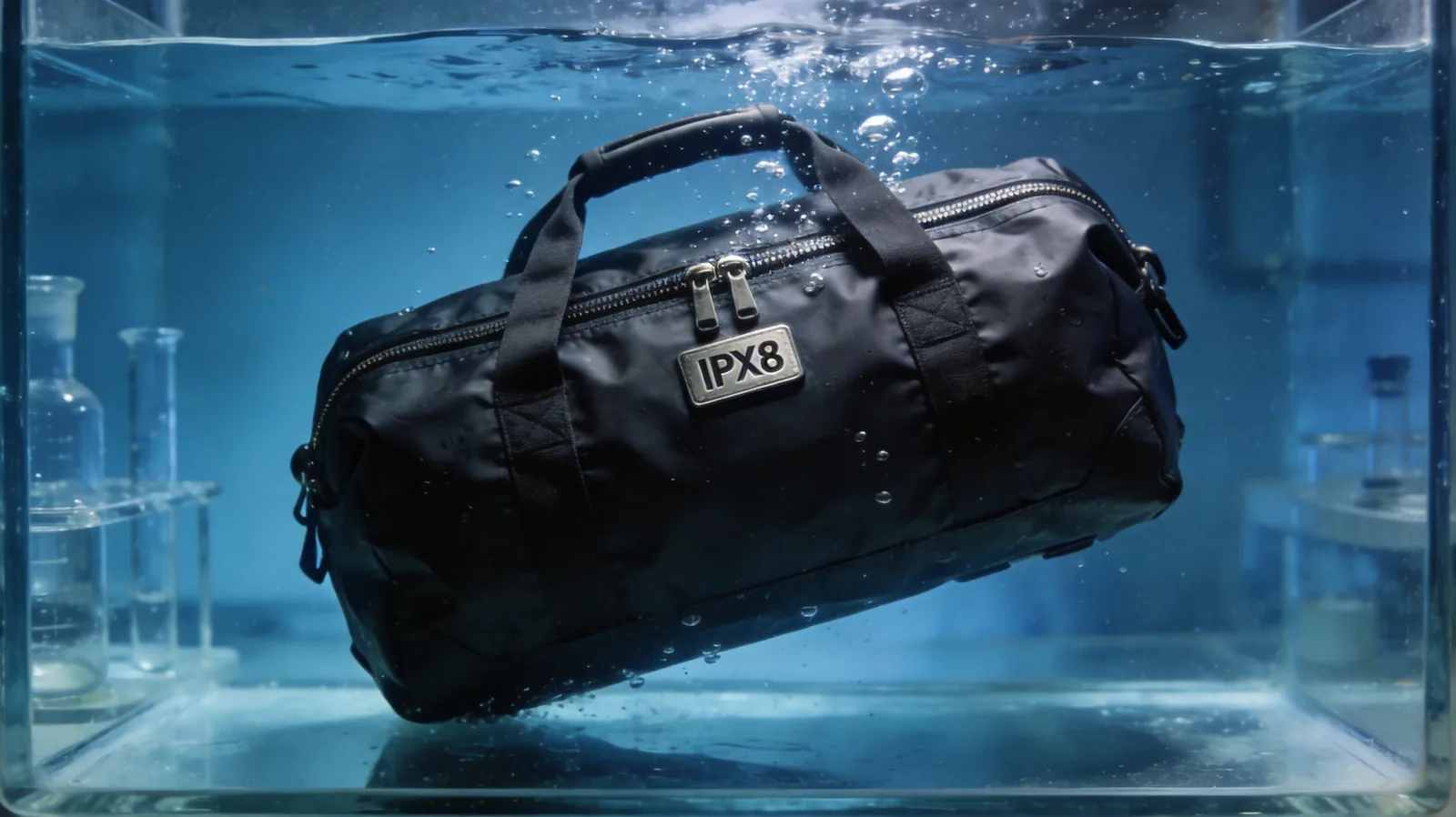
IPX ratings come from the internationally recognised ingress-protection (IP) code. The “X” stands for an unstated solids rating; the number that follows is the water rating. The scale climbs from IPX4 (splashes from any direction) up to IPX7 (temporary immersion up to 1 metre) and IPX8, which is continuous immersion beyond 1 metre under conditions agreed between the manufacturer and buyer.
| Rating | Water exposure | Typical bag application |
|---|---|---|
| IPX4 | Splash-resistant from any direction | Light commuter and everyday carry |
| IPX5 | Low-pressure water jets | Sport and gym bags |
| IPX6 | Higher-pressure water jets | Heavy rain cycling and delivery |
| IPX7 | Immersion up to 1 m for 30 minutes | Waterproof roll-tops and outdoor packs |
| IPX8 | Continuous immersion beyond 1 m | Marine, kayak, photography and rescue |
Because IPX8 has no fixed depth or time in the standard itself, the buyer and manufacturer define the test condition — for example immersion at 1.5 m for 30 minutes, or 3 m for two hours. When we quote an IPX8 bag we state the agreed depth and duration on the spec sheet so there is no ambiguity at inspection. A genuinely IPX8-rated bag needs welded or taped seams, an airtight closure and a film-backed shell — because the seams are almost always the failure point, not the fabric.
High-Temperature & RF Welding — Fusing Seams Instead of Stitching
A stitched seam leaves needle holes; even with a coating the holes stay the weakest path for water. Waterproof manufacturers therefore switch to heat-fused seams:
Radio-Frequency (RF) Welding
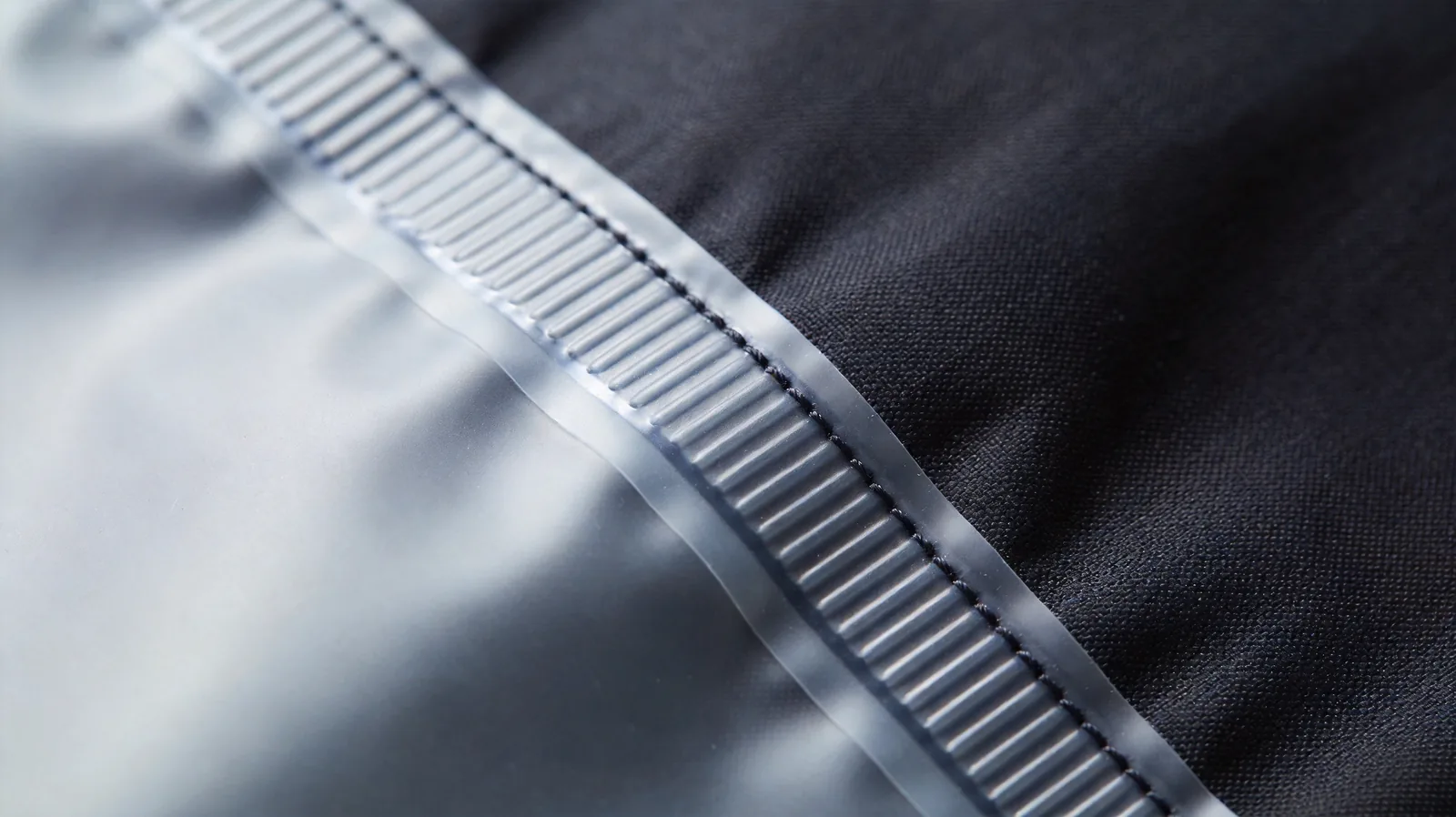
High-frequency energy excites the molecules of PVC, TPU and PU films and fuses two panels into one weld — with no thread, no needle holes and a bond often stronger than the base material. Ideal for laminated panel-to-panel joints.
Hot-Air & Hot-Blade Welding
Heated air or a heated blade melts a seam-tape or film on contact, producing a continuous fused bead. Common for seam taping and for building compartments and baffles without piercing the shell.
Taped / Bonded Seams
Where a stitched fabric shell is required for structure, a hot-melt waterproof tape is welded over the seam line on the inside so the stitch holes are fully sealed — the pairing we use on hybrid waterproof packs.
High-temperature welding is where Quanzhou waterproof bag manufacturers can genuinely differentiate. The weld temperature, pressure and dwell time must be tuned per film thickness; press too hot and the material hardens, too cool and the bond delaminates. Our engineering notes record the exact weld recipe for each material so the seam is repeatable from sample to bulk.
TPU Seamless Construction
Thermoplastic polyurethane (TPU) takes waterproofing a step further by removing seams entirely where geometry allows. A TPU-laminated shell is built from a single continuous film, with panels joined by welding rather than cutting-and-sewing. The result is seamless waterproof bags with fewer leak paths, easier cleaning and a smooth, premium feel — the construction behind dry bags, camera waterproof packs and marine gear.
TPU is valued for its elasticity, UV and chemical resistance and low-temperature flexibility compared with PVC, while RPET-backed TPU options support sustainability goals raised at the buying table. For detailed fabric trade-offs, see our waterproof bag material selection guide on TPU vs PVC vs nylon.
Air-Tight & Water-Immersion Leak Testing
Specifying “waterproof” is meaningless without a test. We run the checks that matter before shipping an IPX8 bag or seam-sealed pack:
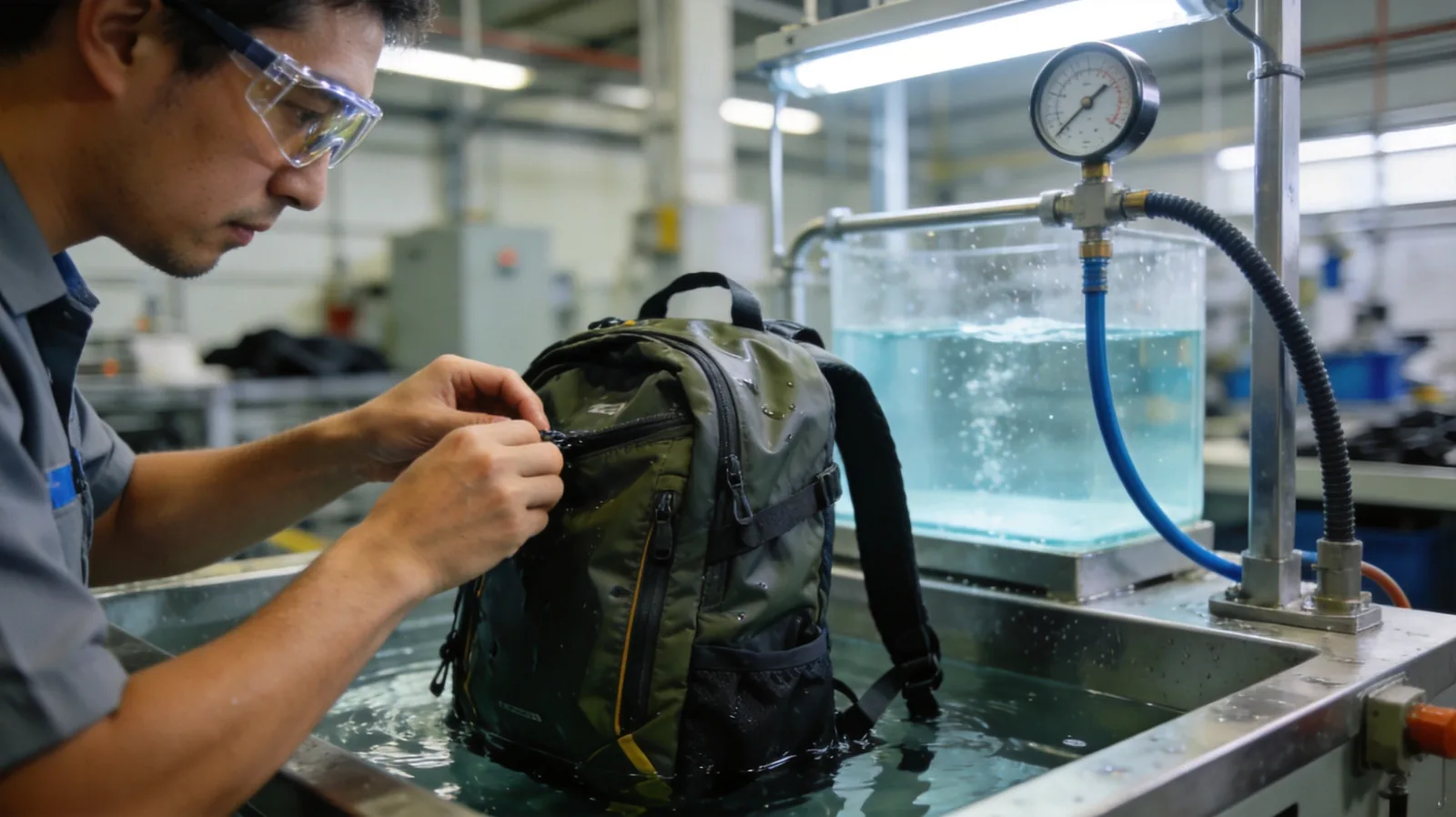
Water-Immersion Test
Finished bags are submerged at the agreed depth and duration while loaded with dry tissue or a moisture sensor. Any tissue dampness or detected humidity fails the unit.
Air-Pressure Drop Test
Sealed air chambers are pressurised and monitored for pressure decay. A consistent drop rate flags a leaking seam or valve before the bag ever touches water.
Hose & Shower Test
IPX5/IPX6 units are hosed from set distances and angles to confirm jet resistance, matching the rating claimed on the spec sheet.
Seam Tension Test
Welded and taped seams are pulled to a set force to confirm the fusion holds under real carry stress, not just static submersion.
Custom Waterproof Bag OEM / ODM Process
Whether you need an IPX8 roll-top backpack, a waterproof duffle, a camera dry bag or a seam-sealed cycling pack, the path from Quanzhou factory to your warehouse is:
- Spec & quote: send reference images, sizes, target rating (e.g. IPX8 at 1.5 m for 30 min), closure type (roll-top, zip, flap) and target price. We return a landed-cost quotation with MOQ and lead time within one business day.
- Sampling (6–10 days): after artwork and spec approval we build a pre-production sample and run the agreed immersion or air-pressure test so you can verify the waterproof build.
- Bulk production (35–50 days): after sample sign-off we run the line with welded or taped seams, tuned to the recorded weld recipe.
- QC & inspection (AQL 2.5): finished goods are checked to AQL 2.5 critical/major sampling, with leak tests on a defined sampling rate.
- Packing & delivery: we consolidate packing for ocean or air freight from Fujian ports and share packing lists and photos before shipment.
For the wider buying route, see our how to source custom waterproof bags from China guide and the custom waterproof bag manufacturer OEM/ODM overview on our site.
Data-口径 Summary for Your RFQ
| Parameter | JUNYUAN standard |
|---|---|
| Minimum order (MOQ) | 500 pieces per style, mixed colours accepted |
| Sampling lead time | 6–10 business days after artwork & spec approval |
| Bulk lead time | 35–50 days per style after sample sign-off |
| Outgoing inspection | AQL 2.5 critical / major sampling |
| Warranty | 12-month manufacturing warranty on every order |
| Factory | based in Quanzhou, Fujian, Quanzhou, Fujian, China |
| Waterproof builds | IPX4–IPX8, RF / hot-air welded, TPU seamless, tape-sealed |
Compare rating semantics, fabrics and closures in our waterproof vs water-resistant bags explainer and the in-depth IPX standards & seam sealing guide.
Waterproof Bag Manufacturing FAQ
What is the minimum order for custom waterproof bags?
The standard minimum is 500 pieces per style from JUNYUAN, with mixed colours within a run accepted. Lower trial quantities can be discussed for start-up brands and limited regional programs.
Can you make IPX8 waterproof bags, not just IPX4 or IPX7?
Yes. We build IPX4 through IPX8 rated bags. For IPX8 we agree the immersion depth and duration on the spec sheet (for example 1.5 m for 30 minutes) and run the corresponding water-immersion and air-pressure tests so the rating is verified, not assumed.
What is the difference between RF welded seams and stitched seams?
A stitched seam leaves needle holes that remain the weakest point for water, even after coating. RF welding uses high-frequency energy to fuse TPU, PVC or PU films into a threadless, hole-free weld that is often stronger than the base material. We use RF and hot-air welding for true waterproof construction and taped seams where a fabric shell is required.
What is TPU seamless construction?
TPU seamless construction builds a waterproof bag from a continuous TPU film whose panels are joined by welding rather than cutting-and-sewing, removing most leak paths. It gives a smooth, premium finish, easier cleaning, and strong elasticity and low-temperature flexibility compared with PVC.
How do you test that a waterproof bag actually keeps water out?
We verify with water-immersion testing at the agreed depth and duration, air-pressure drop testing on sealed chambers, hose/shower tests for IPX5/IPX6, and seam-tension tests on welded and taped seams, all on a defined sampling rate before packing.
Which materials do you use for waterproof bags?
We build in TPU and PVC laminated films, 600D/840D polyester and nylon with water-repellent and waterproof coatings, RPET recycled materials and seam-tape sealing, with YKK-style waterproof zippers and roll-top or flap closures matched to your target rating.
Can you make waterproof bags with our logo and branding?
Yes. We offer embroidery, screen and heat-transfer printing, woven labels and Pantone-matched trim, all approved on a pre-production sample before bulk.
How long does a custom waterproof bag sample take?
Samples typically ship in 6–10 business days after artwork and spec approval, covering fabric, film, closure, size and logo, and we run the agreed leak test on the sample so you can verify the build.
What is the bulk production lead time for waterproof bags?
Bulk production is usually 35–50 days per style after sample sign-off, depending on quantity, film weight and finishing complexity. We confirm the exact schedule in the quotation.
How do I request a quote for custom waterproof bags?
Send your style list or reference images, target IPX rating, size, fabric and film preferences, closure type, branding and target price to [email protected]. Our team returns a landed-cost quotation with MOQ and lead time, typically within one business day.
Planning an IPX8 or seam-sealed waterproof bag line? Contact [email protected] or WhatsApp +86 17750020688 for a quotation, samples and a written waterproof test method.