The PACT Framework is changing how businesses measure and share carbon emissions in their supply chains. Here’s what you need to know:
- What It Does: PACT standardizes the calculation and sharing of Product Carbon Footprints (PCFs), focusing on accurate, supplier-specific data instead of broad estimates.
- How It Works: Using a secure Data Exchange Protocol, it enables automated, detailed data sharing across supply chains, reducing inefficiencies and inconsistencies.
- Who’s Using It: Over 2,500 businesses and 48+ software solutions are already participating, with mandatory third-party verification starting in 2025.
- Why It Matters: Scope 3 emissions often account for over 90% of a company’s carbon footprint. PACT helps identify emission hotspots and align with global regulations like the EU’s CSRD and California’s climate rules.
Key Takeaway: PACT bridges the gap between existing standards (like the GHG Protocol) and the need for automated, product-level carbon data sharing. It’s a step forward for companies aiming to reduce emissions and meet regulatory requirements.
1. PACT Framework

Standardization of Scope 3 Data
The PACT framework offers a clear and structured method for calculating and sharing Product Carbon Footprints (PCFs), addressing inconsistencies in reporting. Operating within a "cradle-to-gate" boundary, it emphasizes accuracy by prioritizing supplier-specific primary data over generic industry averages. This shift is significant, as verified primary data has shown to produce emission footprints that differ by 37% compared to secondary data. Given that Scope 3 emissions often account for more than 90% of a company’s total carbon footprint, this focus on precision is critical. Currently, over 2,500 businesses are involved in pilot programs, exchanging more than 4,500 PCFs. These standardized methodologies pave the way for smoother integration into modern supply chain systems.
Integration with Supply Chain Systems
PACT’s technical infrastructure is designed to simplify data exchange across various platforms. By introducing common APIs and a standardized data model, it ensures that carbon accounting and supply chain systems can communicate effectively. Over 30 technology solutions now conform to the PACT framework, enhancing its utility. For instance, in November 2023, the traceability company OPTEL achieved full compliance with PACT by embedding automated PCF calculations into its Optchain™ platform. This innovation significantly reduces administrative work for suppliers. Additionally, PACT’s governance framework allows organizations to maintain control over how their data is shared. This technical consistency strengthens its alignment with regulatory standards.
Alignment with Regulatory Requirements
The PACT framework aligns with the GHG Protocol Corporate Value Chain (Scope 3) Standard, ensuring compatibility with major global reporting mandates. It supports adherence to the EU’s Corporate Sustainability Reporting Directive (CSRD), the Digital Product Passport (DPP), California’s climate disclosure rules (SB 253 and SB 261), and the International Sustainability Standards Board (ISSB) guidelines. This interoperability allows companies to use PACT data to meet multiple regulatory requirements at once. As Florent Bouguin, Chief Technology Officer at OPTEL, puts it:
"OPTEL’s compliance with the PACT framework provides a practical, efficient path for businesses to meet environmental regulations and manage their carbon footprint confidently."
Moreover, the framework is designed to be auditable and verifiable by third parties, with mandatory PCF verification set to begin in 2025.
Impact on Decarbonization Efforts
By focusing on product-level data, PACT enables companies to identify specific carbon hotspots within their supply chains, making targeted decarbonization strategies possible. In May 2023, eight major companies joined a PACT implementation program that involved over 900 suppliers and facilitated the exchange of more than 1,300 PCFs, showcasing its potential to drive supply chain transformation. Peter Spiller, Partner at McKinsey & Company, highlights this impact:
"Accurate tracking of carbon emissions across global value chains is a key unlock for carbon-data based business decision making and PACT… is at the heart of building the mechanisms to make this possible."
The framework also establishes a shared system for suppliers, making PCF calculations more accessible and scalable across a variety of supply chains.
2. Existing Carbon Accounting Standards (e.g., Greenhouse Gas Protocol, ISO Standards)
Standardization of Scope 3 Data
The Greenhouse Gas Protocol is widely regarded as the "gold standard" for carbon accounting. It defines Scope 3 emissions as all indirect emissions that occur both upstream and downstream in a company’s value chain. While standards like ISO 14067 and the GHG Protocol Product Life Cycle Standard lay the groundwork for calculating Product Carbon Footprints (PCFs), they lack the detailed specifications needed for automated, large-scale data sharing. Shifting from spend-based estimates to activity-based, supplier-specific data is essential to improve accuracy. This lack of granularity demonstrates the need for frameworks that combine methodological rigor with digital capabilities. Notably, supply chain emissions often exceed a company’s direct emissions (Scope 1 and 2) by a factor of 5 to 25.
Integration with Supply Chain Systems
Technical integration poses another significant challenge in carbon accounting. The integration challenge refers to the difficulty of seamlessly sharing and incorporating data across different technological platforms . Current standards often fall short in providing the technical details required for automated data exchange, leading to inconsistent practices across industries. This inconsistency makes it harder for companies to collect granular, primary data at scale. Christoph Jaekel, VP Corporate Sustainability at BASF, emphasizes the importance of collaboration:
"In essence, industries will need to align on shared methodologies and manufacturers will need to embrace the principle to share their product carbon footprint data with their partners along the value chain."
Alignment with Regulatory Requirements
Existing standards form the backbone of mandatory carbon reporting worldwide. For instance, California’s climate disclosure rules require Scope 1, 2, and 3 emissions to be measured using the GHG Protocol Corporate Standard. Similarly, the European Union’s CSRD mandates comprehensive corporate carbon footprint disclosures under the European Sustainability Reporting Standards (ESRS). The International Sustainability Standards Board (ISSB) also aligns its requirements with the GHG Protocol. However, traditional frameworks often need additional tools to meet the demands of evolving regulations. In a step toward reducing fragmentation, the GHG Protocol and ISO announced in September 2025 a partnership to create a unified global standard for Scope 1, 2, and 3 emissions accounting. This collaboration aims to establish a cohesive global framework for emissions measurement.
| Regulation/Standard | Scope 3 Requirement | Alignment Basis |
|---|---|---|
| California Climate Rules | Mandatory | GHG Protocol Corporate Standard |
| EU CSRD (ESRS) | Mandatory | Full Corporate Carbon Footprint |
| ISSB Standards | Mandatory | GHG Protocol |
| US SEC Rules | Not Mandatory | Encouraged for Scopes 1 & 2 |
Impact on Decarbonization Efforts
The GHG Protocol Scope 3 Standard remains the only globally recognized method for companies to measure value chain emissions. It enables businesses to identify major emissions sources and establish science-based reduction targets. While these standards provide a solid foundation for methodology, they lack the technical specifications needed for modern supply chain decarbonization. Frameworks like PACT address this gap by enabling automated, product-level data sharing, which is essential for large-scale decarbonization efforts . This highlights the importance of combining established standards with emerging tools to achieve comprehensive supply chain emissions reductions.
This new PACT is helping companies fight Scope 3 emissions
sbb-itb-1e6451b
Pros and Cons
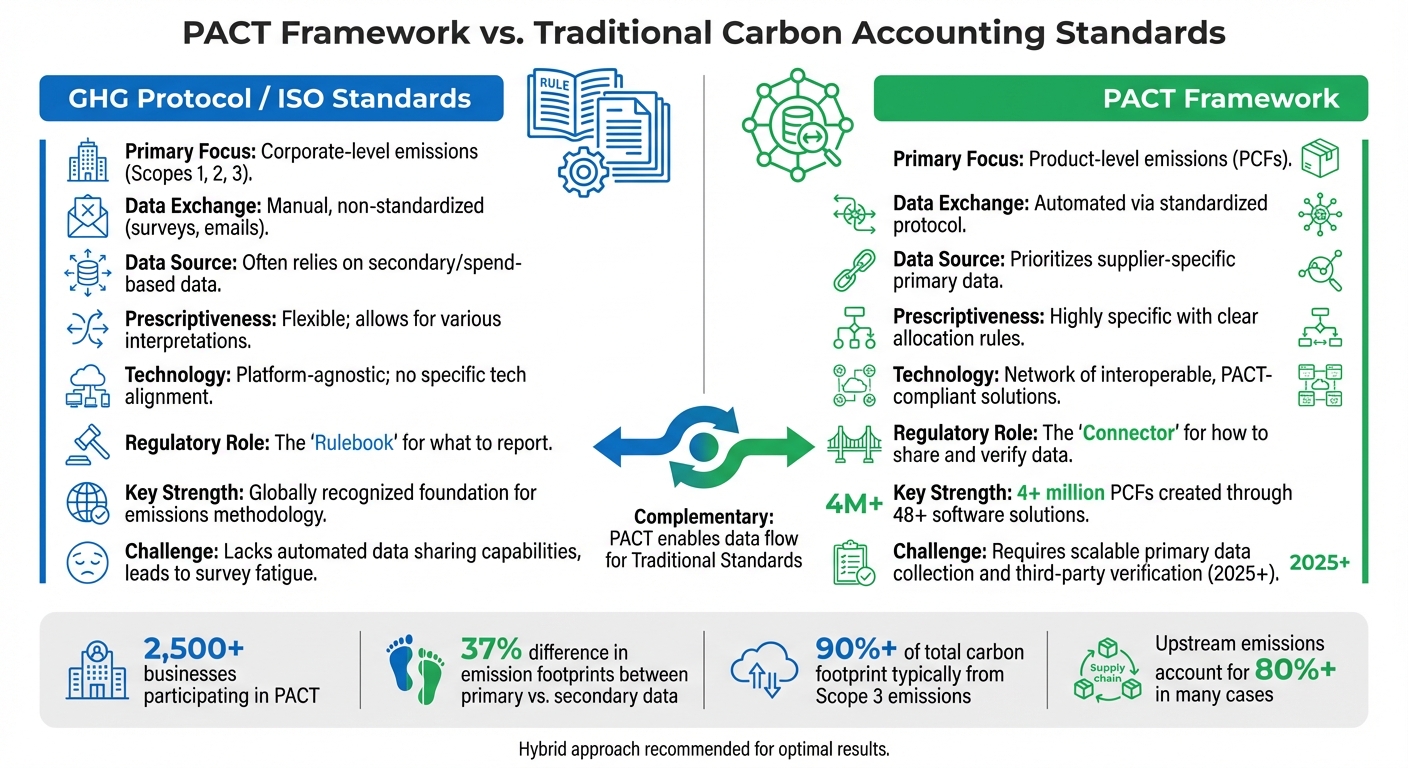
PACT Framework vs Traditional Carbon Accounting Standards Comparison
The PACT Framework and traditional carbon accounting standards each bring their own strengths and challenges to supply chain carbon reporting. Understanding these differences can help organizations decide which approach aligns best with their goals. This comparison also highlights how each system performs when applied to real-world reporting scenarios.
Standards like the GHG Protocol and ISO standards serve as the foundational "rulebook" for calculating emissions. These are globally recognized and underpin regulatory requirements, such as California’s climate disclosure rules and the EU’s Corporate Sustainability Reporting Directive (CSRD). However, they fall short when it comes to enabling automated data sharing. Companies often rely on manual methods, like spreadsheets and PDFs, which lead to inefficiencies. Suppliers frequently experience "survey fatigue" due to repetitive and inconsistent data requests, while sustainability teams spend more time collecting data than driving meaningful action.
The PACT Framework steps in to address these operational shortcomings by introducing a standardized Data Exchange Protocol. This enables automated, secure sharing of Product Carbon Footprints (PCFs) across various technology platforms. So far, the PACT ecosystem has facilitated the creation of over 4 million PCFs through 48+ software solutions. Unlike traditional standards, PACT emphasizes supplier-specific primary data over generalized industry averages. This level of detail allows companies like Unilever to integrate climate performance into purchasing decisions, treating carbon data as a core business priority rather than an afterthought.
However, PACT’s success hinges on scalable primary data collection. For many companies, secondary data still dominates, especially when upstream emissions account for a significant share of total emissions – over 80% in some cases. Additionally, the expected requirement for third-party verification starting in 2025 will add to resource demands. Despite its automated capabilities, sustainability teams still need to manually review incoming data to catch potential discrepancies.
| Feature | GHG Protocol / ISO Standards | PACT Framework |
|---|---|---|
| Primary Focus | Corporate-level emissions (Scopes 1, 2, 3) | Product-level emissions (PCFs) |
| Data Exchange | Manual, non-standardized (surveys, emails) | Automated via standardized protocol |
| Data Source | Often relies on secondary/spend-based data | Prioritizes supplier-specific primary data |
| Prescriptiveness | Flexible; allows for various interpretations | Highly specific with clear allocation rules |
| Technology | Platform-agnostic; no specific tech alignment | Network of interoperable, PACT-compliant solutions |
| Regulatory Role | The "Rulebook" for what to report | The "Connector" for how to share and verify data |
Given these differences, a hybrid approach appears to be the most effective strategy.
Conclusion
PACT is reshaping how companies track and share Scope 3 emissions data. While established standards like the GHG Protocol and ISO outline what to measure, PACT provides the infrastructure needed for seamless data exchange. With participation from over 2,500 companies and support from more than 30 conformant software solutions, the framework has already demonstrated its ability to scale beyond initial pilot programs.
However, technical advancements alone aren’t enough. To fully leverage PACT, organizations need leadership commitment and the integration of climate-focused KPIs into procurement processes. As Naama Avni-Kadosh, Director of PACT at WBCSD, emphasizes:
"Data transparency is vital, but it becomes transformative only when buyers and suppliers tackle decarbonization side-by-side".
This perspective shifts the role of carbon data from a compliance exercise to a strategic tool that influences purchasing decisions and strengthens supplier relationships.
The release of PACT Methodology V3 on April 30, 2025, marks a significant step forward. It introduces consistent rules for new Product Carbon Footprint (PCF) calculations and encourages organizations to categorize suppliers into groups such as "Innovation", "Intervention", "Compliance", and "De-prioritized" based on their maturity levels. This targeted approach is essential given that Scope 3 emissions often exceed 90% of a company’s total carbon footprint. It reflects a broader evolution – from simply meeting compliance requirements to taking strategic, impactful action.
Looking ahead, success lies in combining PACT’s automated data-sharing capabilities with the credibility of established frameworks. By embedding product-level carbon footprints into standard contracting processes and exploring tools like green-premium offtake agreements, companies can drive meaningful decarbonization across their value chains.
Ultimately, progress depends on moving beyond data collection to collaborative action. While PACT provides the technical backbone for sharing information, real emissions reductions demand strong partnerships between buyers and suppliers, supported by clear incentives and shared accountability.
FAQs
How does the PACT Framework help ensure accurate carbon footprint reporting in supply chains?
The PACT Framework improves carbon footprint reporting by adopting a standardized, product-specific method. It emphasizes the use of primary data, applies rigorous data reliability standards, and mandates third-party verification to uphold the credibility of emissions information.
This focus on verified, detailed emissions data enables businesses to share consistent and reliable information throughout their supply chains. As a result, carbon reporting becomes more straightforward, fostering greater clarity and openness.
Why is supplier-specific primary data important in the PACT Framework?
Using detailed, supplier-specific data allows for more precise and clear product-level carbon footprint calculations, which improves the dependability of Scope 3 emissions reporting. This method minimizes data inaccuracies, makes it easier to meet environmental regulations, and encourages closer partnerships throughout the supply chain.
When businesses rely on accurate supplier data, they gain a clearer picture of their carbon footprint, enabling smarter, more effective strategies to cut emissions.
How does the PACT Framework support compliance with global carbon reporting standards?
The PACT Framework is built to integrate smoothly with globally recognized carbon accounting standards. These include the GHG Protocol (with its Scope 3 guidance), ISO 14067 for calculating carbon footprints at the product level, and the EU Product Environmental Footprint (PEF). By adhering to these standards, the carbon data generated through PACT is not only technically sound but also ready for use in regulatory disclosures like the EU’s CSRD or the U.S. SEC climate-risk reporting rules.
As a neutral, not-for-profit initiative, PACT was co-developed by the World Business Council for Sustainable Development (WBCSD) and the GHG Protocol. This collaboration ensures a reliable, globally recognized approach for calculating emissions. For suppliers such as JUNYUAN BAGS, using PACT simplifies the process of determining and verifying product-level emissions. It also helps them meet both regulatory requirements and buyer demands for accurate Scope 3 data in corporate sustainability reporting.



 モバイル/What's App/Wechat
 Eメール
Eメール 追加
追加