Custom bags are a top-performing category on Kickstarter, offering profit margins of 40%-80% while doubling as mobile advertising for your brand. This guide simplifies the process of creating a custom bag campaign, highlighting steps like defining your audience, choosing materials, and managing production with manufacturers like JUNYUAN BAGS. Key takeaways include:
- Start with a user persona: Understand your backers’ needs (e.g., students, professionals, or travelers) to design features like laptop sleeves, USB ports, or eco-friendly materials.
- Select durable materials: Options like nylon, polyester, or recycled PET balance quality and cost. Premium features like RFID-blocking pockets and TSA-friendly compartments can add appeal.
- Work with a reliable manufacturer: JUNYUAN BAGS offers flexible order quantities, fast prototyping, and DDP shipping to simplify logistics and ensure quality.
- Budget carefully: Account for material, labor, and compliance costs. Aim for a 40%-60% gross margin to cover platform fees and unexpected expenses.
- Test prototypes thoroughly: Approve a "golden sample" to ensure consistent quality during production.
This guide walks you through every step, from concept to delivery, ensuring your campaign runs smoothly and meets backer expectations.
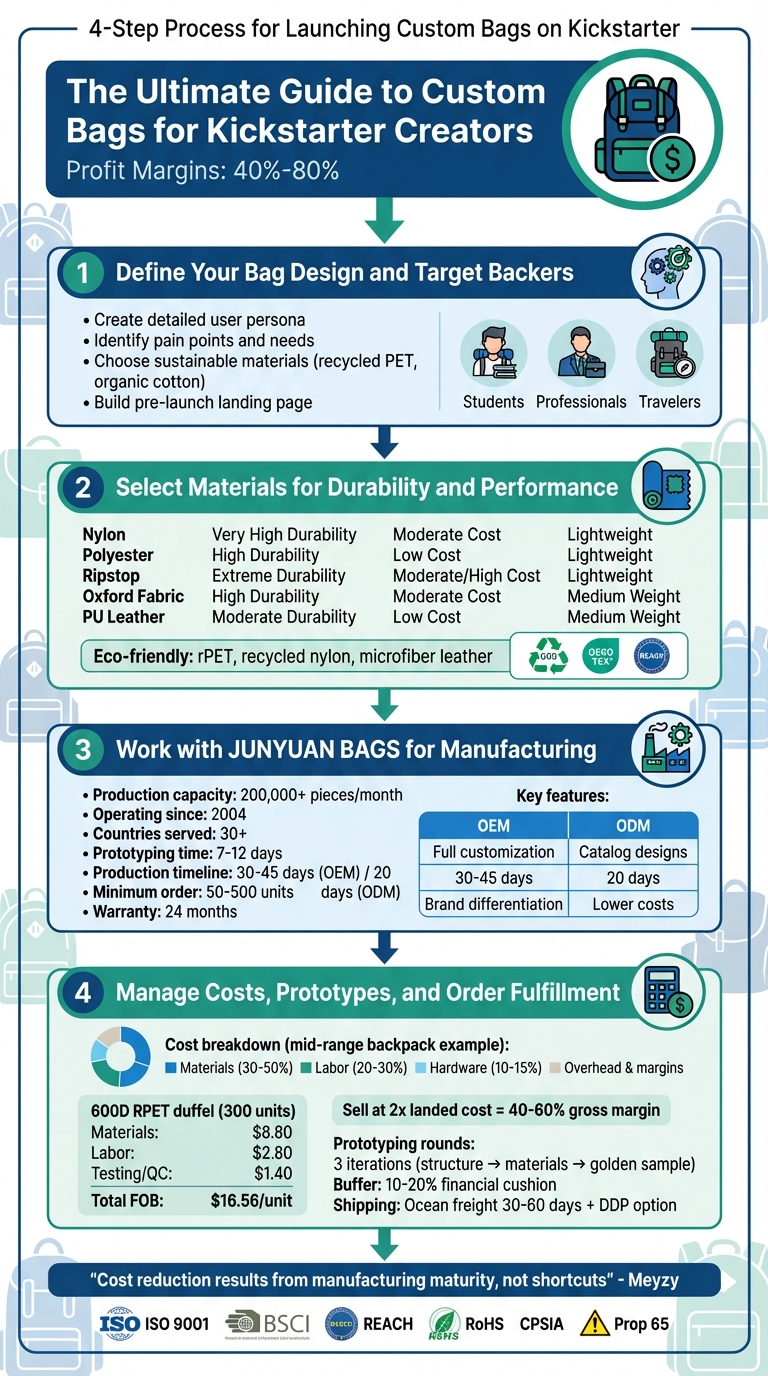
4-Step Process for Launching Custom Bags on Kickstarter
Step 1: Define Your Bag Design and Target Backers
Identify Your Target Backers
Start by narrowing down your audience. Create a detailed user persona that includes specifics like their name, age, profession, and daily routine. This persona will serve as your guide for every design decision, from the size of the pockets to the placement of zippers.
Take inspiration from Roman Khan, Co-founder of Linjer. He and his co-founder Jenn launched a minimalist briefcase on Indiegogo after struggling to find a high-quality, logo-free option under $600. Their campaign raised $144,000 for the initial production run. Reflecting on their success, Khan shared:
"I’ve seen many entrepreneurs fail because they can’t get out of their own heads and put themselves in the shoes of their potential customers."
Think about the challenges your backers face. For instance, a university student might need multiple organizer pockets and a water bottle holder, while a creative professional juggling tech gear and gym essentials might appreciate USB charging ports and RFID-blocking compartments. Addressing these specific pain points will make your bag stand out.
Today’s consumers also care about sustainability. Opt for materials like recycled PET, organic cotton, or plant-based leathers to showcase your commitment to environmentally conscious practices. As Jiangwen Bag puts it:
"A backpack crafted from recycled ocean plastic does not just carry books or a laptop; it carries a story of environmental responsibility."
Engaging with potential backers early is key. Khan advises:
"To make a great product, you have to talk to people, ask for feedback early, and continually iterate and improve your product."
Build momentum by creating a pre-launch landing page to collect email sign-ups and by participating in online communities that align with your target audience’s interests. This approach not only validates your concept but also helps establish a connection with backers who share your values, such as sustainability.
Once you’ve defined your user persona, ensure that your bag’s style and features align with their specific needs.
Select Your Bag Type and Custom Features
After identifying your audience, choose a bag type that fits their lifestyle. For example, tech professionals and students often need backpacks with padded laptop sleeves for 13"–17" devices and organized compartments. Eco-conscious buyers may prefer minimalist totes made from organic cotton or RPET. Urban commuters might favor anti-theft crossbody bags with hidden zippers and metro card strap pockets. Meanwhile, athletes could prioritize duffle bags with mesh ventilation panels and shoe compartments.
| Target Audience | Recommended Bag Type | Key Custom Features |
|---|---|---|
| Tech Professionals | Laptop Backpack / Messenger | Padded sleeves (13"–17"), USB ports, internal dividers |
| Eco-Conscious | Organic Cotton / RPET Tote | Sustainable material certification, minimalist design |
| Urban Commuters | Anti-theft Crossbody / Backpack | Hidden zippers, RFID pockets, metro card strap pockets |
| Fitness/Athletes | Drawstring / Duffle Bag | Mesh ventilation panels, shoe compartments, water-repellent shell |
| Travelers | Large Duffle / Minimalist Backpack | Equipaje straps, quick-access passport pockets, TSA-friendly compartments |
Be precise when specifying your bag’s design details. Factories rely on exact measurements, such as leather thickness (1.2mm), hardware weight, and Pantone color codes (e.g., 19-5917 TPG for navy), to ensure the final product matches your vision.
Adding thoughtful touches like a custom inner lining or a well-placed anti-theft zipper can elevate the unboxing experience and reinforce a premium brand image. Features like hidden zippers positioned against the wearer’s back are particularly appealing to urban professionals looking for added security.
sbb-itb-1e6451b
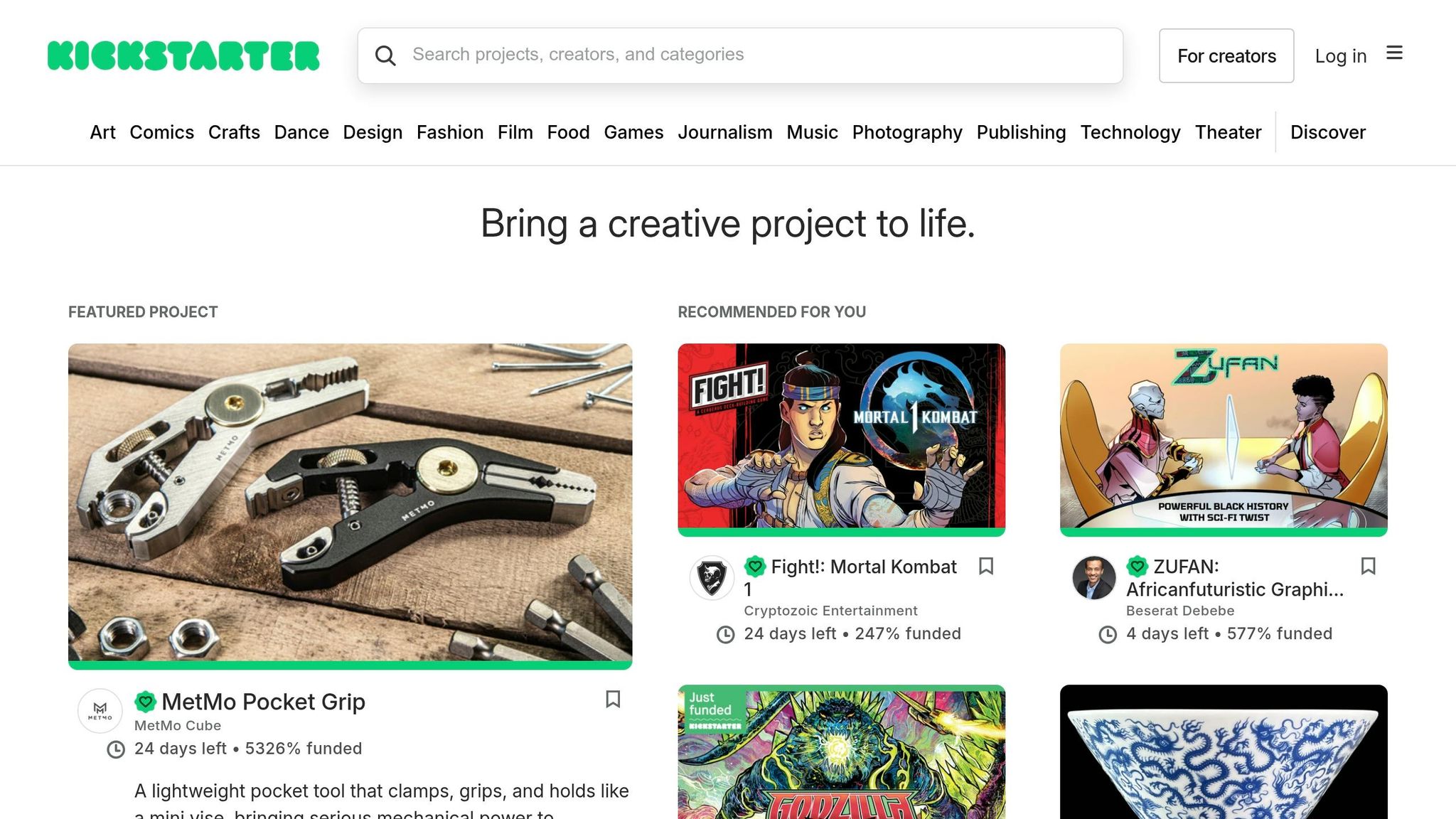
KICKSTARTER Launch: The CARRY-ALL STUDIO! – #ArtBag ep.7
Step 2: Select Materials for Durability and Performance
The materials you choose play a huge role in how backers perceive the quality and durability of your bag. Nylon, originally designed for military use, is a standout for high-performance bags. It’s lightweight, resists tears, and offers water resistance – perfect for travel backpacks or gym bags. Polyester, on the other hand, is a reliable option for mass-produced bags. It dries faster than natural fibers, resists stretching and wrinkling, and balances durability with a low production cost, making it a great fit for campaigns on a budget.
For bags meant to handle tougher conditions, Ripstop fabric is a go-to choice. Its reinforced weave prevents punctures from spreading, which is why it’s commonly used in hiking packs, tactical gear, and rugged duffels. Oxford fabric, with its signature basketweave texture, often comes with PU or PVC coatings to make it waterproof and scratch-resistant. This makes it ideal for business-casual sports bags or hybrid laptop-gym bags that need a refined appearance. Below is a quick comparison of these materials based on their core attributes:
Material Comparison for Custom Bags
| Material | Durabilidad | Coste | Weight | Best For |
|---|---|---|---|---|
| Nylon | Very High | Moderate | Lightweight | Travel backpacks, gym bags, outdoor gear |
| Polyester | High | Low | Lightweight | Sports bags, team duffels, budget campaigns |
| Ripstop | Extreme | Moderate/High | Lightweight | Hiking packs, tactical gear, rugged duffels |
| Oxford Fabric | High | Moderate | Medium | Business backpacks, commuter bags, hybrids |
| Cuero PU | Moderate | Low | Medium | Fashion-forward bags, budget-friendly totes |
PU leather is another option, offering the look of genuine leather at a fraction of the cost. It’s water-resistant, easy to clean, and works well for stylish gym bags or affordable totes. However, it’s best to steer clear of natural fibers like cotton or linen for athletic bags – they absorb moisture, stain easily, and wear out quickly under heavy use.
Eco-Friendly Material Options
If sustainability is a priority, recycled polyester (rPET) is a fantastic option. It retains the fast-drying and shape-holding properties of virgin polyester while reducing environmental impact – perfect for eco-conscious backers. Other eco-friendly materials like recycled nylon or microfiber leather (which uses less water and fewer chemicals than traditional leather) are gaining popularity among creators looking to align their products with sustainability goals.
When opting for eco-friendly materials, make sure they meet recognized standards such as GRS (Global Recycled Standard), OEKO-TEX, or REACH. Pair these materials with high-quality hardware like YKK zippers or Duraflex buckles to ensure your bag’s durability matches its eco-friendly promise. With these material insights in hand, you’re ready to dive into advanced production techniques.
Step 3: Work with JUNYUAN BAGS for Manufacturing
Once you’ve settled on your materials, the next step is finding a manufacturing partner who can bring your Kickstarter vision to life. JUNYUAN BAGS has been in the custom bag production business since 2004, working with brands in over 30 countries. With the capacity to produce more than 200,000 pieces per month and certifications like ISO 9001, BSCI, REACH, RoHS, CPSIA, and California Proposition 65, they’re well-equipped to meet the compliance standards required for selling in the U.S. market.
JUNYUAN offers flexible order quantities, making them a great fit for Kickstarter creators. They also provide DDP (Delivered Duty Paid) shipping to key markets like the USA, EU, UK, and Australia. This means they handle customs clearance and door-to-door delivery, so you won’t face unexpected fees that could derail your budget. Plus, their products come with a 24-month warranty covering zippers, straps, and stitching defects. With these services, JUNYUAN lays a solid groundwork for your manufacturing needs.
OEM vs. ODM Manufacturing: What’s the Difference?
Understanding the difference between OEM (Original Equipment Manufacturer) and ODM (Original Design Manufacturer) can help you choose the right production path for your project. Each approach has its own advantages, depending on your goals, timeline, and budget.
- OEM: This option gives you full creative control. You provide detailed designs, and JUNYUAN handles the production from scratch. While this approach allows for complete brand differentiation, it requires a larger upfront investment and typically takes 30–45 days after sample approval.
- ODM: If speed and cost are priorities, ODM might be the way to go. You can select from pre-existing designs in JUNYUAN’s catalog and customize them with your branding. This method is faster – sometimes as quick as 20 days – and more affordable.
Here’s a quick comparison to help you decide:
| Criteria | OEM (Original Equipment Manufacturer) | ODM (Original Design Manufacturer) |
|---|---|---|
| Design Ownership | Belongs to the client/brand owner | Belongs to the manufacturer |
| Customization Level | Full customization | Limited to catalog designs |
| Development Time | Longer (sampling and adjustments) | Shorter (uses existing prototypes) |
| Best For | Unique designs, brand differentiation | Fast market entry, lower costs |
| Production Timeline | 30–45 days after sample approval | Around 20 days |
"OEM will be the best solution if you want to build a powerful brand image and promote your products."
– Gloria, JUNYUAN BAGS
JUNYUAN BAGS Custom Manufacturing Services
JUNYUAN offers a range of services tailored for Kickstarter campaigns. Their design support includes 3D mockups and professional tech pack development before you commit to sampling. Prototyping takes 7–12 days, and the sample fee is fully refundable with a bulk order. To protect your unique designs, JUNYUAN also signs Non-Disclosure Agreements (NDAs) as a standard practice.
Quality is a top priority. JUNYUAN employs a five-stage quality control process that includes material inspections, in-process checks, a pre-shipment audit (AQL Level II), functionality tests for components like zippers and straps, and a final inspection on 10–15% of all units. They also offer a variety of branding methods, such as embroidery (up to 8 colors), silk screening, heat transfer, debossing, and laser engraving. Advanced features like USB charging ports, RFID-blocking pockets, and TSA-approved locks can also be added. For precise color matching, they recommend providing Pantone (PMS) codes and vector files (AI/EPS) for logos and patterns.
"We’ve delivered 5000+ successful custom projects for brands across 30 countries. Let’s create your signature product line."
– Marvin Zhang, Senior Product Engineer & Manufacturing Specialist, JUNYUAN BAGS
JUNYUAN accommodates a range of order sizes, from a minimum of 50 units for test orders to 300–500 units for standard bulk production. For premium materials or catalog designs, they can reduce the minimum order quantity to 100 units. Payment terms typically require a deposit, with the balance due before shipment, and L/C at Sight is available for orders exceeding $20,000.
Step 4: Manage Costs, Prototypes, and Order Fulfillment
Once your production details are locked in, the next step is to tackle costs, prototypes, and order fulfillment. Budgeting accurately is critical for managing backer funds and meeting Kickstarter deadlines. A custom bag involves more than just fabric and zippers – it’s a combination of various costs that require careful planning.
Breaking Down Costs for Custom Bags
Knowing where your money goes is key to pricing your campaign rewards properly. For soft bags, materials typically account for 30–50% of the total cost, labor takes 20–30%, hardware adds 10–15%, and the rest covers overhead and margins. A mid-range backpack can cost anywhere from $5 to $150 FOB (Free on Board), depending on its complexity and materials.
Here’s a real-world example for a 600D RPET duffel bag with a production run of 300 units:
- Materiales: $8.80
- Labor: $2.80 (42 minutes of work)
- Testing and Quality Control: $1.40
Total FOB unit cost: $16.56.
If you’re using premium materials like full-grain leather, expect much higher costs. For instance, materials alone might run $63.10, with labor costing $7.13 for 95 minutes of work, bringing the FOB to around $97.45 per unit.
Don’t overlook hidden costs like chemical testing, third-party inspections, and tooling fees. Compliance tests (e.g., REACH or Prop 65) range from $120 to $250 per style, while AQL inspections cost $150–$300 per day. Custom hardware also adds upfront tooling and mold fees. To avoid surprises, request a detailed line-item quote from JUNYUAN, including the bill of materials (BOM), operation minutes, and test plans. This transparency helps you compare quotes fairly and identify any missing expenses.
"Prime cost = materials + direct labor. Add overhead, compliance tests, packaging, and margin to reach your FOB quote."
– Meyzy
For healthy margins, aim to sell your bags at roughly twice your total landed cost, which includes manufacturing, freight, customs, duties, and taxes. This approach typically yields a 40–60% gross margin, leaving room for Kickstarter platform fees (8–10% of funding). You can also cut costs by consolidating trims – using the same zipper color or hardware across different bag styles helps you reach higher material order quantities and lower unit prices.
Prototyping and Testing
Prototyping is an iterative process. You’ll likely go through three rounds of samples:
- The first focuses on structure and size.
- The second refines materials and colors.
- The third is your production-ready "golden sample".
For complex handbags, prototypes generally cost between $500 and $1,000 and take 7–14 days to produce. Some partners, like JUNYUAN, offer quicker turnarounds of 7–12 days, and the sample fee is often refundable on bulk orders.
Before approving a prototype, test it thoroughly. Load it with 11–22 lbs (5–10 kg) to simulate real use. Check if the straps hold, zippers function smoothly when overstuffed, and handle joints withstand stress. Perform a damp-rub test on inner seams to ensure colorfastness – dye bleed can lead to backer complaints. Be wary of strong solvent smells, which indicate poor finishing and could generate negative feedback.
Once your design passes all tests, lock in a "golden sample" by signing and dating it. This sample serves as the benchmark for mass production, ensuring consistent quality as the factory scales up.
Fulfilling Orders on Time
Managing costs and validating prototypes is only part of the equation – delivering orders on schedule is equally important. After your campaign ends, Kickstarter typically transfers funds within 14 days. From there, ocean freight shipping can take 30–60 days. JUNYUAN’s DDP (Delivered Duty Paid) shipping to the U.S. simplifies the process by handling customs clearance and door-to-door delivery, avoiding surprise fees that could delay shipments or frustrate backers.
Set an "Address Lockdown Date" just before shipping, not immediately after your campaign ends. Backers often move, and collecting addresses too early can lead to delivery issues. Use tools like BackerKit to manage address collection, handle add-ons, and recover failed payments. For international orders, opt for DDP shipping to pay taxes upfront, ensuring backers receive their bags without unexpected border fees.
To safeguard your budget, build a 10–20% financial buffer to cover defective products, lost shipments, or unforeseen costs. Implement quality control at three key stages:
- Cutting: Verify fabric lot and color.
- In-line: Conduct random checks during sewing.
- Pre-pack: Use AQL reports and drop-tests to catch defects before shipping.
Keep backers informed with monthly updates, including photos of manufacturing progress. Transparent communication about challenges fosters trust far more effectively than silence when issues arise.
Conclusión
Launching a custom bag on Kickstarter requires careful attention to design, materials, and logistics. Start by identifying your target audience and choosing materials that align with their priorities – whether it’s rugged nylon for outdoor adventurers or RPET for those prioritizing sustainability. As Meyzy wisely states, "Cost reduction results from manufacturing maturity, not shortcuts" . This means focusing on thorough prototyping and quality control rather than rushing into production.
Every stage of production should follow a well-thought-out plan. Collaborating with an experienced partner like JUNYUAN BAGS can simplify the process, taking you from initial sketches to final delivery. Their expertise and strict quality control measures help ensure your bags meet the expectations of your backers.
When finalizing production, stay transparent with your budget. Account for a 30–45 day production timeline and consider DDP shipping to avoid unexpected customs fees. Protect your intellectual property with NDAs and confirm compliance with essential certifications. Secure a golden sample before mass production and set aside a 10–20% financial buffer for any unforeseen costs.
Preguntas frecuentes
What bag features make backers pledge?
Backers tend to support bags that strike the right balance between durability, functionality, and style. Practical features like ergonomic straps, multiple compartments, and padded laptop sleeves make a bag more convenient and comfortable to use. Adding standout elements – think eco-friendly materials, built-in USB ports, or insulated pockets – can capture even more attention. In the end, a well-thought-out design with features tailored to specific needs is what truly motivates people to pledge their support.
How do I estimate my landed cost and pricing?
To figure out your landed cost, you need to account for every expense involved from production to delivery. This includes materials, labor, overhead, tariffs, shipping, and your profit margin.
Start by calculating your prime cost, which is the total of materials and labor. Then, add overhead costs and any packaging expenses. Don’t forget to include tariffs and shipping fees – these can vary depending on the country and supplier. By combining all these factors, you’ll arrive at your total landed cost, which is essential for setting competitive retail prices.
OEM or ODM – what should I choose?
When deciding between OEM (Original Equipment Manufacturer) and ODM (Original Design Manufacturer), it all comes down to what you need. OEM is the way to go if you want complete creative control and ownership of the intellectual property. This option allows you to provide detailed designs, making it ideal for unique, tailor-made projects. On the other hand, ODM is a faster and more budget-friendly choice. By using the manufacturer’s existing designs, it’s perfect for startups or businesses aiming for a quicker product launch. The right choice depends on how you prioritize your budget, timeline, and design requirements.


 Móvil/What's App/Wechat
 Correo electrónico
 AÑADE
AÑADE