Launching your first Kickstarter campaign? Start small. Instead of committing to large inventory orders, small MOQ (Minimum Order Quantity) custom bags – starting at 50–100 pieces – let you test your design and market demand with reduced financial risk. Traditional manufacturers often require 300–500 units, but smaller runs help avoid overproduction and unsold inventory, especially since only 30% of fashion-related Kickstarter projects succeed.
Wichtigste Erkenntnisse:
- Lower Financial Risk: Small MOQs minimize upfront costs, crucial for first-time creators.
- Flexibility: Test designs, adjust based on backer feedback, and refine your product.
- Higher Per-Unit Costs, Lower Overall Investment: Fixed costs are distributed across fewer units, but the total spend remains manageable.
- Anpassungsoptionen: Use stock materials, add logos, or create functional features like laptop sleeves or ventilated compartments.
- Quality Control: Start small to ensure dependable quality before scaling production.
By focusing on small, manageable production runs, you can validate your idea, build trust with backers, and lay the groundwork for future growth.
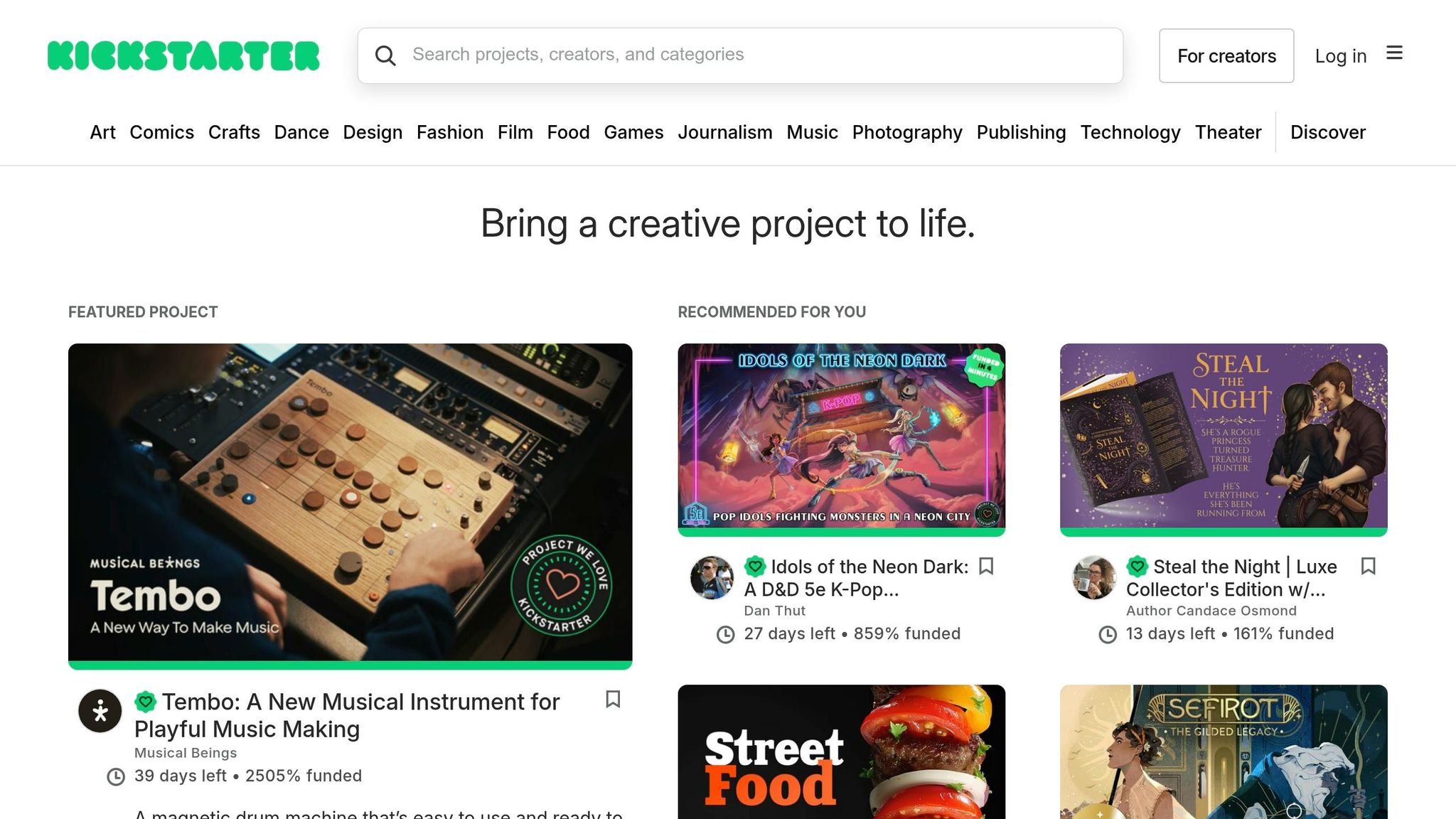
KICKSTARTER Launch: The CARRY-ALL STUDIO! – #ArtBag ep.7
sbb-itb-1e6451b
What Small MOQ Means for Bag Manufacturing
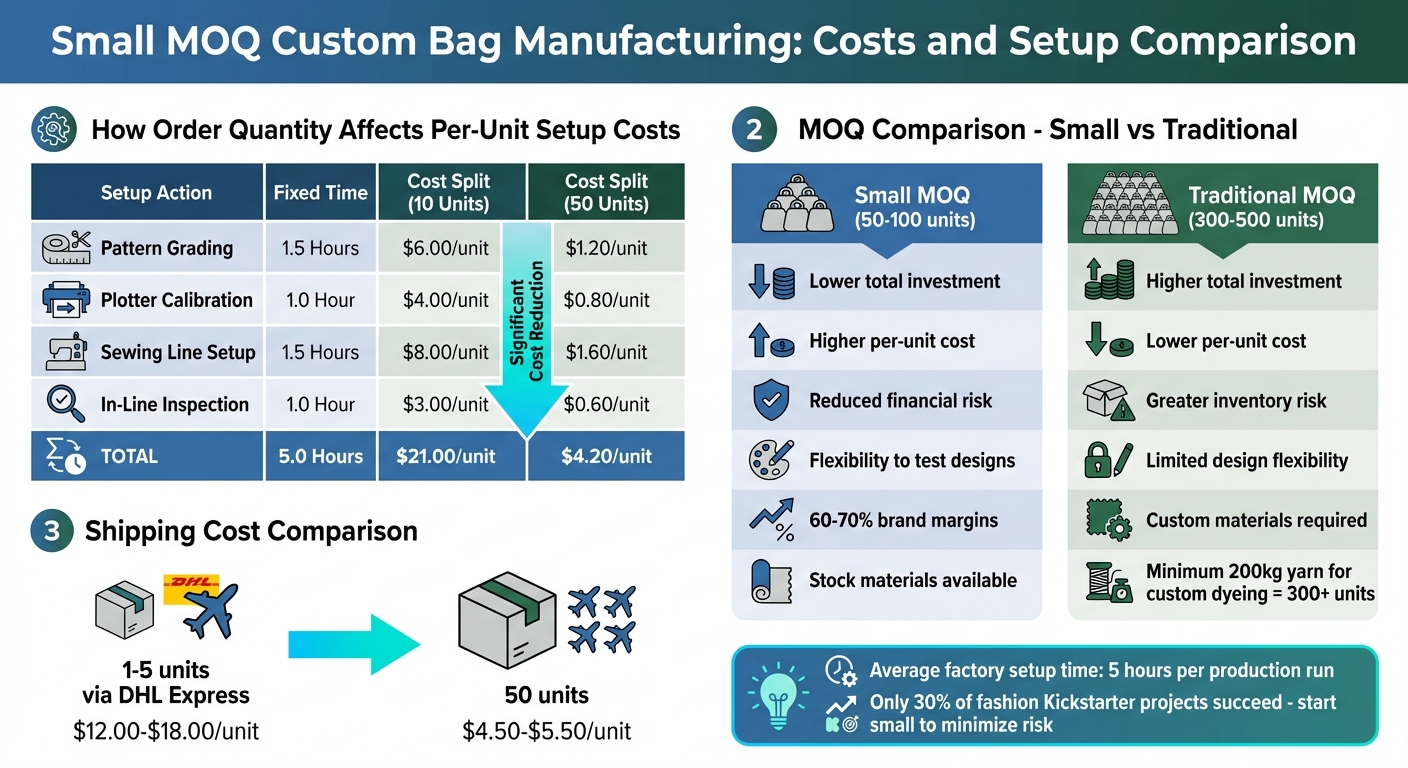
Small MOQ vs Traditional Manufacturing: Cost Breakdown and Setup Comparison
Minimum Order Quantity (MOQ) refers to the smallest production run a factory will accept for a specific bag design, material combination, and configuration. On average, factories dedicate about 5 hours to setting up each production run.
For Kickstarter creators working with tight budgets, understanding MOQ is essential. Some manufacturers cater to smaller projects by offering MOQs as low as 50–100 pieces, especially if you use stock materials or existing designs. This option allows creators to test the waters without committing to large, unproven inventory.
"MOQ functions as a risk-and-efficiency threshold: it determines how fixed costs are distributed across units." – FYBagCustom
While smaller orders come with higher per-unit costs, they significantly reduce overall investment and risk. This approach helps you stay flexible and align production with actual demand as your campaign progresses.
How MOQ Affects Your Manufacturing Costs
Fixed costs, such as pattern grading, plotter calibration, and sewing line setup, are distributed across the total number of units. For example, producing just 10 units might result in setup costs of about $21.00 per unit, while ordering 50 units reduces that cost to approximately $4.20 per unit.
Here’s a breakdown of setup costs depending on order size:
| Setup Action | Fixed Time | Cost Split (10 Units) | Cost Split (50 Units) |
|---|---|---|---|
| Pattern Grading | 1.5 Hours | $6.00 / unit | $1.20 / unit |
| Plotter Calibration | 1.0 Hour | $4.00 / unit | $0.80 / unit |
| Sewing Line Setup | 1.5 Hours | $8.00 / unit | $1.60 / unit |
| In-Line Inspection | 1.0 Hour | $3.00 / unit | $0.60 / unit |
Beyond factory setup costs, there are "hidden MOQs" from upstream suppliers. For example, custom Pantone dyeing typically requires a minimum of 200 kg of yarn, which translates to over 300 units. Similarly, custom-colored zippers, metal hardware, and specialty webbing often come with their own minimum requirements. Opting for stock materials can help keep these costs in check.
Shipping costs also vary with volume. Sending 1–5 units via DHL Express can cost between $12.00–$18.00 per unit, while shipping 50 units brings this down to around $4.50–$5.50 per unit. Despite higher per-unit manufacturing costs with small MOQs, factory-direct small batches can still deliver brand margins of 60–70%, compared to the less than 15% typical of print-on-demand services.
These cost factors highlight why small MOQs, though pricier per unit, offer invaluable flexibility for new creators.
Why Small MOQ Works for First-Time Creators
Small MOQs are a game-changer for new creators, helping minimize inventory risk and allowing for quick adjustments based on market feedback. Instead of committing to thousands of units, you can start with a manageable run of 100–300 pieces to validate your product.
This strategy offers financial breathing room and adaptability during the early stages. For example, you could produce a small batch of 20–50 units for influencer reviews or allocate 100–200 units for early-bird backer rewards during your campaign. If issues arise – like a zipper that sticks, straps that aren’t comfortable, or fabric that doesn’t hold up – you’ll catch them in a smaller, more manageable batch rather than after a large-scale production run.
"Startups do not need massive production. They need agility, affordability, fast iteration, and a manufacturer willing to grow with them." – Szoneierfabrics
Small runs also let you experiment with variations without taking on excessive financial risk. For instance, you could order the same bag in two color options using stock fabrics or produce a backpack and tote with the same material to meet fabric mill minimums. This testing approach not only builds trust with your manufacturer but also strengthens your position for negotiating better rates on larger reorders once your product gains traction.
Standard custom bag orders usually take 30–45 days after sample approval. However, small batches using stock materials can be completed faster, as they skip time-intensive steps like custom fabric dyeing or sourcing proprietary hardware. This speed advantage allows you to learn quickly, pivot based on backer feedback, and remain agile during your campaign.
How to Choose a Small MOQ Custom Bag Supplier
When selecting a custom bag supplier for small MOQ (Minimum Order Quantity) projects, it’s crucial to find one who not only offers competitive pricing but also understands the unique challenges of crowdfunding campaigns. These include tight budgets, strict deadlines, and the need for dependable quality. Start by using specific search terms like "small batch bag production" oder "flexible MOQ luggage supplier" to narrow your options to manufacturers that specialize in smaller production runs.
Prepare a detailed RFQ (Request for Quote) that outlines all your project requirements – product type, materials (e.g., 600D RPET), dimensions, hardware specifics (like YKK zippers), target cost, branding preferences, and your campaign deadline. To understand pricing dynamics, ask for quotes across multiple order quantities, such as 100, 300, 500, and 1,000 units. Pay attention to how quickly suppliers respond and their ability to identify potential design issues. Many professional manufacturers offer 3D or digital mockups before creating physical samples, which can save time and help catch errors early. These steps will help you evaluate suppliers thoroughly and make informed decisions.
Checking Supplier Quality and Certifications
Before committing to a supplier, verify their credentials. Look for internationally recognized certifications like ISO 9001 (Quality Management), BSCI (Business Social Compliance Initiative), or OEKO-TEX Standard 100. Always confirm the most recent audit date to ensure the certifications are current.
A reliable supplier will have a structured quality control process. This often includes five stages: inspecting materials before production, conducting in-process checks during sewing, testing functionality for zippers and straps, performing a pre-shipment audit based on AQL Level II standards, and randomly inspecting 10–15% of the finished units before packing. To minimize risks, request a "golden sample" – a signed prototype that sets the benchmark for quality in stitching, hardware, and material color. Also, consider working with suppliers that offer a warranty (12–24 months) for critical components like zippers, straps, and stitching. Starting with a small test order of 50–100 units can help you assess their quality, timelines, and communication.
If your bags need to meet specific regulatory standards – such as REACH (EU), RoHS, or California Proposition 65 – request compliance documentation early in the process. This ensures your products meet the necessary safety and environmental standards.
Available Customization Options for Your Bags
For Kickstarter campaigns, customization can help your brand stand out without breaking the bank.
Logo application is one of the simplest ways to personalize your bags. Options include embroidery for a high-end look (ideal for designs with eight or fewer colors), silk screening for bold graphics, heat transfer for vibrant full-color designs, or debossing and hot stamping for leather bags. These methods are cost-effective for smaller production runs due to minimal setup requirements.
Material selection also plays a big role in the bag’s appeal and functionality. Durable options like 1680D Nylon are excellent for strength, while RPET recycled fabrics add an eco-friendly narrative. For waterproofing, consider TPU or PVC-coated fabrics. If your order is small, it’s often more economical to choose from stock fabric colors rather than custom dyeing.
To add functional appeal, consider features like ventilated compartments, padded laptop sleeves (suitable for 13–17 inch devices), RFID-blocking pockets, or integrated USB ports. Don’t overlook the unboxing experience – elements like custom hang tags, branded dust bags, or gift boxes can create a lasting impression while staying within budget.
Once your customization needs are clear, focus on negotiating terms that align with your campaign’s goals.
Negotiating Price and Delivery Schedules
After confirming quality and customization details, it’s time to structure pricing and delivery terms that fit your budget and timeline. For small MOQ orders, pricing is calculated differently from bulk manufacturing. Fixed and semi-fixed costs – such as pattern design, sample creation, and machine setup – are spread across the order quantity. This means smaller orders will have a higher per-unit cost.
To manage costs, propose a tiered pricing structure. For example, agree to a higher per-unit cost for an initial 100–200 unit run in exchange for discounted pricing on future reorders. This approach allows you to test the supplier’s capabilities while building a long-term partnership.
"Low MOQ orders function like engineering prototypes, while bulk orders gain from production efficiencies." – FYBagCustom
Production timelines for small batches typically range from 30–45 days after sample approval. However, if you use stock materials, production might be faster since custom fabric dyeing is skipped. For expedited production (around 20 days), expect a surcharge. Before agreeing to penalties for late shipments, confirm that the supplier’s fabric booking and production schedules are realistic.
Payment terms for small orders generally require a 30–50% deposit, with the balance due before shipment. Sample fees, which usually range from $50 to $150 depending on complexity, are often refundable upon placing a bulk order. For Kickstarter campaigns, negotiate Delivered Duty Paid (DDP) shipping terms to major markets like the USA, EU, and UK. This ensures customs clearance and door-to-door delivery costs are included upfront.
Sample development takes about 7–12 days after design confirmation. Use this time to provide precise specifications – such as Pantone (PMS) codes for color accuracy or vector files (AI/EPS formats) for logos – to avoid design errors that could delay production.
Creating Custom Bag Designs That Sell
Designing a bag that clicks with your audience is the key to a successful campaign. It’s not just about aesthetics – it’s about solving a real problem while ensuring your design grabs attention in a crowded market.
Choosing the Right Bag Style for Your Audience
Start by focusing on a specific niche and addressing a clear pain point. Take Travellr, for instance. Created by craftsman Kyle Koster, this travel bag featured a dedicated razor case made from full-grain Horween leather. The idea came from Koster’s own experience of cutting his finger on an exposed razor while traveling. This kind of targeted solution resonates with backers who’ve faced similar frustrations, creating an emotional connection.
Match the bag style to your audience’s lifestyle. For instance:
- Minimalist, Scandinavian-inspired designs are perfect for professionals seeking quality at a reasonable price. This was the strategy Linjer used when they launched their high-quality leather work bags on Kickstarter, priced under $1,500.
- For athletes, prioritize functionality: gym bags with ventilated compartments, travel bags with padded laptop sleeves, or duffels with insulated cooler pockets.
Material choice also matters. It defines your brand’s positioning:
- 1680D Nylon signals durability and is ideal for athletic gear.
- RPET recycled fabrics appeal to eco-conscious buyers.
- Full-grain leather conveys luxury and long-term value.
Keep in mind that fewer than 30% of fashion projects on Kickstarter meet their funding goals. Your design and material choices must stand out.
Adding Your Brand to Custom Bags
Your branding should be clear and memorable without overpowering the design. For smaller minimum order quantities (MOQs), embroidery works well for logos with eight or fewer colors, offering a durable and polished look that won’t peel like printed graphics. For more colorful designs, heat transfer oder silk screening are cost-effective options with low setup costs.
Consistency in color is essential for brand recognition. Provide Pantone (PMS) codes to manufacturers to ensure your colors match perfectly across different materials. For logos, use vector files in .ai or .eps formats to avoid pixelation when scaling. To save costs, stick to stock fabric colors instead of custom dyeing, which often requires higher minimums.
Don’t stop at the logo. Think about the unboxing experience. Affordable extras like custom hang tags, branded dust bags, or logo-printed tissue paper can elevate your brand’s image without breaking the bank. Adding a QR code to tags or inserts is another low-cost way to connect buyers to your brand story or social media.
Balancing Design with Practical Use
A great bag strikes a balance between style and functionality. A product that looks good and works well can earn glowing reviews and loyal customers. For example, in January 2025, WaterField Designs launched the "Flex Travel Gym Bag" after a community-driven design process. Starting in October 2024, their team collaborated with members of the Fitness SF gym chain, using surveys to finalize details like size, compartments, and materials (waterproof nylon and vegan leather). The result was a bag that combined "timeless style" with practical features tailored to gym-goers’ needs.
For athletic bags, consider these practical features:
- Ventilated compartments to separate dirty shoes from clean clothes.
- RFID-blocking pockets for added security.
- Padded shoulder straps for comfort when carrying heavy loads.
These features don’t have to compromise style. For example, ventilated compartments can use sleek mesh panels, while internal laptop sleeves keep the exterior slim.
Durability is non-negotiable. Use verstärkte Nähte at stress points, YKK or waterproof zippers, and metal hardware to ensure your bag lasts. Before committing to production, request a 3D mockup from your manufacturer. This lets you visualize how your logos and features will look, helping you catch any design issues early. It’s a simple step that ensures your bag is as functional as it is stylish.
Managing Costs for Small MOQ Orders
Budgeting for a small production run means understanding how fixed costs affect smaller batches and finding ways to trim expenses without sacrificing quality. These strategies are especially helpful for Kickstarter creators who value the flexibility and reduced financial risk that come with small MOQs.
Calculating Your Total Production Costs
Your production costs include fixed costs (like pattern engineering, tooling, and machine setup), semi-fixed costs (test runs or small-lot surcharges), and variable costs (materials, labor, and packaging). For small orders, fixed costs are the biggest challenge since they stay the same no matter how many units you produce.
For example, setup costs of $21.00 per unit for 10 units drop significantly to $4.20 per unit when you produce 50 units. Here’s how the cost breakdown typically looks for soft bags:
- Materialien: 30–40% of total costs
- Labor: 20–30%
- Hardware: 10–15%
But don’t forget hidden costs like chemical tests ($120–$250 per style), colorfastness and abrasion tests ($25–$80), and third-party inspections ($150–$300 per day). Developing a prototype for a complex bag can also cost $500–$1,000 and take 7–14 days.
"If a quote looks strangely low, it often excludes a step (zipper grade, extra edge-paint coats, or tests). Ask for a line-item BOM + operation-minutes + test plan." – Meyzy
To avoid unexpected charges, ask your supplier for a line-item Bill of Materials (BOM), operation-minute sheets, and a detailed test plan. These tools make it easier to negotiate costs and spot any missing steps.
For Kickstarter campaigns, platform fees are another factor. Kickstarter takes 5% of funds raised, and payment processors add another 3–5%. Plan for these fees to avoid running short during production.
Getting Better Pricing Through Smart Ordering
You can lower per-unit costs by consolidating materials – using the same fabric, hardware, and trim across different styles or colors. This approach helps you hit higher material tiers and unlock better pricing from suppliers. Opting for stock materials can also eliminate custom dyeing minimums and small-lot surcharges. For instance, using the same 600D RPET fabric and YKK zippers for both a gym duffel and a weekender bag can push you into a better pricing bracket.
Another cost-saving option is working with an ODM (Original Design Manufacturer). By selecting a base design and customizing only the materials or branding, you can reduce development costs and speed up production compared to full OEM manufacturing.
It’s also smart to request quotes for multiple order sizes, like your MOQ, 300 units, 500 units, and 1,000 units. Price drops often come in "steps" rather than gradual reductions, so ordering 300 instead of 200 units might cut your unit cost by 20%, making the higher upfront cost worthwhile.
You might also negotiate a "test order" agreement. This means paying a higher per-unit price for an initial small run of 200 units, but securing a written promise for significant discounts or rebates on larger follow-up orders of 1,000+ units. Sharing your Kickstarter goals and marketing plan can help position your small order as the start of a long-term relationship with the manufacturer.
While these strategies can lower costs, careful planning is essential to avoid unexpected expenses.
Preventing Unexpected Expenses and Delays
Once you’ve optimized your order pricing, it’s time to prepare for extra fees and delays. Shipping costs can vary widely depending on volume. For example, DHL Express shipping for 1–5 units might cost $12–$18 per unit, but shipping 50 units could lower that to $4.50–$5.50 per unit. To simplify things, request DDP (Delivered Duty Paid) terms so customs duties and import fees are included upfront.
Secure a golden sample – an approved prototype that serves as your quality benchmark before bulk production begins. This sample helps prevent costly quality issues and rework. Also, set your AQL (Acceptable Quality Limit) standards at 2.5 for major defects and 4.0 for minor defects to balance quality control without inflating rework costs.
Be mindful of tax obligations. If your campaign raises $20,000 or more across 200+ transactions, you’ll receive an IRS Form 1099-K. Some states have even lower thresholds, like $600 in the District of Columbia, Maryland, and Massachusetts, or $1,000 in Illinois and New Jersey. Keep in mind that the tax year is based on when pledges are collected, not when you receive the payout.
Finally, include a timeline buffer. Small MOQs can take longer if custom materials don’t meet supplier minimums, forcing them to special-order items like fabric or hardware. Communicate realistic delivery dates in your campaign’s "Risks and Challenges" section to set clear expectations with your backers.
Schlussfolgerung
Kickstarter creators can take their first steps with confidence by leveraging small MOQ strategies, which help minimize financial risks. Opting for small MOQ custom bags allows newcomers to produce professional-quality products without committing to large inventory investments. With test orders starting at just 50 units or premium designs beginning at 100 pieces, you can validate your idea, gather meaningful feedback, and establish trust with backers before scaling up your production. Features like refundable sample fees and DDP shipping options simplify budgeting by eliminating unexpected expenses.
Small MOQs also provide the flexibility to adapt quickly. You can experiment with materials and fine-tune designs based on early feedback. Even with smaller orders, quality is never compromised – thanks to a 5-stage quality control process and a 24-month warranty covering zippers, straps, and stitching. Additionally, NDA agreements safeguard your unique designs, giving you peace of mind as you develop your brand.
JUNYUAN-TASCHEN builds on these advantages by offering extensive experience, with over 5,000 successful custom projects completed across 30 countries. Backed by more than 20 years of manufacturing expertise, their ISO 9001 and BSCI certifications ensure dependable quality. Plus, their specialized crowdfunding resources are tailored to help you navigate the complexities of Kickstarter campaigns.
"We’ve delivered 5000+ successful custom projects for brands across 30 countries. Let’s create your signature product line." – Marvin Zhang, Senior Product Engineer & Manufacturing Specialist, JUNYUAN BAGS
FAQs
What’s the best first MOQ for a new Kickstarter bag?
The best starting MOQ for a new Kickstarter bag typically falls between 50 to 100 units. This range strikes a balance between keeping costs manageable and testing the market effectively. That said, the exact number can depend on your manufacturer and the unique needs of your project.
How can I keep customization costs low at small MOQs?
To manage customization costs effectively with small MOQs, consider partnering with suppliers like JUNYUAN-TASCHEN. They offer flexible order quantities, free design servicesund transparent pricing, making it easier to stay within budget. Look for suppliers that include logo options and design customization without additional fees. Additionally, efficient production processes and clear cost breakdowns can help you sidestep hidden expenses, keeping your custom bag project affordable.
What should I ask a supplier to avoid delays and surprises?
When working with suppliers, it’s crucial to clarify a few key details to steer clear of delays and last-minute surprises. Start by discussing their production timelines, minimum order quantities (MOQs), and how flexible they are with lead times. Make sure to pin down the expected delivery date and confirm whether they can manage smaller MOQ orders if needed.
Another important step is to ask if they offer samples before committing to large orders. This allows you to verify the quality of their products beforehand. Tackling these questions early on can help you sidestep unexpected hiccups during the production process.
Related Blog Posts
- From Zero to 500 Orders: How a Startup Scaled with Low MOQ Custom Bags
- What is the industry standard minimum order quantity (MOQ) for custom golf bag manufacturing, and what factors, such as design complexity or material, influence it?
- MOQ Strategies: How Small Brands Can Work with Chinese Bag Manufacturers
- Ultimate Guide to Custom Bag Design for Businesses


 Mobile/What's App/Wechat
 E-Mail
 ADD
ADD