Launching a successful Kickstarter bag campaign requires more than just a great idea – it takes strategic planning, a clear understanding of your audience, and a reliable manufacturing partner. Here’s a quick summary of the key steps:
- Know Your Audience: Research your ideal backers’ needs and preferences through surveys, forums, and social media. Tailor your bag’s features to solve their specific problems.
- Design with Purpose: Focus on balancing functionality and style. Use high-quality materials like recycled fabrics or durable nylon, and avoid adding unnecessary features.
- Set Realistic Goals: Calculate production costs, shipping, fees, and a contingency buffer to set an achievable funding goal. Aim to hit 30% funding in the first week to boost visibility.
- Choose the Right Manufacturer: Partner with experienced factories that offer low minimum order quantities, quality certifications, and clear communication.
- Create a Winning Campaign: Use professional photos and videos to highlight your bag’s features. Write a compelling story that explains the problem your bag solves and why backers should trust you.
- Learn from Others: Study past campaigns to replicate their successes and avoid common mistakes, like overcomplicated designs or unrealistic pricing.
Key Takeaway
Your bag campaign should combine a clear understanding of your audience, a practical and stylish design, and a well-planned production and marketing strategy. With careful preparation, your Kickstarter project can exceed expectations and build trust with backers.
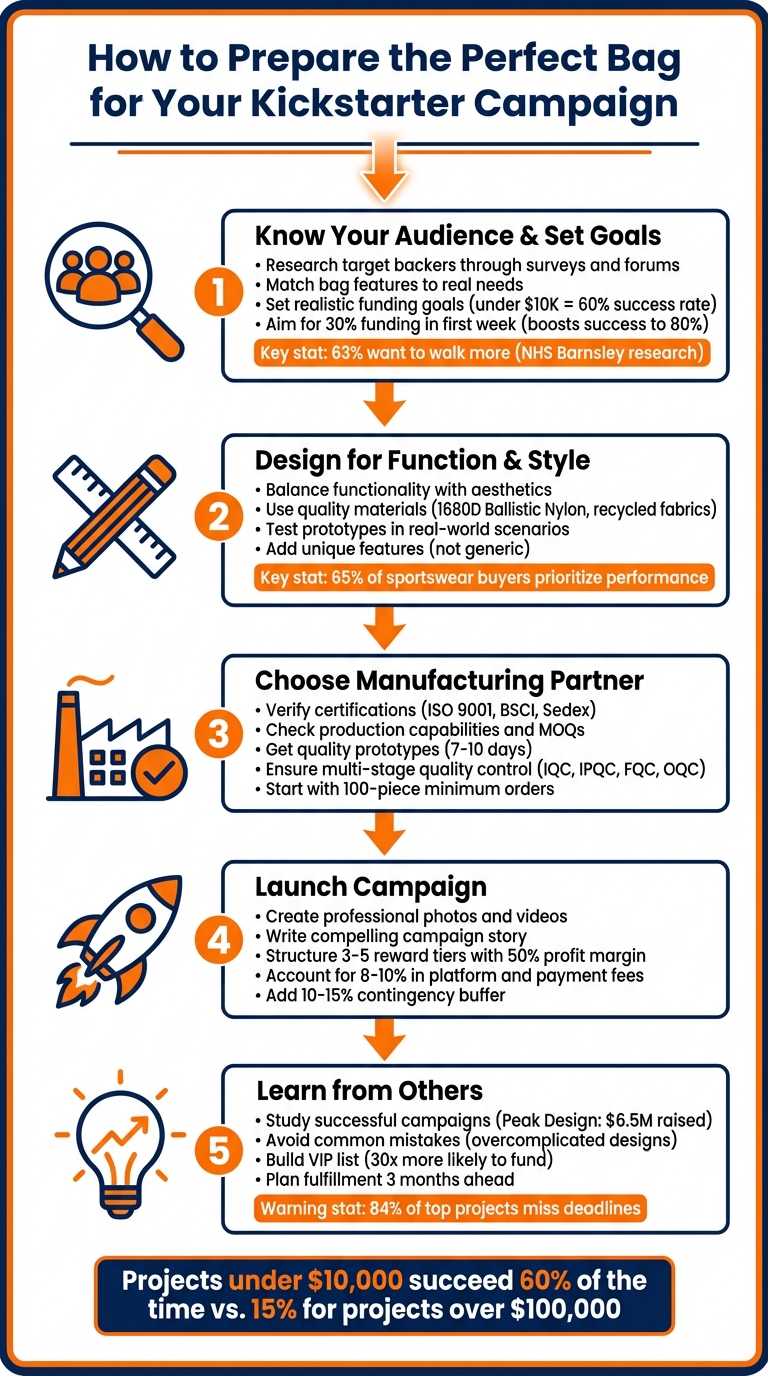
5-Step Process to Launch a Successful Kickstarter Bag Campaign
Kickstarter Campaign Structure, Timeline, & Planning
sbb-itb-1e6451b
1. Know Your Audience and Set Clear Campaign Goals
Before jumping into design, it’s crucial to know exactly who you’re creating for. The difference between a campaign that fizzles out at 20% funding and one that smashes its goal often comes down to understanding what your backers actually need – not just what you think they need.
1.1 Research Your Target Backers
Start by building a detailed profile of your ideal backer. Don’t stop at basic details like age or location. Dive deeper – what does their daily routine look like? What frustrations do they have with current bags? Where do they spend their time online? A great example of this approach comes from NHS Barnsley, which conducted extensive research in 2009. Through surveys and discussions, they found that 63% of their audience wanted to walk more, but traditional exercise felt too intimidating. By reframing walking as "free and flexible", they tapped into a real need.
You can do something similar by joining Facebook groups, browsing Reddit threads, or reading comments on comparable Kickstarter campaigns.
"I’ve seen many entrepreneurs fail because they can’t get out of their own heads and put themselves in the shoes of their potential customers." – Roman Khan, Co-founder, Linjer
Surveys are another useful tool. Use platforms like Google Forms oder Mailchimp to ask potential backers about the features they want and the price points they expect. ALPAKA, for instance, spent 10 months refining their 7even Messenger bag after an earlier project failed. They tested 25 prototypes and sent 150 bags to influencers and bloggers to gauge real-world demand. This kind of hands-on testing can reveal which features matter most and which might just complicate your design unnecessarily.
1.2 Match Bag Features to Backer Needs
Once you’ve gathered insights, focus on features that solve real problems for your audience. For example, if your target is urban commuters worried about theft, you might include discreet zippers that sit flush against the body. On the other hand, athletes might prioritize easy access to water bottles and snacks, making external pockets more important than hidden compartments. Research shows that 65% of sportswear buyers prioritize performance features, so think about functionality first.
Testing your prototype in real-world scenarios is key. Does the shoulder strap become uncomfortable after hours of use? Do zippers snag on workout gear? These practical insights can save you from costly redesigns later. Be cautious about adding too many features, though. Ask yourself: does this solve a specific problem for my backers, or is it just an unnecessary extra?
"Our backpack failure taught us a crucial lesson, which was to keep the design simple, not adding extra features that had no value to our target customer." – Jin Li, Co-founder, ALPAKA
1.3 Set Achievable Funding Goals
With a solid design in place, it’s time to set realistic funding goals. Remember, Kickstarter uses an all-or-nothing model – if you don’t hit your goal, you won’t receive any money. Setting the bar too high can scare off backers, while setting it too low might leave you unable to fulfill orders.
Start by calculating your actual costs. This includes production costs per unit (get quotes for different quantities to understand price breaks), shipping costs (which can range from $50 to $80 internationally for larger bags), Kickstarter’s 5% fee, payment processing fees (3–5%), and a 10–15% contingency buffer. On average, about 10% of funds raised are lost to fees and taxes before they even hit your account.
Keep in mind that projects with goals under $10,000 succeed about 60% of the time, while those over $100,000 have less than a 15% success rate. A great example is Aaron Radcliffe’s Fyro T22 Backpack campaign in 2024. He set a $10,000 goal and used a reservation funnel, where backers paid $1 to lock in early-bird pricing. This strategy identified serious buyers early, leading to $232,000 raised in the first 48 hours and a final total of $373,464 – over 3,700% funded.
Aim to hit 30% of your goal in the first week, as this boosts your campaign’s success rate to 80%. Also, make sure you’ve built in at least a 50% profit margin per reward tier to cover production and marketing costs. Pricing your rewards correctly from the start ensures you’re prepared for fees, taxes, and any unexpected expenses.
2. Design a Bag That Works and Looks Good
Once you know your audience, the next step is designing a bag that people will actually use – and be proud to show off. The most successful Kickstarter bags don’t just solve problems; they look great doing it. Striking the right balance between functionality and style is critical. Backers need to trust that your bag will perform well und fit seamlessly into their lives. Here’s how to merge practicality with eye-catching design.
2.1 Balance Function and Appearance
Your bag has to work in the real world, not just look good in photos. Start by considering how your audience will use it. For example, urban commuters might value a sleek design with compartments for clothes and shoes. Avoid "scope creep" – adding features that sound cool but don’t address actual needs.
Test your prototype in everyday scenarios. Use it for a week and pay attention to the details. Do the straps cause discomfort? Do zippers snag? Does it look professional enough for a meeting or stylish enough for a weekend getaway? Current trends lean toward sleek, minimal designs that transition easily between work, gym, and travel. Subtle branding and clean lines are popular, along with modern touches like built-in charging ports, RFID-blocking pockets, or convertible straps that let the bag switch between a backpack, duffel, or messenger bag.
Once you’ve nailed the functionality, think about materials that enhance both performance and aesthetics.
2.2 Select Quality Materials
The materials you choose directly affect how durable and appealing your bag will be. Backers can tell the difference between cheap and premium fabrics, and they’re often willing to pay more for quality. For durability, high-denier fabrics like 1680D Ballistic Nylon are excellent – they resist water and wear better than standard 600D polyester. For outdoor or sports bags, look at waterproof fabrics or reinforced polyester.
Sustainability matters more than ever. By 2025, over 50% of bags on the market will be plastic-based, making eco-friendly materials a standout choice. Recycled options like RPET (recycled PET), recycled nylon, or organic cotton appeal to environmentally conscious backers. Some campaigns even use 100% recycled fabrics with PFAS-free weatherproofing to reduce their environmental impact.
Hardware quality is equally important. Reliable zippers and buckles prevent frustration and extend the bag’s lifespan. Metal zippers, though pricier, last longer and feel more premium compared to nylon coils. Brands like YKK are known for their dependability, and mentioning them in your campaign can reassure backers. Reinforced stitching, like bar-tacks or box-X stitches at stress points, keeps straps from tearing under heavy loads.
When sourcing materials, ask manufacturers for a Bill of Materials (BOM) that details fabric types, coatings, and hardware brands. This ensures you’re getting exactly what you ordered. For consistent branding, use Pantone-accurate dyes to match fabric colors perfectly.
2.3 Add Features That Make Your Bag Different
Generic bags don’t perform well on Kickstarter. Backers want something they can’t just grab off a shelf. Adding unique, problem-solving features will set your bag apart. Take inspiration from campaigns like Peak Design’s Roller Pro, which raised $13,408,553 from 24,219 backers in March 2025. Their standout feature? The SlimDrive™ carbon fiber handle, which saved space compared to traditional aluminum trolley tubes, paired with a hybrid soft/hard shell construction.
"Inside almost every roller bag on the market, you’ll find a floppy fabric liner, and under that liner, you’ll find two big honkin’ tubes… We chose the hard way. When we told our factory we wanted to redesign things from the ground up, they told us we were crazy." – Peter Dering, Founder & CEO, Peak Design
Think about features that make daily use easier. For example:
- Drawbridge-style openings offer 270° access, making it simple to find items quickly.
- Quick-access pockets in shoulder straps let users grab essentials like phones or transit cards without removing the bag.
- Modular inserts (like camera cubes or tech organizers) allow users to customize interiors for specific needs.
Expandable capacity is another feature that resonates with backers. Bags that adjust for different trip lengths are versatile and practical. Moment’s "The Everything Bags" campaign in June 2023 raised $74,971 from 589 backers, thanks to a design that included modular inserts and minimized fabric waste by repurposing scraps into smaller pouches.
Tailor features to your target audience. For athletes, add ventilated compartments for sweaty clothes or shoes. For commuters, include anti-theft features like concealed pockets or RFID-blocking layers. Lightweight, durable materials like X-Pac (inspired by sailcloth) can also appeal to users seeking high performance.
The goal is to create a bag that feels like it was made specifically for your backers’ lifestyles – not just another generic option. This reinforces your campaign’s story of thoughtful design and reliability, building trust and confidence among your supporters.
3. Choose the Right Manufacturing Partner
Your design’s success hinges on the factory that brings it to life. A dependable manufacturing partner transforms your idea into a polished, high-quality product. However, the wrong choice can jeopardize your entire Kickstarter campaign. When selecting a partner – like JUNYUAN-TASCHEN – focus on their expertise in custom bag production, communication clarity, and consistent quality.
3.1 Check Manufacturer Qualifications
Start by verifying the factory’s credentials. Certifications like ISO 9001 ensure consistent quality management across 165 countries. For ethical production, look for Sedex oder BSCI certifications, which indicate fair labor practices and transparent supply chains. If you’re opting for eco-friendly materials, check for certifications like GOTS (for organic cotton) or GRS (Global Recycled Standard), which requires at least 50% recycled content.
Assess their production capabilities to ensure they can handle your chosen materials, whether leather, canvas, recycled PET, or synthetics. Can they execute customization techniques like embroidery, screen printing, or transfer printing? Discuss Minimum Order Quantities (MOQs) and lead times upfront. Larger factories might offer lower costs per unit but require higher MOQs, while smaller manufacturers may provide more flexibility. Also, confirm their timelines align with your Kickstarter fulfillment schedule.
"Selecting a reputable and experienced manufacturer is crucial for a successful custom bag project." – Porta-Brace
Examine their quality control processes. Reliable factories inspect products during multiple stages – cutting, sewing, and finishing – to catch defects early. Ask if they’re audited regularly; some factories undergo audits every two years to maintain compliance. Additionally, ensure their materials meet safety standards like REACH (EU chemical safety) or OEKO-TEX (textile safety).
Once you’ve confirmed their qualifications, move on to testing their capabilities through detailed prototypes.
3.2 Get Quality Prototypes and Samples
Before committing to bulk production, test a physical prototype. This sample helps you verify that everything works as intended – zippers should glide smoothly, buckles should snap securely, and straps should handle weight without fraying. Test each zipper repeatedly and load the bag to check the durability of its stitching under stress.
Compare the prototype to your technical drawings. Are the dimensions accurate? Does the material meet your expectations for weight, texture, and color? Ensure logos are correctly placed and cleanly applied, whether through embroidery, embossing, or printing. Even small inconsistencies can impact the product’s overall quality.
Take time to evaluate both the design and functionality. Carry the prototype around for a few days – does it feel balanced when loaded? Are the pockets easy to access? Does the final look match your vision? This is your chance to make adjustments before scaling up production. A well-tested prototype builds trust with backers, showing them you’re ready for production. Collaborate closely with the manufacturer’s design team to ensure your vision is accurately translated into the final product.
Once you’ve validated the prototype, focus on clear communication to avoid production errors.
3.3 Communicate Clearly with Your Manufacturer
Clear communication is key to avoiding costly mistakes. Provide detailed technical specifications from the outset, including exact dimensions, seam allowances, material weights, and stitching patterns. If you’re working with a manufacturer like JUNYUAN BAGS, their design team can help create production-ready templates, but it’s essential to be specific about your requirements.
"The accuracy of the pattern making is necessary to ensure consistency of production because the slightest mistake may interfere with the fit, shape and the quality of the end product." – Fashion Week Online
Be precise about customization details. Specify branding techniques – whether it’s screen printing, embroidery, or transfer printing – and clearly indicate logo placement. Define internal features like pocket layouts, compartment sizes, and hardware choices. The more detailed your instructions, the fewer revisions will be needed later.
Confirm MOQs, delivery timelines, and shipping plans early on to ensure your bags arrive on schedule for Kickstarter fulfillment. Choose manufacturers who respond quickly – some guarantee replies within 12 hours, keeping your project on track.
"A manufacturer with a skilled design team and knowledgeable sales staff will make your collaboration smoother and more enjoyable." – Kingsons
4. Prepare Your Kickstarter Campaign Launch
Now that your production details are finalized, it’s time to focus on crafting a campaign that truly showcases your bag. A successful campaign doesn’t just inform – it connects with backers on a deeper level. The way you present your bag through visuals, videos, and storytelling will play a huge role in winning support.
4.1 Create Professional Photos and Videos
When it comes to Kickstarter, high-quality visuals are non-negotiable. Did you know that 75% of online shoppers rely on product photos to make decisions? Strong visuals can even boost conversion rates by up to 67%. For your campaign, aim for a mix of clean studio shots, lifestyle images that show the bag in action, and short videos highlighting its features.
Before you start shooting, prep your bag – dust it off, steam out any wrinkles, and lightly stuff it to maintain its shape. Capture it from multiple angles to highlight its design and functionality. Using a 50mm or 85mm prime lens can help you avoid distortion and achieve a natural look.
Lighting is just as important. Soft, diffused light – like what you’d get on a cloudy day or from a softbox – works best to eliminate harsh shadows or glare on zippers and straps. For videos, keep them under 3 minutes and hook viewers within the first 10 seconds. Show the bag in everyday use so backers can imagine how it fits into their lives.
"Images can make or break your campaign. Great ones not only get people excited about your project but also represent it in a clear, cohesive way." – George Rohac, Member of Kickstarter’s Community Advisory Council
If you hire a professional, expect to pay about $975 for a 5-image package oder $1,450 for 10 images. Assign specific photos to each reward tier so backers can immediately see what they’re getting. And always use photos of actual prototypes to build trust and credibility.
Once your visuals are ready, the next step is crafting a campaign story that resonates with backers.
4.2 Write a Clear Campaign Story
Great visuals grab attention, but your campaign story seals the deal. Use this space to explain how your bag solves everyday problems. Start with your motivation: What issue did you notice, and what inspired you to tackle it? Introduce yourself and your team, emphasizing the skills and experience that prove you can deliver.
Describe the problem your bag addresses – whether it’s poor organization, flimsy materials, or the lack of eco-friendly options. Use a before-and-after approach to show how your product can transform daily routines or travel experiences. Sharing sketches, prototype tests, and key milestones can further reassure backers. Testimonials from early testers or media mentions can also add credibility.
"Be human, and be direct. Kickstarter is all about real people helping other real people create something special. Let backers get a sense of who you are and why you’re the right person to do this." – Adam J. Kurtz, Creator
Keep your text concise and easy to skim. Break it up with subheadings, bullet points, and images. Animated GIFs are a fun way to highlight features like expandable compartments or adjustable straps. Include a "Risks and Challenges" section to address potential issues like manufacturing delays and explain how you’ll handle them.
4.3 Structure Reward Tiers and Pricing
Your bag’s design and functionality should shine through in your reward tiers. Pricing is a balancing act – you need to hit your funding goal while staying profitable. Start by calculating the landed cost (manufacturing, freight, customs, taxes) and add at least a 50% profit margin to cover project expenses. Remember, Kickstarter takes a 5% platform fee, and payment processors claim another 3% to 5%, so you’ll lose 8% to 10% of your funds right off the top.
A "Good, Better, Best" pricing model works well. Offer:
- A low-cost entry tier ($1 to $5) to build momentum.
- A mid-range "Hero" tier ($35 to $100) with extras like pouches or premium straps.
- A premium "All-In" tier (over $100) for superfans who want exclusive options.
Stick to 3 to 5 core tiers to keep things simple. Use charm pricing for mid-tier rewards (e.g., $49 instead of $50) to make them feel like a better deal. For premium tiers, round numbers like $100 or $500 convey a sense of luxury. Consider adding a high-priced "decoy" tier to make your main offerings look even more appealing by comparison.
For international shipping, group destinations into zones (Domestic, North America, Europe/UK, Rest of World) and use Delivered Duty Paid (DDP) to cover duties upfront, avoiding surprise fees for backers.
"Setting a low goal that doesn’t actually meet your funding needs is a recipe for disaster." – Aaron Hansen, VP of Crowd Ox
Plan for the unexpected. Add a 10% to 15% buffer for unforeseen expenses and overestimate manufacturing and shipping costs by about 30% to account for potential price hikes. If you include stretch goals, keep their production costs to around 10% of the reward cost difference to protect your margins.
5. Learn from Past Kickstarter Bag Campaigns
Taking cues from successful campaigns can sharpen your strategy and help you avoid costly missteps. By examining what worked (and what didn’t) in past Kickstarter bag campaigns, you can make more informed decisions before launching your own.
5.1 Examples of Funded Bag Campaigns
Some campaigns have not only met their goals but also significantly exceeded them. Let’s take a closer look at a few standouts:
- Bomber Barrel (October 2014): This duffel bag campaign raised $430,393 from 5,102 backers on a modest $15,000 goal. Their success stemmed from offering a Super Early Bird tier at $69, which bundled the duffel with a mini travel kit and paracord bracelet. This created early momentum and appealed to adventure enthusiasts.
- Stubble & Co (March 2020): The London-based company raised £73,894 from 553 backers for their Adventure Bag made from recycled plastic, surpassing their £18,000 goal. Early backers got the bag for £125 to £145, a solid discount from the £185 retail price. They also introduced a stretch goal to include two extra sets of zip pulls for customization, keeping backers engaged throughout the campaign.
- Peak Design: Their Everyday bag line is a Kickstarter legend, raising $6.5 million and contributing to the company’s total of over $15 million across six campaigns. Their secret? Up to 20 design revisions per bag based on user feedback. They focused on creating multi-functional products, like camera bags that didn’t look like camera bags, to appeal to a broader audience.
"The biggest challenge was distilling what makes V1 great and not deviating from that. That’s really hard to do while taking some big design swipes and redesigning from the ground up." – Art Viger, Lead Designer, Peak Design
- ALPAKA: This brand learned early on that keeping designs simple and focusing on targeted features was crucial.
What do these campaigns have in common? They all built trust by showcasing physical prototypes, targeting niche audiences, and offering transparent pricing that highlighted the value for backers.
5.2 Mistakes to Avoid
While success stories are inspiring, there are also lessons to be learned from campaigns that missed the mark.
- Ink+Volt (January 2018): This campaign for a high-end laptop bag had a $45,000 goal but fell short by just $300. Despite the near success, they canceled the campaign upon realizing they actually needed $100,000 to meet the factory’s 800-unit minimum order. A second attempt in March 2018 with lower pricing also failed, leading to financial losses. The problem? Their existing audience for paper products wasn’t willing to spend $300 on a luxury laptop bag.
This underscores a key takeaway: don’t assume your current audience will automatically support a new product. Test product-market fit by running targeted ads or selling similar third-party products to gauge interest before committing to production.
- Launching Too Soon: Rushing to launch can backfire.
"If you need to pause your campaign to get everything buttoned up, pause it. Don’t launch too soon." – Doug Barber, Co-founder, Minaal
Take the time to simulate shipping costs and backer scenarios to avoid fulfillment delays. Also, ensure you understand your factory’s Minimum Order Quantities (MOQs) to prevent funding gaps, like those faced by Ink+Volt.
- Overcomplicated Designs: Adding too many features can lead to manufacturing headaches. Keep it simple and avoid “scope creep.”
"Remove your ego from your design feedback process. Don’t lead people with what you think…ask them what they think." – Jimmy Hayes, Minaal
Physical prototypes are invaluable for gathering honest, in-person feedback from your target audience before finalizing your design.
Lastly, focus your outreach efforts on niche blogs and YouTube channels. Minaal found that these sources converted far more backers than broad coverage from major media outlets. Targeted outreach ensures you’re reaching the right audience – people who are genuinely interested in your product.
Schlussfolgerung
Launching a successful Kickstarter bag campaign comes down to three key factors: a design that expertly combines style and functionality, a dependable manufacturing partner, and a campaign strategy that establishes trust right from the start. The stakes are high – 84% of top-funded Kickstarter projects miss their delivery deadlinesund 81% of backers who experience a failed project won’t support that creator again. Getting it right the first time is critical for your reputation.
Begin with a design that has been thoroughly tested in real-life scenarios. Load prototypes with 11–22 lbs of gear, strengthen stress points with bar tacks or box-X stitching, and validate every feature with feedback from your target audience. Next, partner with a manufacturer that offers end-to-end production capabilities to avoid delays caused by outsourcing. JUNYUAN BAGS is an example of a partner that delivers on this promise, offering rapid prototyping within 7–10 days, low minimum order quantities starting at 100 pieces, and rigorous quality control through multi-stage inspections (IQC, IPQC, FQC, OQC) to ensure consistent results. Once production is locked in, focus shifts to fulfillment.
Fulfillment costs can easily outpace production expenses. To stay ahead, research shipping rates, customs fees, and warehousing options at least three months before your campaign goes live. Overestimate package dimensions and weights to account for potential cost changes. Build a VIP list, as backers who place a $1 deposit during pre-launch are 30 times more likely to fund your campaign compared to email-only subscribers. Aim to hit your funding goal within the first 24 hours to leverage Kickstarter’s discovery algorithm and maintain open communication with backers if there are any delays.
With careful planning and the support of a reliable manufacturing partner like JUNYUAN BAGS, you can position your campaign to not only meet expectations but surpass them.
FAQs
How do I validate my bag idea before launching?
To make sure your bag idea connects with your target audience, start by crafting a well-thought-out concept that solves a specific problem or meets a clear need in the market. Here’s how you can approach it:
- Sketch Your Ideas: Begin with rough sketches to bring your vision to life. These early drafts help you explore different styles and features.
- Refine with Design Software: Once you have a basic outline, use design software to fine-tune the details. This step allows you to create precise, professional designs.
- Build a Prototype: Create a simple prototype to test your bag’s functionality and aesthetic appeal. This hands-on approach is crucial for spotting any design flaws or improvements.
- Study Successful Campaigns: Look at other successful bag launches or similar products. Analyze what worked for them – whether it’s their marketing, design choices, or how they engaged with their audience.
- Gather Feedback: Share your prototype with potential users or focus groups. Listen carefully to their input and use it to tweak your design.
By following this process, you can make sure your bag is not only functional but also something your audience will love before committing to large-scale production.
What funding goal should I set for my first bag campaign?
When determining your funding goal, it’s crucial to base it on a detailed budget that accounts for every expense. This includes costs like:
- Manufacturing and materials
- Marketing efforts
- Shipping and logistics
- Taxes and platform fees
Setting your goal too low could leave you unable to cover essential expenses, while setting it too high might intimidate potential backers. A well-thought-out, realistic goal not only increases your chances of reaching it but also shows backers that you’ve done your homework. This kind of transparency builds trust and confidence in your project.
What should I ask a bag manufacturer before I commit?
Before you move forward, it’s smart to ask the manufacturer a few key questions to ensure they’re the right fit for your Kickstarter project. Here are some important ones to consider:
- What materials do you recommend, and are custom options available? This helps you understand their flexibility and whether they can meet your specific product requirements.
- Can you provide prototypes for testing? Prototypes are crucial for both refining your product and showcasing it to potential backers.
- What is your manufacturing process, and how do you handle quality control? Knowing their process gives you insight into how they maintain consistency and reliability.
- What are your lead times, costs, and minimum order quantities? These details will help you plan your budget and timeline effectively.
Asking these questions ensures the manufacturer’s capabilities align with your campaign’s goals and expectations.



 Mobile/What's App/Wechat
 E-Mail
 ADD
ADD