Crowdfunding a bag project can be tough, but success comes down to getting a few key things right. Here’s what you need to know:
- Solve a Real Problem: Your bag must address specific needs (e.g., better storage, durability, or multi-use design). Test and refine based on user feedback.
- High-Quality Materials: Use durable, premium materials that match your bag’s purpose. Test prototypes extensively.
- Versatility: Include features like wet-dry compartments or ventilated shoe pockets for added functionality.
- Comfort: Focus on ergonomic designs with padded, adjustable straps and breathable materials.
- Attractive Design: Keep the look clean and professional. Use subtle branding and consistent color schemes.
- Eco-Friendly Practices: Use recycled materials and offer carbon-neutral shipping to meet backer expectations.
- Clear Problem-Solution Statement: Clearly communicate how your bag solves common issues, like organization or durability.
- High-Quality Visuals: Use professional photos and videos to showcase your bag’s features in action.
- Realistic Goals and Timelines: Set achievable funding targets, plan a 30-day campaign, and communicate progress clearly.
- Engage Your Community: Build a pre-launch email list, offer exclusive rewards, and keep backers updated throughout the campaign.
10 Essential Features for Successful Crowdfunding Bag Projects
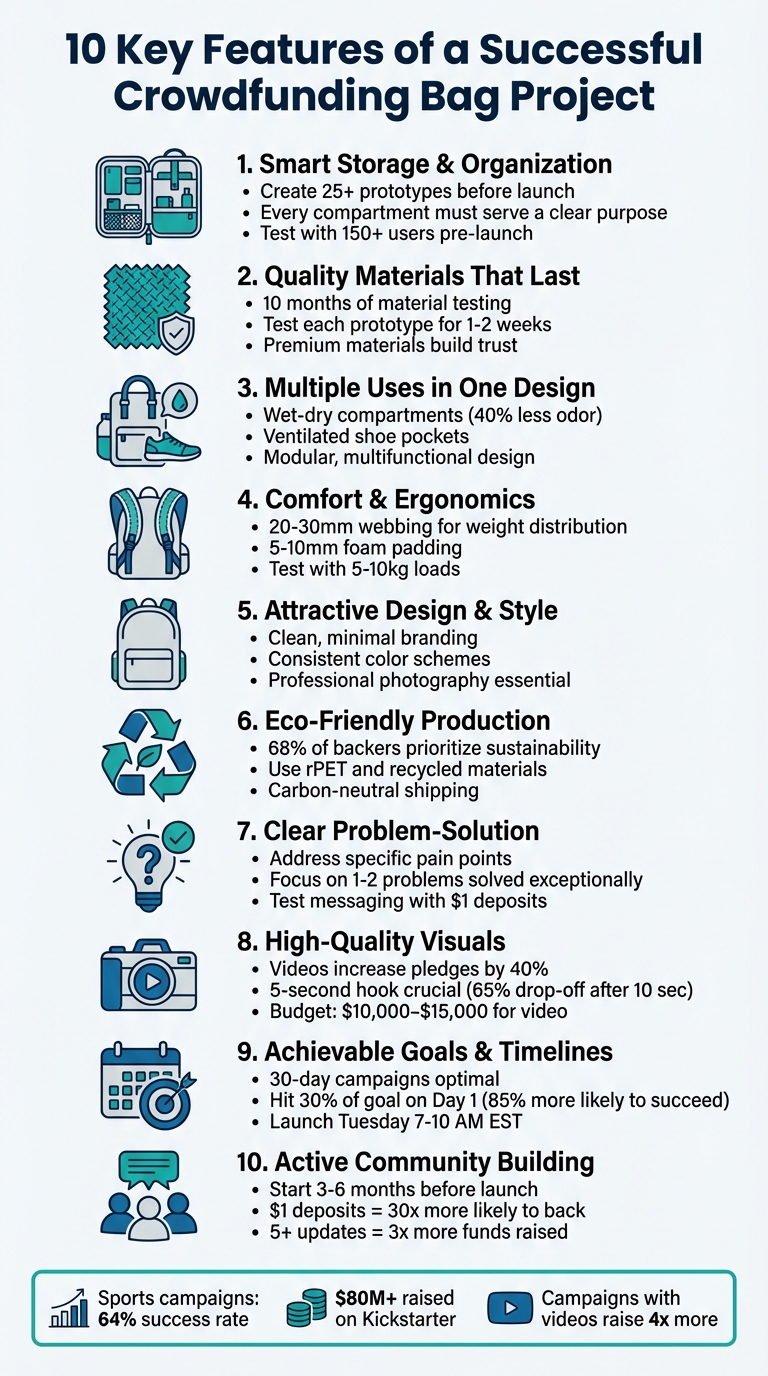
1. Smart Storage and Organization Design
Functionality and Practicality
Overcomplicating storage design can backfire. ALPAKA learned this the hard way when their backpack project failed. According to co-founder Jin Li, the failure stemmed from "scope creep" – adding features that didn’t provide real value. After that experience, they spent 10 months refining their 7ven Messenger bag, creating 25 prototypes and testing each one before landing on the final design.
"Our backpack failure taught us a crucial lesson, which was to keep the design simple, not adding extra features that had no value to our target customer."
- Jin Li, Co-founder, ALPAKA
Every compartment in your product should serve a clear purpose. If it doesn’t, it’s better to leave it out. Linjer, for instance, identified a specific gap in the market: a high-quality briefcase priced under $600. This focus resonated with backers, helping them raise $144,000 on Indiegogo. Their success highlights the importance of prioritizing clarity and functionality.
Refining your design based on user feedback is essential. ALPAKA took this approach by producing 150 bags and distributing them to influencers and testers before their Kickstarter launch. This step ensured their storage design worked in real-world scenarios. Remember, it’s not about what you think athletes need – it’s about confirming those needs with the people who will use the product.
sbb-itb-1e6451b
2. Quality Materials That Last
Material Quality and Durability
The materials you choose can make or break the trust of your backers. ALPAKA is a great example of how attention to detail pays off. Between early 2015 and late 2016, they spent 10 months refining their 7ven Messenger bag, creating 25 prototypes in the process. Each prototype was tested rigorously – used for 1 to 2 weeks – to uncover weak points in the fabric or design. This kind of hands-on testing exposes flaws that might otherwise go unnoticed.
Using premium materials can set your product apart in a crowded market. Take Linjer, for instance. In 2014, they launched a line of men’s leather goods on Indiegogo, emphasizing the quality of their materials rather than flashy marketing. The result? They raised $144,000 for their first production run and nearly $1,000,000 across later campaigns. Their success underscores an important point: when you’re pitching an untested product, quality can speak louder than any marketing slogan.
Functionality and Practicality
Material choices don’t just affect durability – they also influence functionality and costs. For example, while durable fabrics can enhance your product’s longevity, they might also increase weight, which can push international shipping costs to $50–$80 per unit. These are expenses you’ll want to calculate early in the planning stages.
When prototyping, always use the actual materials you plan to include in the final product. While paper or cardboard models are great for testing shapes, they won’t reveal how real fabrics behave during production. Issues like fraying, stretching, or unexpected weight only become apparent when working with the materials you’ll actually use. This step ensures your design is as practical as it is durable.
3. Multiple Uses in One Design
Functionality and Practicality
Imagine a bag that effortlessly transitions between the gym, the office, and weekend travel. That kind of versatility is what makes a design truly stand out. Features like wet-dry compartments, made with coated fabrics, ensure sweaty gym clothes don’t mix with your laptop or clean shirt. This small detail can cut odor retention by up to 40% compared to single-compartment bags.
Another thoughtful addition? Ventilated shoe compartments. These use mesh panels or air vents to let your shoes breathe while keeping dirt and moisture away from the rest of your belongings. Breathable mesh significantly reduces moisture buildup during workouts. For anyone juggling fitness and work, this smart organization can be a game-changer.
Take Huru, for example. When they introduced their H1 backpack on Kickstarter in 2017, they tripled their funding goal in just two days. One standout feature? A multifunctional messenger bag that also served as a removable waist belt for the main backpack. This modular design boosted the bag’s utility without complicating production. Huru’s success didn’t stop there – they expanded to over 50 countries by standardizing compartment layouts across all models. This consistency meant users always knew where to find their keys or Brieftasche, no matter which Huru bag they were using.
Such practical versatility doesn’t just improve functionality – it also enhances the overall appeal of the brand.
Visual Appeal and Branding
A multifunctional bag also needs to look the part. For instance, a design that works for cycling commutes and business meetings should have a clean, minimalist look – nothing that screams "gym bag." Features like hidden anti-theft pockets and reflective strips add practicality while maintaining a polished, professional appearance.
Modern tech integrations, such as built-in USB charging ports or dedicated tablet sleeves, cater to urban professionals who need a bag that matches their fast-paced lifestyle.
"If you always put your keys in the left pocket, then when you take the keys from the left compartment of the backpack, you will always put them into the left compartment of the messenger bag. This is such a meticulous thing, but people who like such uniformity in things appreciate it a lot." – Huru
These thoughtful design choices don’t just meet functional needs – they create a seamless experience for users.
4. Comfort and Ergonomic Features
Functionality and Practicality
Nobody wants a bag that’s a pain to carry – literally. To make sure it’s comfortable for the long haul, shoulder straps should use 20–30 mm webbing to evenly spread the weight. For messenger and crossbody bags, adjustable straps (120–140 cm) with 5–10 mm foam padding in key areas can make a huge difference. This padding not only cushions the body but also protects the gear inside. Adding mesh panels (80–120 g/m²) is another smart move, as they improve airflow and help prevent overheating during use. To keep the load manageable, aim for 3–5 compartments that help distribute weight evenly and keep everything secure. During the prototyping phase, testing the bag with a 5–10 kg load can mimic real-life conditions and help identify any ergonomic flaws before the final product hits production. A comfortable design doesn’t just improve usability – it also reassures backers that the product is practical and well-thought-out.
Material Quality and Durability
Comfort isn’t just about design – it’s also about the materials. Choosing lightweight fabrics can significantly reduce fatigue for the user. Nylon ripstop fabrics (70–140 g/m²) are a great choice because they’re both durable and light, making it easier for users to carry the bag throughout their day without feeling weighed down.
5. Attractive Design and Consistent Style
Visual Appeal and Branding
The look of a bag can make or break its sales. Successful crowdfunding campaigns often skip flashy logos in favor of clean, minimal designs and premium materials that give a high-end feel. Where you place your logo also matters. For maximum visibility, the front center area (about 8–12 inches) is ideal. Alternatively, subtle branding can be added to 1–1.5 inch strap webbing or discreet interior labels. Even small details, like matching the bag’s hardware finishes – whether matte black, silver, or brass – to its color scheme, contribute to a polished and professional appearance.
"Good photography can do wonders to make a product look premium; bad photography can also do wonders to make it look like crap and turn everybody off." – Roman Khan, Co-founder, Linjer
Take Linjer, for example. In March 2017, co-founders Roman Khan and Jenn Hui launched their bag line on Kickstarter, raising $125,000 in just 24 hours. Their approach? High-quality materials, understated branding, and professional photography that showcased their products at their best. This highlights how much visual presentation can influence backers’ confidence and campaign results.
Consistency across your brand is equally important. If your visuals and messaging feel mismatched or inconsistent, potential backers may question the quality of your product. Using Pantone-accurate dyes and lab dips can ensure your bag’s colors align perfectly with your brand across various materials. In crowdfunding, even the smallest design elements, like a well-thought-out logo, can signal innovation. Campaigns with distinctive, cohesive visual identities are often seen as more forward-thinking, which can boost backers’ willingness to support them. By maintaining this consistency, you not only solidify your brand identity but also set the stage for stronger community connections down the line.
6. Eco-Friendly and Ethical Production
Material Quality and Durability
Today’s backers expect sustainability to be part of the package. Using eco-friendly materials not only aligns with these expectations but also strengthens your brand’s reputation in custom sports bag manufacturing. rPET (recycled polyethylene terephthalate), made from post-consumer plastic bottles, stands out for its durability and eco-credentials. For sports bags, recycled nylon ripstop offers a tear strength of 250–300 N while maintaining a lightweight profile of 70–140 g/m² (roughly 2.1–4.1 oz/yd²). Matching materials to the bag’s purpose is key: structured backpacks benefit from rPET, recycled cotton canvas (300–400 g/m², about 8.9–11.9 oz/yd²) works well for duffels, and mesh panels are ideal for shoe compartments needing ventilation.
Certifications such as GRS, OEKO-TEX, and ISO 14001 validate your sustainability claims. These certifications resonate with the 68% of backers who prioritize carbon-neutral shipping and demand production transparency. Combining recycled materials with clear, ethical production practices can significantly boost backer trust.
Backer Engagement Strategies
Transparency isn’t just a buzzword – it’s the foundation of trust. A great example is Maya Rodriguez, co-founder of Oceanic Yoga Mats, who raised $327,000 in 2025 – far exceeding her $80,000 goal. Her success stemmed from implementing plastic-free fulfillment and blockchain tracking, which led to a 23% repeat customer rate and a 4.8/5 satisfaction score. This shows the power of keeping backers informed.
Visual proof matters. Use tools like QR codes or blockchain systems to provide real-time production updates. This approach not only keeps backers in the loop but also reduces the stress of unanswered questions like, "Where is my order?".
"Sustainability is no longer a trend. It is something employees and customers expect from the brands they admire." – Sports Marketing Plus
Stretch goals can also be a clever way to integrate eco-friendly upgrades. For example, you could offer a vegan leather case or plastic-free packaging once certain funding milestones are achieved. Keep in mind that working with ethical suppliers may require extending your fulfillment timeline by about 30%.
7. Clear Problem and Solution Statement
Functionality and Practicality
When it comes to creating a successful campaign, clearly defining the problem your product solves is key. For sports bag users, common frustrations include damp, smelly gear, misplaced essentials like keys and phones, damaged electronics, and bags that can’t handle heavy loads. Address these pain points head-on. For example, if your bag tackles the issue of wet shoes, emphasize features like mesh panels (80–120 g/m²) for better ventilation. If organization is the focus, showcase practical elements like internal zipper pockets or dedicated key clips.
Take Audrey, the creator of Kublet, as a case in point. Her initial Kickstarter campaign in August 2022 flopped when she marketed her product as "mini monitors for your desk." Eight months later, she rebranded it as "the ultimate simple yet powerful data tracker" and raised over $150,000 – six times more than her first attempt. The product itself didn’t change; the success came from a sharper, more relatable problem statement.
Visual Appeal and Branding
Visuals are a powerful way to communicate your solution. If your bag is waterproof, show water rolling off its surface in a video. If it can hold 30 lbs (13.6 kg) comfortably, demonstrate someone loading and carrying it with ease. A great example is the iXi smart golf trolley, which raised $880,585. Its campaign videos showed the trolley climbing hills and following users, directly addressing any doubts about its functionality.
Backer Engagement Strategies
Refining your product and message through user feedback is another crucial step. ALPAKA’s co-founders learned this when developing the 7even Messenger bag. They created 25 prototypes and tested 150 bags with influencers before launch, ensuring their design addressed the most critical user needs. Instead of trying to solve every possible issue, focus on one or two problems your bag handles exceptionally well.
Pre-launch testing can also help fine-tune your problem statement. Run ads that require minimal commitment, like a $1 reservation deposit. Data shows that backers who make even a small financial commitment are 30 times more likely to convert into full customers compared to those who only provide an email address. Use this feedback to refine your messaging, making sure the problem-solution statement truly resonates with your audience.
8. High-Quality Photos and Videos
Visual Appeal and Branding
High-quality visuals can take your bag’s presentation to the next level, complementing its design and materials. Photos and videos should immediately tell the story of your bag. Studio shots with clean backdrops are perfect for showing off design details from multiple angles. Meanwhile, location shots – whether at the gym, on a hike, or during a daily commute – help potential buyers imagine the bag in their own lives. For instance, a campaign that showcased a bag in varied environments like the wilderness, bustling city streets, and professional spaces brought in nearly $1.3 million CAD. These visuals don’t just look good – they lay the groundwork for engaging video content that highlights your bag’s features and benefits.
Functionality and Practicality
Static images are great, but action shots and GIFs can take it a step further by demonstrating features in action. A short GIF, for example, can show how easily a side pocket opens or how a strap adjusts, emphasizing the bag’s clever design. As LaunchBoom explains, “Action shots… showcase product benefits”. Your main campaign video should act like a visual elevator pitch. Take the BAUBAX Travel Jacket campaign as an example – it raised $9,192,055 by showing the contrast between a disorganized traveler and one efficiently using the jacket’s features. And here’s the good news: you don’t need to break the bank on production. Many effective videos, complete with voiceovers, minimal locations, and stock footage, are made for under $10,000, though staying under $15,000 is a solid benchmark.
Backer Engagement Strategies
Grab attention right away with a 5-second hook – skip the long logo intros since 65% of viewers drop off within the first 10 seconds. Focus your video on the top three features that solve common user pain points, and keep any technical demonstrations short – under 60 seconds is ideal. Campaigns with well-produced videos often see pledge rates increase by 40% compared to those relying only on static images.
9. Achievable Funding Goals and Clear Timelines
Functionality and Practicality
Setting clear funding goals and timelines is essential to keep your campaign on track and maintain momentum. To determine your funding goal, start by calculating all manufacturing costs, including platform fees (5%), marketing (around 35%), and payment processing fees (3–5%). These often-overlooked expenses can eat up over 50% of the funds raised. Don’t forget to factor in your manufacturer’s minimum order quantity (MOQ) to ensure your goal is realistic.
Take the 2023 Bear Mountain Camping Adventure campaign as an example. They used a pre-launch list of 1,826 VIPs, each paying a $1 reservation fee. With a product priced at $39, they estimated $21,364 in revenue on Day 1. By setting a conservative funding goal of $5,000, they achieved a VIP conversion rate of 51%, ultimately generating over $89,000 on launch day. The campaign went on to raise an impressive $781,450 overall.
Equally important is your campaign timeline. A 30-day campaign strikes the right balance by creating urgency without exhausting your marketing resources. Campaigns aiming for less than $10,000 tend to have a success rate of around 50%, compared to just 20–30% for higher targets. Before launching, allocate 4–6 weeks for research and another 2–4 weeks for pre-launch activities, like building an email list. It’s worth noting that someone who makes a $1 reservation deposit is 30 times more likely to back your project than someone who only provides an email address.
Once your funding goal and timeline are in place, consistent and transparent communication with your backers becomes just as critical.
Backer Engagement Strategies
To keep your backers engaged, break your campaign into clear stages – design finalization, material sourcing, and mass production – so supporters can track your progress. Campaigns that post five or more updates raise three times more funds than those that remain silent. Let your backers know when to expect the next update to manage expectations and minimize any uncertainty.
"Goals that are overly-high may seem daunting, while goals that are overly-low may arouse suspicion – so, it’s best to choose goals that are as minimal as possible without risking failure to fulfill."
- Madhurima Nag, Head of Content, Gadget Flow
For the best chance of success, launch your campaign on a Tuesday morning between 7:00 and 10:00 AM EST. Aim to hit at least 30% of your total funding goal on Day 1, as campaigns with a strong start are 85% more likely to succeed.
10. Active Community Building and Backer Rewards
Backer Engagement Strategies
Creating a strong community around your bag project is crucial, and it’s something that starts months before your campaign even launches – typically 3 to 6 months ahead. A popular tactic among successful projects is to secure serious backers early with a small pre-launch reservation deposit, often just $1.
Take the example of the Botany board game campaign in November 2025. By increasing its ad budget from $5,000 to $13,000, the team grew their email list from 4,407 to 8,700. On launch day, they raised $105,965 and eventually exceeded $1 million in total funding. For bag projects, sharing behind-the-scenes updates – like prototype photos, design tweaks, or manufacturing hurdles – on social media can transform casual followers into loyal backers who are ready to support you from day one.
"Crowdfunding marketing isn’t just about promoting a campaign. It’s about building relationships, creating anticipation, and turning strangers into believers who’ll back your project on day one."
To deepen engagement, invite VIP backers into exclusive online groups where they can connect directly with you and other supporters. Promptly responding to comments and messages, while being transparent about setbacks or fund usage, builds trust and keeps people invested in your journey. During the campaign, consider introducing stretch goals and letting your community vote on product upgrades. This approach fosters a sense of ownership, encouraging both immediate contributions and long-term loyalty to your brand.
Functionality and Practicality
Once trust is established, well-structured reward tiers can solidify backer commitment. Start with a low-cost option – like a $1–$5 pledge for those who just want updates – then offer your bag at tiered discounts. For example, you could create a Super Early Bird tier for the first 100 backers, an Early Bird tier for the next 500, and a standard pricing tier for everyone else throughout the campaign.
To increase the average pledge amount, consider bundling your bag with useful accessories. Items like extra straps, protective cases, or inserts can be packaged as add-ons through value stacking. A great example of this strategy is the UVMask campaign in 2020. By offering an ecosystem of add-ons – such as filters, premium straps, and hard cases – they raised $5.5 million, achieving an average order value of about $300, even though the base product started at under $99. For bag projects, using a pledge manager like PledgeBox after the campaign allows you to offer additional add-ons, turning post-campaign logistics into an extra revenue stream. With fees as low as 3% on upsells, this is a low-risk way to boost your overall funding.
7 Tips to Get Kickstarter Backers & Funding For Beginners
Schlussfolgerung
Launching a successful crowdfunding campaign for a custom sports bag means finding the right balance between delivering a high-quality product and executing a smart strategy. The ten features discussed earlier come together to address key needs: smart storage solutions und durable materials tackle real challenges for athletes, while engaging visuals und community involvement inspire backers to support your idea even before it becomes a reality.
The numbers back this up. Sports-related campaigns on Kickstarter boast a 64% success rate, collectively raising over $80 million so far. Including a pitch video can make a huge difference, with campaigns that feature one raising four times more than those without. Additionally, securing at least 30% of your funding in the first week significantly boosts your chances of success. That initial traction often stems from a combination of a well-thought-out product, pre-launch community efforts, and clear, honest communication.
"You can hire out design, but you can’t hire out someone willing to care deeply about the product quality and usability." – Jimmy and Doug, Co-founders, Minaal
These insights and examples highlight the value of a well-rounded approach. Think back to ALPAKA’s focus on iterative design and testing, or OYO Fitness’s success with blending performance marketing and community engagement to surpass their funding goals. Both stories show that delivering an exceptional product and building strong relationships with backers go hand in hand. Together, they create the foundation for crowdfunding success.
FAQs
How can I validate my bag idea before launching?
To make sure your bag idea hits the mark, focus on aligning it with what your audience wants and what’s practical to produce. Start by creating prototypes and testing them for both durability and usability – this will give you a sense of how the product performs in real-world conditions. Gather feedback from potential users during this phase to spot any issues or improvements.
Next, dive into market research to zero in on the features your target audience values most. Once you’ve identified those, collaborate with manufacturing experts to fine-tune your design and ensure it’s feasible to produce at scale. Finally, use tools like surveys or focus groups to gauge demand and refine your concept further based on direct input from potential customers.
What should my crowdfunding funding goal include?
When setting your crowdfunding goal, it’s crucial to include all costs required to bring your project to life and deliver on your promises. This means factoring in expenses like manufacturing, shipping, marketing, platform fees, and any additional overhead. Don’t forget to leave room for unexpected costs – things rarely go exactly as planned. A well-thought-out, realistic funding target not only helps you cover these expenses but also ensures you can deliver rewards and meet backer expectations.
How many prototypes do I need before production?
Prototyping is a crucial step before diving into mass production. Having at least one prototype helps you test the design, functionalityund Materialien of your product. This process allows you to identify and fix any issues early, saving time and resources down the line. For more intricate designs, multiple prototypes might be necessary to fine-tune specific features. A carefully developed prototype that mirrors the final product as closely as possible sets the stage for a smoother production process.
Related Blog Posts
- From Concept to Delivery: A Step-by-Step Walkthrough of Our Custom Bag Production Process
- 5 Red Flags to Avoid When Choosing a Custom Bag Supplier [2025 Industry Report]
- Case Study: From Concept to Market – Launching a Private-Label Duffel Bag
- 1. How to Prepare the Perfect Bag for Your Kickstarter Campaign



 Mobile/What's App/Wechat
 E-Mail
 ADD
ADD