Launching a Kickstarter campaign for a custom bag? Here’s what you need to know:
- First 48 Hours Matter: Campaigns that gain traction early are more likely to succeed. A strong start activates Kickstarter’s discovery tools and increases visibility.
- Understand Backers: Backers want practical features like expandable compartments, high-quality materials (e.g., YKK zippers, water-resistant fabrics), and clear communication from creators.
- Trends to Watch: Eco-friendly materials, modular designs, and lightweight bags are in demand. Bags designed for specific activities (e.g., travel, commuting) perform better.
- Design Tips: Focus on quality materials, functional features, and simplicity. Overcomplicated designs can hurt your campaign. Test prototypes with users to refine your product.
- Marketing Essentials: Use professional visuals, a clear story, and targeted reward tiers. A campaign video (1.5–4 minutes) showcasing your bag’s features is critical.
- Set Realistic Goals: Campaigns with funding goals under $10,000 are more likely to succeed. Keep reward tiers simple to avoid overwhelming backers.
Key Takeaway: Success on Kickstarter isn’t just about the product – it’s about solving real problems, building trust, and presenting your vision effectively. Meticulous planning and understanding your audience are crucial.
Kickstarter Custom Bag Campaign Success Statistics and Key Metrics
Understanding Kickstarter Backers and Current Bag Trends
What Backers Look for in Custom Bag Projects
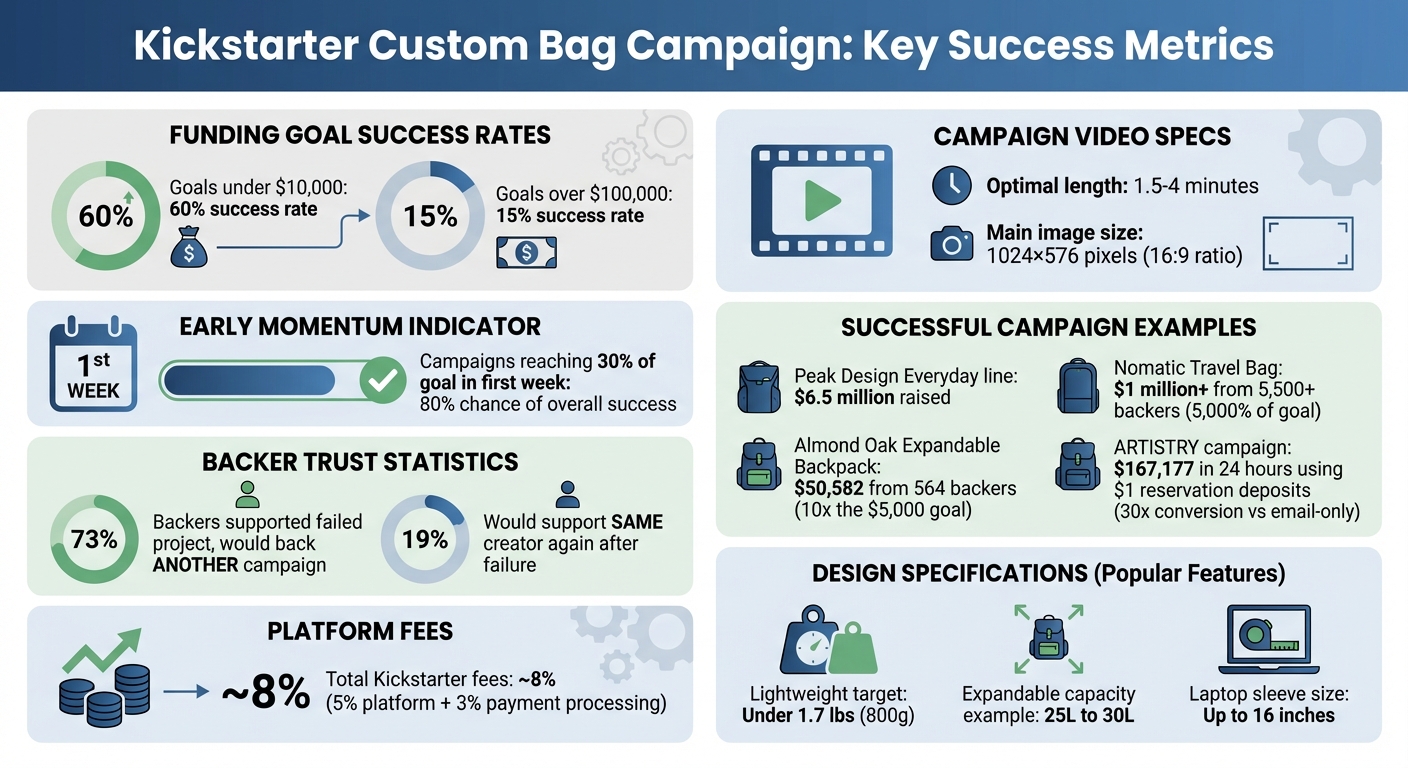
Kickstarter backers are drawn to projects that prioritize practical functionality. They’re looking for features that solve everyday problems, like expandable compartments that increase capacity from 25L to 30L, clamshell openings for easier packing, and padded laptop sleeves that can accommodate devices up to 16 inches. For travelers, security features like hidden passport compartments and luggage pass-through sleeves are especially appealing.
The use of high-quality materials and components also plays a big role in gaining backer trust. Recognizable brands such as YKK zippers, Fidlock magnetic buckles, and water-resistant 280D nylon with PU coating signal thoughtful design and durability. Lightweight designs – under 1.7 lbs (800g) – are particularly attractive to minimalist, one-bag travelers who value practicality without added bulk.
Transparency is another critical factor. Backers appreciate creators who keep them in the loop by sharing updates and explaining design changes, such as adjustments to stitching or pocket placement. This open communication builds trust. Interestingly, while 73% of backers who supported a failed project would consider backing another Kickstarter campaign, only 19% would support the same creator again. This highlights how important it is to deliver on promises and maintain consistent communication throughout the project.
These preferences provide a foundation for understanding broader trends shaping the custom bag market.
Current Trends in the Custom Bag Market
Sustainability has become a non-negotiable for many backers. Eco-friendly materials, such as recycled fabrics and organic cotton, are now expected rather than optional. Additionally, the rise of the made-to-order model helps reduce waste, ensuring that unsold products don’t end up in landfills.
Another major trend is modular and customizable designs. Backers are increasingly interested in bags that can adapt to their needs – whether through adjustable capacities using expansion zippers, customizable colors, or hardware configurations. When it comes to aesthetics, the market is split between bold, artistic all-over prints and sleek, minimalist designs. Choosing the right style to align with your brand can make a big difference. Bags engineered for specific activities – like urban commuting, digital nomad lifestyles, or weekend getaways – consistently outperform generic options. Meanwhile, crossbody bags and fanny packs have seen a surge in popularity, thanks to their hands-free convenience in both streetwear and travel settings.
Take, for example, the success of Dylan’s Kickstarter campaign, "Almond Oak: The Expandable Travel Backpack", which ran from February 4 to March 6, 2025. This 25L backpack, expandable to 30L, featured high-quality components and weighed only 780g. The campaign raised $50,582 from 564 backers – over 10 times its $5,000 goal. This case highlights how aligning with trends like lightweight design, expandability, and durable materials can turn a niche product into a runaway success.
sbb-itb-1e6451b
How to Design a Custom Bag that Gets Noticed
Selecting Advanced Features and Quality Materials
When designing a custom bag, materials and technical details are more than just features – they’re trust builders. For instance, weight plays a bigger role than you might expect. Successful campaigns often highlight precise measurements, like a 21L daily bag weighing 2.31 lbs (1.05 kg), to show attention to detail.
Structural components are equally important. Features like molded foam panels and durable straps can distribute weight so effectively that bulky hip belts become unnecessary. This creates a sleek, professional look without compromising comfort. Reinforcing stress points with bar tack stitching boosts durability, and a suspended, adjustable laptop "ladder" system is a smart way to protect devices from floor impact while accommodating different sizes.
A modular design can take things further by offering flexibility. For example, removable padded hip attachments can transform a travel pack into a business bag. This adaptability allows users to configure the bag to suit their specific needs. However, keep in mind that even scaling back features during development can increase production costs by 10% or more – so plan your budget carefully.
Offering Customization Options to Backers
Jin Li, co-founder of ALPAKA, learned a hard lesson when a previous backpack project failed due to overcomplicated design. Reflecting on the experience, he said:
"Our backpack failure taught us a crucial lesson, which was to keep the design simple, not adding extra features that had no value to our target customer".
Armed with this insight, the ALPAKA team spent 10 months refining their 7even Messenger bag, creating 25 prototypes while focusing only on features their audience truly valued.
A great way to offer customization without overwhelming your audience is through Kickstarter’s reward itemization. Instead of creating endless reward tiers, let backers choose specific configurations, colors, or components. You can even introduce "Secret Rewards" for an exclusive touch. Thoughtful options – like the placement of bottle holders – can improve both style and functionality without adding unnecessary complexity.
Before launching, test your customization ideas with real users. ALPAKA sent 150 pre-production bags to influencers and blogs to gather feedback. This approach helped them determine which features resonated with their audience and which didn’t. Real-world testing ensures your final design strikes a balance between usability and style.
Combining Practical Use with Good Design
Testing prototypes hands-on for one to two weeks after each iteration can reveal issues that sketches or digital models might miss. For example, you might discover that an external pocket interferes with the main compartment zipper. These practical insights are invaluable for fine-tuning your design.
Streamlined organization is another key factor. Instead of overloading the bag with small pockets, focus on practical elements like document sleeves and dedicated compartments. Internalizing features, such as bottle holders, can maintain a clean, professional look, even if it means sacrificing quick access. These trade-offs should reflect what matters most to your target audience.
Intentional design is everything. Whether you’re aiming for a minimalist or professional aesthetic, every visible detail should support that vision. This could mean internalizing utility features for clean lines or selecting hardware finishes that align with your brand’s identity. Remember, backers aren’t just buying a bag – they’re investing in your creative journey. A design that showcases thoughtful decisions and care will resonate deeply with potential supporters.
Running a Successful Kickstarter Campaign for Your Custom Bag
Creating a Clear Story and Brand
Your Kickstarter campaign page should feel like a conversation, not a hard sell. Picture yourself explaining your project to a friend – what would you say? What questions might they ask? How would you prove you’re prepared and capable of delivering?
Start by explaining the problem your bag solves and the gap it fills in the market. This approach helps build trust and gives backers a reason to care about your project, not just the product. Focus on the two or three standout features that define the bag’s value for users, saving smaller details for later. Mention how visuals can reinforce your message – this will be expanded further in the next section.
Take inspiration from campaigns like the Basslet wearable subwoofer, which clearly targeted specific groups like music producers and VR gamers. Its brief overview cut straight to the point:
"The Basslet is a wearable subwoofer for your body… so you can literally feel the music."
Notice how they avoided over-the-top claims like "world’s best" or "world’s first." Kickstarter staff tend to favor projects that steer clear of exaggerated language. Transparency is also key – break down how you’ll use the funds, detailing costs for manufacturing, shipping, and marketing. For example, instead of just saying your bag is waterproof, show it in action – maybe in a video or GIF with water pouring over it.
Once you’ve nailed your story, the next step is to back it up with polished visuals that show your passion and professionalism.
Presenting Professional Photos, Videos, and Prototypes
Your main campaign image should be 1024×576 pixels (16:9 ratio) with plenty of negative space to keep it clean and easy to see on any device. As Kickstarter’s design guidelines explain:
"Negative space is more attractive to the eye than a cluttered image."
Your campaign video will be the star of the show. Aim for a runtime of 1.5 to 4 minutes to hold viewers’ attention. Shoot in a clean, well-lit environment, and make sure you appear in the video to create a personal connection with backers. Plan your talking points ahead of time so you can clearly explain what makes your bag special.
Don’t just tell people about your process – show them. Include sketches, failed prototypes, and the design journey to highlight your commitment and hard work. Use animated GIFs to showcase key features of the bag. Moving visuals are more engaging than text alone and help backers understand how your product fits into their lives. Real-world photos of the bag in action can also make it easier for people to picture themselves using it. If questions come up during the campaign, update your page with diagrams or GIFs to address them.
With visuals that grab attention and build trust, it’s time to focus on your funding goals and reward tiers.
Setting Achievable Funding Goals and Reward Tiers
Kickstarter’s all-or-nothing model means you only get funded if you hit your goal. That goal needs to cover everything – prototyping, manufacturing, quality control, packaging, shipping, customs, marketing, and Kickstarter’s 8% fee (5% platform fee and about 3% for payment processing).
Here’s something to consider: campaigns with goals under $10,000 succeed 60% of the time, while only 15% of projects with goals over $100,000 reach their target. Also, projects that hit 30% of their goal in the first week have an 80% chance of success. Setting a realistic goal not only helps you reach "fully funded" status faster but also generates the momentum and social proof to attract more backers through Kickstarter’s algorithm.
When it comes to rewards, keep things simple. As LaunchBoom explica:
"When humans have too many choices, they often make no choice at all. For that reason, we want to keep our rewards as simple as possible."
Structured reward tiers work well. For example, you could offer a "Super Early Bird" tier (limited to 100 backers), an "Early Bird" tier (limited to 300 backers), and a standard tier with no limits. The Desk Nest campaign raised $468,628 using a similar approach, while the ARTISTRY campaign pulled in $167,177 in just 24 hours by offering a $1 reservation deposit during pre-launch. That strategy converted backers at 30 times the rate of email-only signups.
Lessons from Successful Kickstarter Bag Campaigns
Why These Campaigns Succeeded
The most successful Kickstarter bag campaigns share one key trait: they solve real problems for specific audiences. Take Peak Design, for instance. They raised a staggering $6.5 million for their Everyday line by obsessively refining their camera bag through 20 iterations. They used Bluesign-approved recycled fabrics, eliminated unnecessary topstitching, and created a bag versatile enough for both commuters and travelers.
Another standout example is Nomatic‘s Travel Bag. Launched in July 2016, this bag featured 20 functional elements, including a TSA-friendly laptop pocket and a built-in laundry bag. By August the same year, the campaign had pulled in over $1 million from more than 5,500 backers – 5,000% more than their original goal. As co-founder Jacob Durham explained:
"The remarkable support we’ve received proves the world’s been waiting for a versatile bag that makes traveling a lot easier".
A recurring theme in these campaigns is the relentless focus on prototyping and gathering user feedback. ALPAKA, for example, spent nearly 10 months creating 25 prototypes for their 7even Messenger bag after a previous project didn’t meet expectations. Before launching, they produced 150 units to send to influencers and bloggers, ensuring there was genuine demand.
Minaal also hit the million-dollar mark across two campaigns by building a loyal community of travelers. Founders Jimmy and Doug spent years collecting feedback through real-world testing in airports and hostels. As Jimmy shared:
"Remove your ego from your design feedback process. Don’t lead people with what you think…ask them what they think".
This deep connection with their target audience allowed them to refine their product to meet real needs.
These stories highlight practical strategies you can use to shape your own Kickstarter campaign.
How to Use These Strategies for Your Campaign
To replicate these successes, focus sharply on your niche and engage deeply with your audience. Start by narrowing in on a specific group rather than trying to appeal to everyone. Observe how your target customers use their bags and ask them about the frustrations they face with current options. Then, invest in an iterative prototyping process to refine your design for both functionality and durability. As Peak Design’s six campaigns – raising over $15 million – have shown, a thoroughly tested product can build an incredibly loyal following.
Before launching your campaign, consider producing a small batch of your product (around 150 units) to share with influencers, bloggers, and early adopters. Their feedback can help you validate demand and iron out any issues. When it’s time to market your campaign, focus on niche publications and platforms that speak directly to your audience. Minaal found that targeted press outlets converted far better than broad, general media coverage.
Finally, plan your fulfillment strategy carefully. Think through potential challenges and scaling scenarios in advance. As Doug from Minaal advised:
"Ask lots of questions and ask them as early as possible… If you need to pause your campaign to get everything buttoned up, pause it. Don’t launch too soon".
Allow extra time and budget for unexpected hurdles. The most successful campaigns prioritize preparation over perfection.
Conclusão
Making your custom bag stand out on Kickstarter boils down to solving real problems, connecting with your backers, and presenting your vision with clarity and simplicity. Throughout this guide, we’ve seen how the most successful campaigns focus on refining their designs based on actual user feedback rather than cramming in unnecessary features. Take ALPAKA’s experience as a reminder: overcomplicating a design without adding value for your audience can derail even the most promising ideas.
At its core, Kickstarter success isn’t just about the product – it’s about the people and stories behind it. Rebekah Tyler, an author and creator, captured this perfectly:
"On Kickstarter people back the person who’s created the project more than the project itself. They believe in the person and they want to help that person because they know they’re trying their hardest to fulfill their dream".
This highlights the importance of showing why your bag matters: the journey, the problem you’re solving, and the passion driving your work.
Before launching, take the time to prototype and test with real users to ensure there’s demand. Set a funding goal that’s realistic and achievable – projects that gain momentum early are more likely to attract additional backers. Don’t overlook marketing either; allocate your budget wisely in the weeks leading up to and during your campaign. Proper planning is the foundation for a smooth and successful launch.
And most importantly, finalize every detail before you go live. Study successful campaigns, figure out which reward tiers resonate most, and map out your fulfillment strategy down to the smallest element. Delaying your launch to fine-tune these details can make all the difference between a campaign that raises $10,000 and one that hits $1 million. Preparation, not luck, is the secret ingredient.
FAQs
How do I validate demand before launching?
To gauge demand before kicking off your Kickstarter campaign, consider testing the waters with small-batch pre-orders, limited-time pop-up events, or landing pages combined with targeted social media ads. These strategies can give you a clear picture of interest in your product.
Additionally, setting smaller, achievable funding goals and meeting them early can signal strong demand. These steps not only validate market interest but also help ensure your custom bag has a dedicated audience before diving into full-scale production.
What should I budget beyond manufacturing?
When planning your Kickstarter campaign, it’s important to account for more than just manufacturing costs. Don’t forget key expenses like marketing, campaign page design, product photography, and video production.
You’ll also need to budget for pre-launch marketing to build excitement, outreach efforts to connect with backers, and fulfillment costs to deliver on your promises. Covering these areas ensures you’re prepared for every phase of your campaign and sets the stage for a project that grabs attention and achieves its goals.
How can I offer customization without too many tiers?
To make customization easier, aim for around five carefully designed reward tiers. Prioritize quality by including options for customization within these tiers, such as add-ons or upgrades. Incorporate exclusive perks like early bird specials or Kickstarter-only editions to spark interest and urgency, but avoid making the structure too complex. Keeping the choices simple helps backers quickly select their preferred level while staying aligned with your budget and timeline.



 Telemóvel/What's App/Wechat
 E-Mail
 ADD
ADD